Author: Victor de Paula

  • The Thursday Murder Club Books in Order

    The Thursday Murder Club Books in Order

    The Thursday Murder Club Books in Order: The Complete Guide (2025-2026)

    In a quiet retirement village in Kent, four unlikely friends meet every Thursday to investigate unsolved crimes. What started as a hobby quickly turned into a global literary phenomenon. Richard Osman’s The Thursday Murder Club series has charmed millions with its blend of cozy mystery, sharp wit, and poignant reflections on aging.

    With the release of the fifth book, The Impossible Fortune, in 2025 and a star-studded movie adaptation now streaming on Netflix, interest in the series is at an all-time high. Whether you are a newcomer wanting to start from the beginning or a fan looking for a refresher on the characters, this guide covers everything you need to know about reading The Thursday Murder Club books in order.

    The Thursday Murder Club Books in Order

    To fully appreciate the character arcs and evolving relationships, it is highly recommended to read the series chronologically. Here is the complete list:

    1. The Thursday Murder Club (2020)

    The book that started it all. We are introduced to Cooper’s Chase Retirement Village and the core quartet: Elizabeth, Joyce, Ibrahim, and Ron. They usually discuss “cold cases,” but when a property developer is found murdered on their doorstep, they find themselves in the middle of their first live case. This novel establishes the tone—funny, clever, and unexpectedly touching.

    2. The Man Who Died Twice (2021)

    Elizabeth receives a letter from an old colleague (and ex-husband), a man accused of stealing diamonds worth millions from the mafia. He needs her help to stay alive. The stakes are raised as the club deals with MI5 agents, local drug dealers, and a trail of bodies. This installment delves deeper into Elizabeth’s mysterious past as a spy.

    3. The Bullet That Missed (2022)

    The Thursday Murder Club is on the hunt again, this time looking into the decade-old disappearance of a television news reporter. The case leads them to a former KGB colonel and a media star. Meanwhile, Elizabeth faces a moral dilemma when a mysterious “Viking” threatens to kill her unless she assassinates a target. It’s a story about consequences and the ghosts of the past.

    4. The Last Devil to Die (2023)

    Perhaps the most emotional entry in the series. When an old friend in the antiques business is killed and a dangerous package goes missing, the gang is thrown into the world of art forgery and drug smuggling. Amidst the mystery, the book tackles the heartbreaking reality of dementia, particularly through the storyline of Elizabeth’s husband, Stephen. It is a masterpiece of balancing grief with humor.

    5. The Impossible Fortune (2025)

    The latest addition to the series (released in 2025) sees the gang facing perhaps their most perplexing puzzle yet. Without giving away spoilers, The Impossible Fortune takes the club beyond the confines of Cooper’s Chase in pursuit of a legacy that has remained hidden for generations. It proves that even after five books, Osman hasn’t lost his touch.

    The Main Characters

    The heart of the series is its cast. Here is a breakdown of the members of the club:

    • Elizabeth Best: The unofficial leader. A former MI5 agent (though she never explicitly confirms it), she is sharp, commanding, and has connections everywhere. She is the brain behind the operations. Played by Helen Mirren in the movie.
    • Joyce Meadowcroft: A former nurse and the narrator of the diary entries in the books. Joyce initially seems like a gentle, unassuming old lady, but she is observant, flirtatious, and often provides the crucial breakthrough. Played by Celia Imrie.
    • Ibrahim Arif: A retired psychiatrist. He is the intellectual of the group, thoughtful, anxious, and deeply analytical. He provides the psychological profiles of their suspects. Played by Ben Kingsley.
    • Ron Ritchie: A famous former trade union leader. loud, brash, and distrustful of authority, Ron is the muscle (and often the mouth) of the group. He is fiercely loyal to his friends. Played by Pierce Brosnan.

    The Movie Adaptation (2025)

    The long-awaited film adaptation finally arrived in August 2025. Directed by Chris Columbus (Home Alone, Harry Potter), the movie brought the characters to life with an A-list British cast. It premiered on Netflix, introducing a whole new audience to the charm of Cooper’s Chase.

    Key Cast Members:

    • Helen Mirren as Elizabeth
    • Pierce Brosnan as Ron
    • Ben Kingsley as Ibrahim
    • Celia Imrie as Joyce
    • David Tennant as the villainous Ian Ventham

    Why Read in Order?

    While each mystery is self-contained, the personal lives of the characters evolve continuously. Elizabeth’s struggle with her husband’s illness, Joyce’s search for romance, and Ron’s relationship with his son are threads that run through all five books. Reading them out of order would spoil emotional beats and character developments that are just as important as the whodunnit.

    Conclusion

    Richard Osman has created something rare: a series that is as comforting as a cup of tea but as gripping as a thriller. The Thursday Murder Club books celebrate the idea that life doesn’t stop getting interesting just because you get older. With The Impossible Fortune now on shelves and the movie available to stream, there has never been a better time to join the club.

    Frequently Asked Questions (FAQ)

    1. What is the correct reading order for The Thursday Murder Club?

    The order is: 1. The Thursday Murder Club, 2. The Man Who Died Twice, 3. The Bullet That Missed, 4. The Last Devil to Die, 5. The Impossible Fortune.

    2. Is there a 5th Thursday Murder Club book?

    Yes, The Impossible Fortune was released in 2025 as the fifth book in the series.

    3. Who plays Elizabeth in the movie?

    Dame Helen Mirren portrays Elizabeth Best in the 2025 film adaptation.

    4. Do I need to read the books before watching the movie?

    It is not strictly necessary, but reading the first book will give you deeper insight into the characters’ inner thoughts, which can enhance the viewing experience.

    5. Is Richard Osman writing more books?

    Richard Osman has launched a new series (starting with We Solve Murders), but returned to the Thursday Murder Club with the fifth book. He has expressed intent to continue writing for these characters as long as there are stories to tell.

  • Rediscovering Life Through Poetry

    Rediscovering Life Through Poetry

    The Gray World We’ve Created

    We live in an age of endless notifications, productivity hacks, and algorithmic precision. Our days unfold like carefully programmed routines: check emails, attend meetings, complete tasks, repeat. Somewhere in this relentless march toward efficiency, we’ve lost something essential—our capacity for wonder.

    If you were to paint the essence of modern life, what color would you choose? Most of us would reach for gray. Not the dramatic gray of storm clouds or the elegant gray of marble, but the dull, uninspiring gray of a computer screen or office cubicle. This isn’t just a metaphor; it’s how we’ve trained ourselves to see the world.

    We’ve become experts at optimization but beginners at amazement. The poetry of existence—those small miracles that unfold in ordinary moments—has been drowned out by the noise of our overstimulated lives.

    Poetry: The Antidote to Modern Malaise

    The solution to this crisis isn’t another productivity system or self-help strategy. It’s something far more ancient and powerful: poetry.

    Reading poetry offers us a pathway back to seeing the world through fresh eyes. It transforms that monotonous gray into a spectrum of colors we haven’t experienced since childhood. When we engage with poetry, we’re not just reading words on a page—we’re participating in a conversation with beauty itself.

    Poetry serves as a bridge between our rational minds and emotional hearts, between the practical world and the realm of infinite possibility. It teaches us to feel deeply, notice subtly, and appreciate the artistry that exists in both language and life.

    Breaking Down the Barriers

    Let’s address the elephant in the room: many people believe poetry isn't for them. They think it’s reserved for hopeless romantics or pretentious intellectuals—a secret club with obscure rules and hidden meanings.

    This couldn’t be further from the truth.

    If you can appreciate a stunning sunset, the sleek design of a car, or the playful antics of a pet, you already possess the capacity to appreciate poetry. The same part of you that responds to visual beauty, musical harmony, or athletic grace can connect with poetic expression. Poetry is simply another medium through which beauty and meaning are conveyed.

    girl walking through grass

    Finding Your Poetic Voice

    Not all poetry will speak to you, and that’s perfectly normal. Just as there are excellent films and forgettable ones, inspiring songs and mediocre ones, the world of poetry contains both masterpieces and mediocrity.

    The key is to read widely and trust your instincts. If a particular poem or poet leaves you cold, move on without judgment—either of the work or of yourself. Literary taste is deeply personal. What moves one person may not move another.

    Trust your emotional responses. If a poem makes you pause, think, or feel something unexpected, you've found something valuable. The most important criterion for good poetry isn’t what critics say—it’s how it affects you personally.

    The Transformation Begins

    Once you begin incorporating poetry into your life, something remarkable happens: you start noticing poetry everywhere. This isn’t magical thinking; it’s the natural result of training your mind to perceive beauty, metaphor, and deeper meaning in everyday experiences.

    Poetry teaches us to slow down and pay attention. In a world that rewards speed and surface-level processing, poetry demands the opposite. It asks us to linger with words, consider multiple meanings, and feel the rhythm and texture of language.

    This practice of mindful attention naturally extends beyond reading into living.

    The Art of Romanticizing Life

    Perhaps the most transformative aspect of embracing poetry is its ability to help us romanticize our own existence. This doesn’t mean living in fantasy or denial, but rather learning to see the inherent beauty and significance in ordinary moments.

    Instead of viewing each day as simply a vessel to bedtime—a series of tasks to be completed before we can rest—poetry teaches us to find meaning and beauty in the journey itself.

    Consider these everyday moments through a poetic lens:

    • Morning light filtering through your window becomes a daily miracle
    • The rhythm of your footsteps on the sidewalk becomes personal percussion
    • Shadows falling across your desk create a constantly changing work of art

    Romanticizing life means becoming an active participant in your own story rather than a passive observer waiting for something interesting to happen. It means recognizing that your life, right now, contains elements worthy of poetry—moments of beauty, connection, growth, and meaning that are easily overlooked when we’re focused solely on productivity and outcomes.

    Simple Steps to Start

    Embracing a more poetic approach to life doesn’t require dramatic changes or extensive literary education. Here’s how to begin:

    Start small. Read one poem a day, perhaps with your morning coffee or before bed. Don’t worry about analysis or interpretation; simply let the words wash over you and notice what you feel.

    Experiment with variety. Try classical sonnets, contemporary free verse, spoken word poetry, or translated works from other cultures. The diversity of poetic expression means there’s almost certainly something that will speak to your particular sensibilities.

    Practice conscious appreciation. Pay attention to moments of unexpected beauty in your daily life. When something strikes you as particularly moving or meaningful, take a moment to really experience it. This practice of conscious appreciation is itself a form of poetic living.

    The Ripple Effects

    As you develop a more poetic perspective, you’ll likely notice improvements in multiple areas of your life:

    Your capacity for empathy may deepen as you become more attuned to nuance and emotional subtlety. Your communication skills may improve as you develop a greater appreciation for the power and precision of language.

    Perhaps most importantly, you'll develop a richer relationship with your own inner life. Poetry validates the importance of feelings, imagination, and subjective experience in a world that often prioritizes only what can be measured and quantified.

    Reclaiming Wonder

    The call to make life poetic again isn’t about escaping reality—it’s about experiencing reality more fully. It’s about recognizing that the world is already filled with profound beauty and meaning. We simply need to develop the eyes to see it and the heart to feel it.

    In choosing to embrace poetry, we’re choosing to prioritize wonder alongside efficiency, beauty alongside productivity, and meaning alongside achievement. We’re acknowledging that a life well-lived is not just about what we accomplish, but about how deeply we experience the journey.

    The abundant beauty has been sitting in front of us this entire time, waiting patiently for us to notice. Poetry simply gives us the tools to finally see it—and in seeing it, to transform not just how we read, but how we live.

    The world is not gray. We simply forgot how to see its colors.

  • The ’90s Night System: Regain Control of Your Life

    The ’90s Night System: Regain Control of Your Life

    Have you ever felt that nagging guilt after realizing you’ve spent the entire day mindlessly scrolling through feeds? It usually comes with a real fear: that your life will be wasted tapping on a glass screen without purpose. If this sounds familiar, it might be time to discover a simple system to regain control: ’90s Night.

    Why You Don’t Have All the Blame

    It’s essential to understand that screen addiction isn't entirely your fault. Modern applications are purposely designed to get us hooked. Companies invest millions of dollars optimizing their platforms to steal as much of your time as possible.

    On the surface, these apps seem free, but in reality, they charge a price much higher than money: your time and your attention — two of the world’s most valuable resources. The ’90s Night system is a direct way to reclaim these resources and, consequently, regain control of your life.

    man in the bathroom scrolling your cellphone

    What Is ’90s Night?

    The concept is exactly what the name suggests: living one evening as if you were in the 1990s. The fundamental principles are simple:

    • No screens
    • No social media
    • No doom-scrolling
    • No guilt

    The idea is flexible — you can call it “80s Nights” or “60s Sundays” if you prefer. The specific style matters less than the fundamental rule: no screens.

    90s gifs boys dancing

    Rediscovering Superior Entertainment

    Instead of scrolling through endless feeds, this practice encourages you to explore other forms of entertainment — forms that are often more engaging and superior to what modern apps offer.

    Reading: Your Portal to New Worlds

    Reading, in particular, offers a unique benefit that social media cannot replicate: it can genuinely transport you to a completely new world, providing a level of immersion honestly greater than anything social media offers.

    To achieve this, you’ll need to use something you may not have exercised in a while: your imagination. It might take some time to get used to, but once you get involved, you won’t want to leave.

    rick of rick and morry thinking

    Important Tip for Beginners

    If you don’t consider yourself a reader, take this as a sign to start this new habit. The key is to start reading what interests you — it doesn’t have to be anything sophisticated or a profound literary work. Comics are just as valid as the classics.

    The Unexpected Benefits of Unplugging

    While you may start ’90s Night simply to cure your phone addiction, you’ll likely begin to notice several other positive benefits:

    1. Better Sleep

    One of the first things you’ll notice is that you’ll sleep much better, like a baby. This is a direct result of your eyes not being bombarded by blue light before bed.

    2. Deeper Social Connections

    By being more present, you may find that you have deeper, more meaningful conversations with friends and family. Instead of being half-distracted, you’ll be completely present in the moment.

    3. Mental Clarity and Lightness

    Perhaps the best part of this practice is that you actually feel like a child again. When you spend hours scrolling through feeds, your mind becomes wired and can’t turn off, leading to a constant state of stimulation.

    By breaking this cycle, you’ll start to enjoy well-deserved mental clarity and a mind free from brain fog. This is a clarity that was “stolen from you” when you had no choice but to grow up in a hyper-connected world.

    Your Challenge to Break Free

    The solution to regaining your focus and your life doesn’t have to be complicated. It can start with a simple challenge to yourself:

    Put down the phone for a few hours and see how it feels.

    By intentionally disconnecting, you create the space needed to rediscover offline pleasures and regain control over your most valuable resources: your time and your attention.

    Start today — choose one night this week to be your first ’90s Night and rediscover what it means to live without screens.

  • The Self-Help Lesson from an 1864 Russian Novel

    The Self-Help Lesson from an 1864 Russian Novel

    The Surprising Self-Help Lesson from a Russian Novel Written in 1864

    What if the most transformative guide to self-improvement wasn’t found among the glossy-covered self-help bestsellers with promises of success in seven steps? What if, instead, it was buried deep within the dark, dense pages of a Russian novel written in 1864 by a master of the human soul: Fyodor Dostoevsky?

    The work in question is Notes from Underground. And while it plunges into alienation and despair, it offers a powerful and urgent lesson: the eternal battle between self-responsibility and the seductive pull of victimhood.

    In our pursuit of personal growth, we crave ready-made formulas—shortcuts to happiness. But Dostoevsky offers no shortcuts. He offers a mirror. And in that uncomfortable reflection, we are forced to face the parts of ourselves we’d rather avoid. Real change starts there—not with the promise of a painless life, but with the courage to accept life as it is: raw, imperfect, and profoundly human.

    The Lament of Defeat: “They Won’t Let Me”

    Near the climax of the narrative, the protagonist—known only as the Underground Man—lets out a desperate cry:

    “I can’t be good; they won’t let me.”

    This isn’t just a moment of despair. It’s the philosophy that defines his life. It’s the final stamp on his own self-condemnation—the perfect excuse to keep alive the cycle of resentment, shame, and stagnation.

    The Underground Man lives in a literal basement. But that underground is also metaphorical—it represents his disconnection from the world and from himself. He despises society but yearns for its acceptance. He’s a walking contradiction: intelligent yet inert, sensitive yet cruel, self-aware yet paralyzed.

    When he blames “them,” he shifts the burden of his life onto external forces—society, colleagues, the woman he humiliates and tries to love, the laws of nature, maybe even God. By doing so, he absolves himself from the duty to act. He becomes a martyr of his own failure, a tragic hero in a story he refuses to rewrite.

    The Seductive Comfort of Victimhood

    This is the trap Dostoevsky exposes with brutal clarity: the victim mentality is comforting—and dangerous. All of us, at some point, face this dilemma: take the reins of our existence, or surrender to the narrative that the world is against us?

    Being a victim is often easier. Blaming our parents, the government, the system, the boss, the partner—it temporarily relieves us from the weight of owning our mistakes and limitations. That surrender can feel as comforting as a blanket on a cold night.

    But that comfort is a prison.

    The walls are built of excuses. The ceiling is held up by the belief that the world is unfair. And the window shows only a distorted reflection—one where we see ourselves as misunderstood martyrs. We act as though we’re leaves in the wind, forgetting that while we can’t control the storms, we can adjust our sails and keep a firm hand on the helm.

    The Paradox of Freedom and Suffering

    Dostoevsky understood something essential about human nature: true freedom demands suffering and responsibility.

    The Underground Man dreams of freedom without consequences—where he can act on whims without facing outcomes. He wants to prove his free will by declaring “two plus two equals five.” But that’s not freedom—it’s denial of reality.

    True freedom isn’t the absence of limits, but the conscious choice of how to respond to what life throws at us.

    And that includes pain. Growth hurts. Change hurts. Responsibility is a burden. But that suffering has purpose—it shapes, strengthens, liberates. Passive suffering, on the other hand, is sterile, corrosive, empty. It’s the suffering of the Underground Man, who drags himself through life, year after year, blaming “them.”

    The choice was never whether or not to suffer. It’s whether to suffer with meaning or in vain.

    Take the Helm of Your Ship

    As safe as the “underground” may seem, there comes a point when hiding is no longer an option. You have to climb to the deck, face the storm, feel the salt sting your eyes—and move forward.

    Dostoevsky’s message, told through the failure of his character, is a cry: rise.

    The world will test you. The waves will knock you down. The wind will try to pull you off course. The victim mentality tells you to let go of the wheel and pray. The responsibility mindset tells you to clench your fist and hold on.

    Hold fast. The sea won’t calm. But how you navigate it is—and always has been—in your hands.

    Releasing the Angel from the Stone

    Michelangelo once said that the angel was already inside the marble—he just removed the excess. In the same way, your potential is already within you. What’s needed is to chip away the excuses, the fear, the guilt.

    To take responsibility is to sculpt your inner self.

    You can stay underground, repeating that “they won’t let you be good.” Or you can rise to the surface, face the heavy sky, and despite everything, grasp the helm with resolve and carve out your own destiny.

    The question that echoes from 1864 remains just as relevant today:

    Will you let others decide who you are?

    Or will you be the author, the captain, and the sculptor of your own life?

  • The Productivity Secret That Comes from 1882

    The Productivity Secret That Comes from 1882

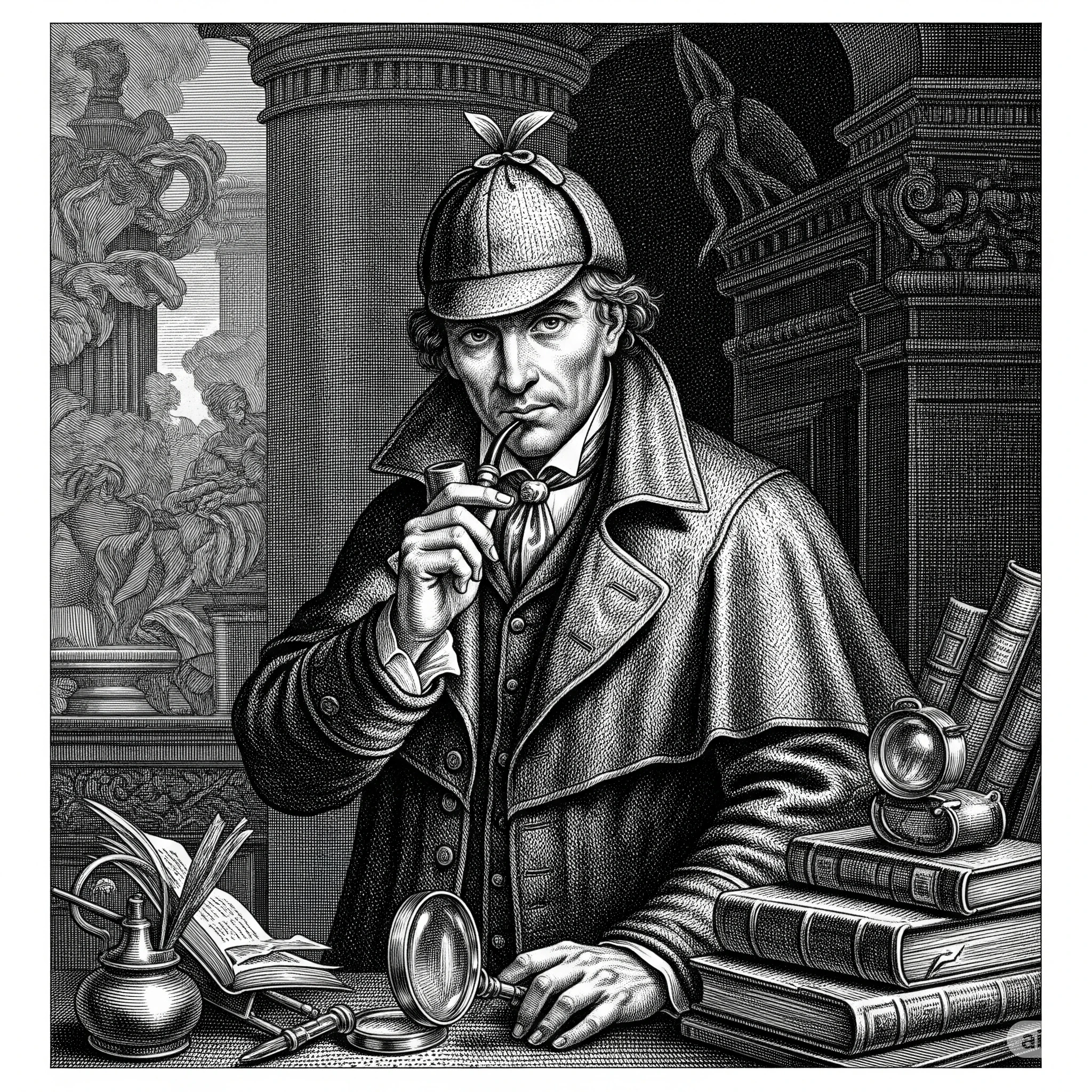
    The Scherlock Holmes secret spice

    We live bombarded by productivity methods. From the Pomodoro technique to time blocking, from TikTok trends to the latest apps — the options are endless. But perhaps the most powerful productivity hack isn’t a modern invention. In fact, it was created in 1882, hidden within the pages of an English crime novel.

    The secret to high-performance productivity lies in the character of Sherlock Holmes. His methods offer timeless lessons on focus, environment, and perseverance. By examining the principles that guided the world’s greatest detective, we can discover a more effective and sustainable way to approach our own work and challenges.

    The Superpower of Singular Focus

    Sherlock Holmes’s legendary deductive abilities weren’t a natural gift, but the result of years of dedicated training. His genius was rooted in a single powerful skill: the ability to focus with unwavering intensity.

    When confronted with a difficult case, Holmes would concentrate all his mental energy on that one task, completely blocking out all noise and distractions. He wasn’t a multitasker — you would never find him watching a Mr. Beast video while pondering a clue.

    His state of obsession during a case was so profound that he would often go days without eating or sleeping. Instead, he preferred to chain smoke and pace around his room, completely immersed in a state of deep concentration. His partner, Dr. Watson, noted numerous times that absolutely nothing could distract Sherlock when he was in this trance-like state.

    The crucial lesson here isn’t to deprive yourself of food in the name of productivity. The real lesson is that Sherlock’s unique intellect and productivity reside in his ability to focus.

    In an age of constant notifications and digital distractions, the temptation to divide our attention is stronger than ever. The next time you feel the urge to scroll through your phone while you should be studying or working, consider following Sherlock’s example. The ability to commit fully to a single task is the foundation of meaningful progress.

    man, focusing with your eyewears

    Engineering an Environment for Deep Work

    Beyond his mental discipline, Sherlock Holmes was a master of environmental design. He instinctively created a space at 221B Baker Street where deep work wasn’t just possible — it was automatic. His surroundings were carefully curated to facilitate concentration and contemplation, not distraction.

    Observe his rituals:

    • When he was deep in thought and needed to work through a problem, he would pick up his violin, not his phone
    • When he needed to slow down and ponder, he would pick up his pipe, not scroll through YouTube Shorts

    The point isn’t to advocate for nicotine use or learning the violin. The key insight is that Sherlock had rituals, and these rituals were essential to his process. They were small, repeatable actions that signaled to his brain that it was time to work.

    This is a powerful concept that stands in direct opposition to our modern conditioning. Modern life trains us to respond to notifications when we should be responding to rituals.

    How to Apply This Lesson

    To apply this lesson, you must create your own process — a set of steps that tells your brain it’s time to focus. The specific ritual doesn’t matter as much as its consistency.

    It could be something simple like:

    • Listening to a specific playlist before heading to the gym
    • Making a cup of coffee right before you start studying
    • Organizing your desk in a particular way

    The goal is to build a consistent habit that automatically triggers a state of focus.

    The Unsung Virtue of Grit: A Lesson from Dr. Watson

    While Sherlock embodies genius-level focus, his loyal companion, Dr. Watson, offers an equally vital lesson. Watson may not have been a genius, but he possessed an incredible amount of grit.

    His determination is perfectly captured in The Hound of the Baskervilles, where he states:

    “I swore it should not be due to lack of energy or perseverance that I should miss this chance that fortune has thrown my way.”

    The modern translation of this sentiment is simple:

    “I’m going to do what I need to do regardless of how I feel.”

    Life presents us with numerous opportunities, but we often miss or ignore them because we’d rather stay in our comfort zone and do something easy, like rewatching our favorite TV show for the 28th time.

    This mindset is about choosing to act based on intention, not emotion. It aligns with the idea that when faced with two choices, we should always choose the option that involves short-term pain, as it almost always leads to long-term gains.

    Imagine what you could achieve if you consistently chose the path of perseverance over the path of immediate gratification.

    Beyond Apps and Systems

    Reading Sherlock Holmes won’t magically organize your calendar or plan your week for you. Its lessons are more fundamental. The stories show you what you’re capable of achieving if you truly lock in and refuse to quit.

    The solution to our productivity problems isn’t necessarily a new app or a complex system. Often, the answer is much simpler. You just need some focus and some grit.

    The next time you encounter a difficult challenge or a hard case in your own life, resist the urge to scroll or quit. Instead, channel your inner Sherlock, cultivate your focus, and work the case until it’s solved.

  • Berserk: Life Lessons from the Darkness

    Berserk: Life Lessons from the Darkness

    Berserk: Life Lessons from the Darkness

    In the vast universe of manga and anime, few series capture the raw intensity, emotional depth, and profound storytelling found in Kentaro Miura’s masterpiece, Berserk. This dark fantasy transcends simple entertainment to become a powerful source of inspiration and strength for its readers. Through its harrowing narrative, Berserk delivers valuable life lessons that resonate across all walks of life, exploring themes of growth, resilience, and the discovery of hope in humanity’s darkest moments.

    The story doesn’t just teach us how to survive—it shows us how to truly live and thrive. By examining its core themes, we can see how the series functions as a profound exploration of the human experience in all its complexity.

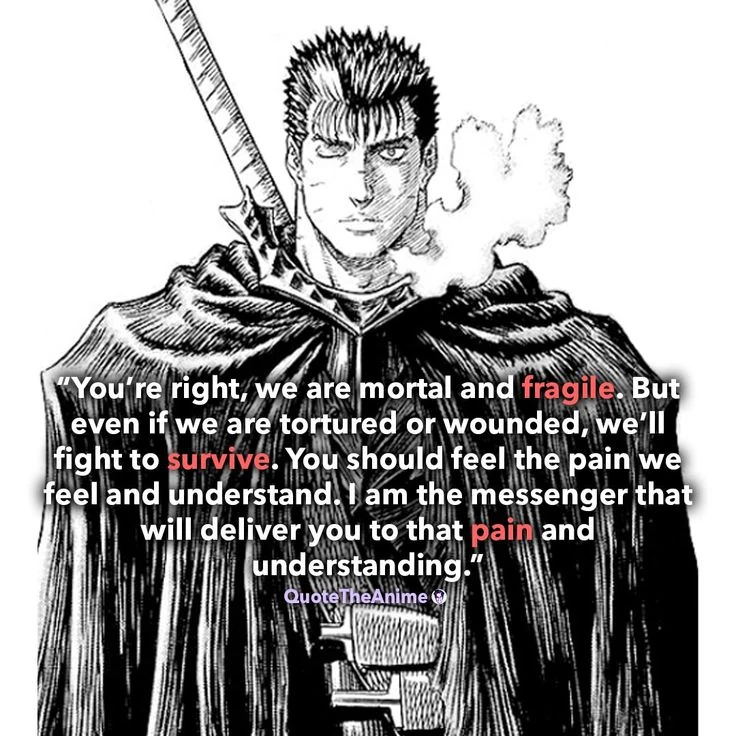
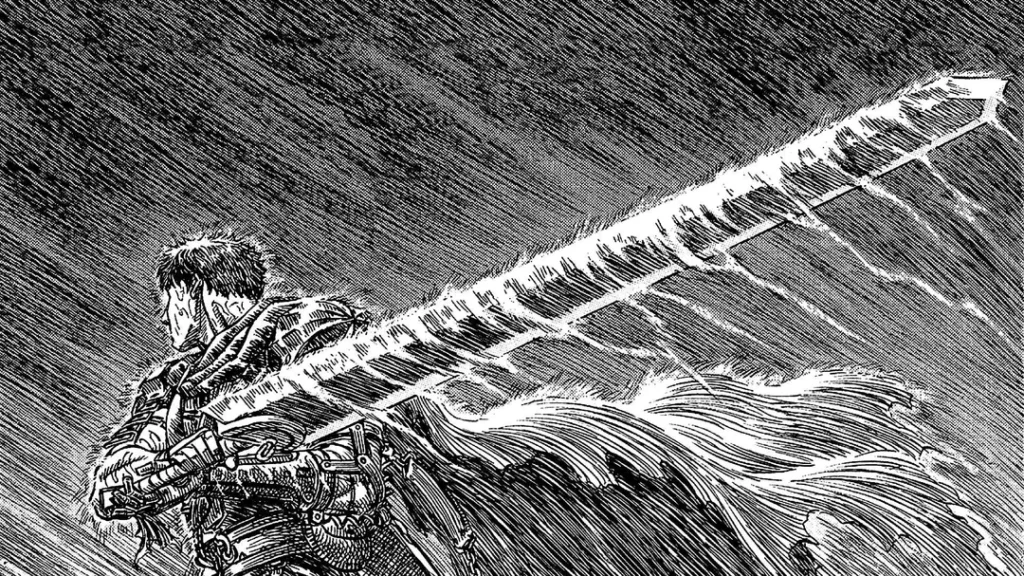
    berserk caracter

    Finding Strength Through Unimaginable Suffering

    At the heart of Berserk stands Guts, a protagonist who endures almost unthinkable physical and emotional torment throughout the series. His catalog of horrors reads like a nightmare: betrayed by his stepfather as a child, forced to watch his friends be sacrificed and devoured, witnessing his partner’s assault by his best friend while losing his eye and forearm in the process.

    Yet from this endless cascade of tragedy emerges something remarkable. Guts’s journey becomes a testament to the incredible strength of the human spirit and its capacity to endure the harshest trials. His relentless resilience acts as a beacon of hope, not just for the characters within the story, but for readers as well.

    The narrative powerfully suggests that no matter how dark life may seem, there exists an inner strength within all of us—a strength that can be harnessed to overcome even the most formidable challenges. Guts proves that survival isn’t just about enduring pain; it’s about transforming that pain into power.

    The Healing Power of True Connection

    Initially, Guts battles his inner demons by pushing others away. When he first joins the mercenary group known as the Band of the Hawk, he isolates himself, preferring to practice his swordsmanship alone at night rather than socializing with his comrades around the campfire. This behavior mirrors a common human tendency—when we feel down, we often withdraw because we don’t want to burden others with our problems.

    However, as the story progresses, Guts gradually begins to open up to his brothers in the Band of the Hawk. The relationships he forms prove to be pivotal, highlighting the healing power of genuine connection. Through these bonds, Berserk sends a clear message: you do not have to endure your struggles alone.

    By building a support network and sharing our burdens with trusted friends, we can realize that we are not alone in our struggles. The manga demonstrates that isolation is often our greatest enemy, while connection becomes our greatest strength.

    Facing the Monsters Within

    The internal struggles Guts faces are brilliantly depicted through the supernatural elements of the story. The monstrous apostles and demonic entities he battles externally often mirror the personal demons raging within him. This narrative choice underscores a crucial life lesson: confronting and acknowledging our inner demons head-on is essential for healing.

    This reflects the wisdom in the common saying that “accepting you have a problem is half the battle.” The story doesn’t shy away from the difficulty of this process—in fact, it embraces it. Berserk consistently presents the confrontation with our inner darkness as a necessary, though challenging, step toward any meaningful personal growth.

    Through Guts’s battles, we learn that running from our problems only gives them more power over us. True strength comes from turning to face what haunts us, no matter how terrifying it may seem.

    Discovering Your Own Dream

    A central theme in Guts’s journey is his quest for meaning and purpose in a world that often seems devoid of both. In a pivotal moment, he makes a difficult choice: he leaves the Band of the Hawk, abandoning the luxury, comfort, and camaraderie he had found, in order to pursue his own journey and discover his own dreamnot to fulfill someone else’s.

    This powerful narrative encourages readers to reflect deeply on their own lives, prompting essential questions about the significance of their actions and their personal pursuit of fulfillment. For those grappling with hardship and struggle, this exploration of meaning can act as a catalyst for rediscovering purpose and finding the motivation to move forward.

    As readers progress on this quest alongside Guts, they are gently coaxed into asking themselves uncomfortable but essential questions about their own reality and purpose. The story reminds us that a life lived for others’ dreams is not truly lived at all.

    Strength Through Vulnerability

    Contrary to the archetype of an unflappable hero, Guts is portrayed as a deeply vulnerable and flawed individual. A significant part of his character arc involves accepting his vulnerabilities and learning how to navigate through them. This connects directly to the theme of confronting one’s demons, suggesting that embracing vulnerability is not a sign of weakness, but rather a step toward authenticity and self-acceptance.

    This message is particularly relevant in today’s world, as it encourages people to seek help, express their emotions openly, and be true to themselves. By presenting its hyper-masculine protagonist as someone who grows through embracing vulnerability, the series powerfully argues that doing so is a source of true strength.

    In a culture that often demands we appear invulnerable, Berserk reminds us that our greatest power comes from acknowledging our humanity—our fears, our pain, and our need for others.

    A Guide Through Life’s Darkness

    In essence, Berserk uses its dark fantasy setting to weave a compelling story that serves as a guide for navigating life’s complexities. It illustrates the profound potential for personal growth, the necessity of resilience, and the possibility of finding light even in the most oppressive darkness.

    The series teaches us that struggle is not the end of our storyit's often the beginning of our greatest transformation. Through Guts’s journey, we learn that true strength isn’t about avoiding pain or pretending it doesn’t exist. Instead, it’s about facing that pain head-on, seeking support when we need it, and never giving up on the possibility of finding meaning and purpose in our lives.

    Berserk ultimately reminds us that even in our darkest moments, we possess the power to keep moving forward, to keep fighting, and to keep believing in the possibility of a better tomorrow.

    Explore More:

  • The Hidden Wisdom of Fiction

    The Hidden Wisdom of Fiction

    The Hidden Wisdom of Fiction: Why Stories Transform Us More Than Self-Help Books

    In our productivity-obsessed world, we hunt for life hacks, bio-optimization techniques, and the perfect self-improvement formula. Bookstore shelves overflow with guides on habits, power dynamics, and resilience—each promising to transform complex wisdom into digestible bullet points. Yet perhaps we’re searching in the wrong place entirely.

    The profound wisdom we seek may not lie in neatly packaged lists, but within the immersive worlds of fiction. Stories can provide exponentially more transformative insight than non-fiction ever could, fundamentally changing how we absorb and apply life’s deepest truths.

    The Dilution Problem

    Most self-help books suffer from a critical flaw: they’re derivative works. Authors distill lessons from countless novels, biographies, and experiences, then repackage them into convenient summaries. While this approach seems efficient, it creates a devastating problem.

    When you compress the depth and richness of ten novels’ worth of wisdom into 100 pages, you inevitably dilute its meaning and impact. The profundity gets lost in translation, washing over readers like a shallow wave instead of immersing them in a deep ocean of transformative experience.

    The Bullet Point Trap

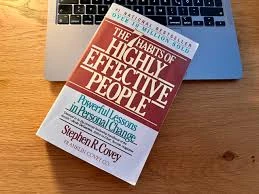
    Consider reading The Seven Habits of Highly Effective People. The author tells you that resilience is essential. You might highlight it, perhaps even take notes, then move on to the next habit. By the time you reach habit five, the first lesson has already begun fading from memory.

    When life inevitably presents a genuine challenge that tests your resilience, you'll likely fumble. The lesson simply didn’t stick—it’s incredibly difficult to embody abstract wisdom and apply it to the chaos of daily life.

    The Power of Lived Experience

    Now imagine reading The Count of Monte Cristo instead. This single 1,312-page story explores the very essence of resilience through lived experience. You don’t just read about resilience as a concept—you witness it through Edmond Dantès’ arduous journey.

    His profound trials, his unwavering determination, his moments of despair and triumph all sink deep into your consciousness as the story unfolds. You don’t merely learn about resilience; you live it alongside him. The emotional investment becomes total.

    When life throws you a curveball, you’re more likely to rise to the challenge. Edmond’s story becomes a personal touchstone, his struggles and triumphs serving as inspiration precisely when you need it most.

    Fiction’s Transformative Power

    This is fiction’s fundamental strength: its lessons don’t just inform you—they shape you. Stories mold readers like clay, leaving imprints far stronger than any bullet-pointed list ever could.

    History’s greatest minds, often too vulnerable to express their deepest truths directly, chose instead to channel their wisdom through fictional characters. This is why lessons from authors like Dickens or Dostoevsky resonate more powerfully than generic business advice ever could.

    The Right Approach to Reading

    How should you begin? The advice is counterintuitive: don’t seek out “great novels with life-changing wisdom.” Approaching fiction as a self-improvement project is counterproductive—you probably won’t enjoy the experience.

    Instead, let wisdom find you naturally. The most effective strategy is remarkably simple: read what genuinely interests you.👈

    Read what excites you. Read what embarrasses you. Read what confuses you. The genre doesn’t matter—just start reading. By following genuine curiosity, you’re far more likely to stick with it and, in the process, learn exponentially more about life than all the self-help books combined could ever teach you.

    When you read for pure enjoyment, the lessons adhere like nothing else can.

    Your Answers Already Exist

    Every answer you’re searching for already exists in fiction:

    • Courage? Discover it in To Kill a Mockingbird
    • Leadership insights? Explore Heart of Darkness by Joseph Conrad
    • Understanding profound change? Immerse yourself in Les Misérables

    The Real Path to Wisdom

    Ultimately, a meaningful life isn’t about collecting wisdom like trading cards or completing self-help books like mandatory assignments. Life is about pursuing what genuinely excites uswhat ignites our curiosity.

    The lessons we learn from stories we truly connect with become the ones we can carry and apply in our daily lives. They may not be numerous, but they prove impactful, ready to surface and serve us precisely when we need them most.

    In a world drowning in productivity hacks and optimization strategies, perhaps the most radical act is simply this: pick up a novel that intrigues you, and let the story work its quiet magic.

  • Key Points of Naval Ravikant

    Key Points of Naval Ravikant

    Key Points of Naval Ravikant: Books, Wisdom, and Quotes for a Wealthy Life

    Introduction

    In the noise of modern digital life, few voices resonate with the clarity and depth of Naval Ravikant. An entrepreneur, philosopher, and investor, Naval has become a guiding light for millions seeking not just financial independence, but a life of profound happiness and peace. He is best known for his thread on “How to Get Rich (without getting lucky)” and the subsequent book compiled by Eric Jorgenson, The Almanack of Naval Ravikant.

    Naval’s philosophy is a unique blend of capitalism and Buddhism—a roadmap for mastering the material world while maintaining spiritual equilibrium. He challenges us to rethink how we earn, how we learn, and how we live. This article delves deep into the key points of Naval Ravikant’s teachings, explores the books that shaped him, and analyzes the quotes that have become mantras for a new generation of thinkers.

    Whether you are looking to build specific knowledge, understand leverage, or simply find a way to be happier today than you were yesterday, Naval’s wisdom offers a practical toolkit. Let’s explore the architecture of a wealthy and happy life according to Naval Ravikant.

    The Almanack of Naval Ravikant: A Modern Manual

    The Almanack of Naval Ravikant is not a book written by Naval himself, but a curation of his tweets, podcasts, and essays, brilliantly compiled by Eric Jorgenson. It organizes his scattered thoughts into a cohesive guide to wealth and happiness. The beauty of the book lies in its density; there is no fluff, only distinct, actionable insights.

    The book is divided fundamentally into two parts: Wealth and Happiness. This structure itself is a lesson—that solving the money problem is a necessary step for many to clear the mental space required for the pursuit of happiness, though the two pursuits are distinct skills.

    Part I: Wealth

    Naval resets the definition of wealth. It is not merely having money; it is having assets that earn while you sleep. Wealth is the factory, the robot, the code, the investment—money is just the medium of transfer. He argues that getting rich is not about luck; it is a skill that can be learned and repeated.

    Part II: Happiness

    Contrary to the popular belief that happiness is a trait you are born with or a destination you reach, Naval defines happiness as a skill. It is a choice you make and a set of habits you cultivate. It is the absence of desire, the state of being content with what is, rather than yearning for what is not.

    Key Point 1: Specific Knowledge

    One of Naval’s most powerful concepts is “Specific Knowledge.” This is knowledge that you cannot be trained for. If society can train you, it can replace you. If you can be replaced, you are a commodity, and commodities are paid the minimum necessary wage.

    Specific knowledge is found by pursuing your genuine curiosity and passion rather than whatever is hot right now. It often feels like play to you, but looks like work to others. It is usually on the edge of technology or art, and it is highly creative. Because it is unique to you, no one can compete with you on it. As Naval famously says, “Escape competition through authenticity.”

    Building specific knowledge requires you to lean into your natural obsessions. Are you naturally good at organizing? At coding? At understanding people? Double down on these traits. The internet allows you to scale this specific knowledge to a global audience.

    Key Point 2: The Three Forms of Leverage

    To get rich, you need leverage. Specific knowledge applied with leverage is the formula for massive wealth. Naval identifies three forms of leverage:

    • Labor: This is the oldest form of leverage—people working for you. It is high status but messy and difficult to manage. Naval is generally dismissive of this unless absolutely necessary.
    • Capital: Money. This is the dominant form of leverage in the 20th century. If you have money, you can invest it to make more money. It scales very well but requires initial capital to start.
    • Code and Media: This is the leverage of the new rich. It includes software, books, blogs, videos, and podcasts. It is “permissionless leverage.” You do not need anyone’s permission to write a book or code an app. It costs almost nothing to replicate. You build it once, and it works for you while you sleep.

    Naval urges us to focus on Code and Media. If you can’t code, write books, create blogs, or record videos. Build a reputation and an audience that trusts you.

    Key Point 3: Happiness is a Choice

    Naval treats happiness as a default state that we cloud with our desires and judgments. He often quotes Confucius: “We have two lives, and the second begins when we realize we only have one.”

    A core tenet of his happiness philosophy is the management of desire. “Desire is a contract that you make with yourself to be unhappy until you get what you want.” By constantly wanting things—a better car, a different job, a new partner—we are perpetually in a state of lack. Happiness comes from dropping these contracts.

    He advocates for meditation, not necessarily in a religious sense, but as a practice of observing one’s thoughts without judgment. By watching your mind, you realize that you are not your thoughts, and you can choose which ones to engage with. He suggests that peace is happiness at rest, and happiness is peace in motion.

    Key Point 4: The Art of Decision Making

    Naval is a master of mental models. He believes that wisdom is knowing the long-term consequences of your actions. A few of his heuristics for decision making include:

    • The Long Term Game: “Play long-term games with long-term people.” All returns in life, whether in wealth, relationships, or knowledge, come from compound interest.
    • The Difficult Choice: “If you have a hard decision to make, and you’re split 50/50, take the path that is more painful in the short term.” The concept is that the harder path usually leads to better long-term growth (Hard choices, easy life. Easy choices, hard life).
    • Inversion: Instead of trying to be smart, try not to be stupid. Avoid the obvious pitfalls like addiction, jealousy, and anger.

    Naval Ravikant’s Recommended Reading List

    Naval is a voracious reader who reads to satisfy his curiosity, not to finish books. He believes that reading is the ultimate meta-skill that can be traded for anything else. Here are some of the books he frequently recommends:

    • Sapiens: A Brief History of Humankind by Yuval Noah Harari: For understanding the history of our species and the fictions that bind us.
    • The Beginning of Infinity by David Deutsch: A transformative book on the power of knowledge and explanations.
    • Skin in the Game by Nassim Nicholas Taleb: Understanding asymmetry in risk and reward.
    • The Sovereign Individual by James Dale Davidson: A prophetic book about the digital age and the decline of the nation-state.
    • Siddhartha by Hermann Hesse: A beautiful novel about the search for self and enlightenment.
    • Poor Charlie’s Almanack by Charlie Munger: Wisdom on mental models and investing from Warren Buffett’s partner.
    • Thinking, Fast and Slow by Daniel Kahneman: Understanding the biases of the human mind.

    Naval suggests that reading the foundational books (science, math, philosophy) is better than reading the “new” books. The old books have stood the test of time (the Lindy Effect).

    10 Transformations Quotes by Naval Ravikant

    Naval’s tweets are modern proverbs. Here are ten that encompass his philosophy:

    1. “Play long-term games with long-term people.”
    2. Specific knowledge is found by pursuing your genuine curiosity and passion rather than whatever is hot right now.”
    3. “Escape competition through authenticity.”
    4. “Earn with your mind, not your time.”
    5. “Impatience with actions, patience with results.”
    6. “A distinct self is an illusion. It limits you. It implies you have a fixed personality.”
    7. “Meditation is intermittent fasting for the mind.”
    8. “Clarity of mind is power.”
    9. “Work as hard as you can. Even though who you work with and what you work on are more important than how hard you work.”
    10. “The three most harmful addictions are heroin, carbohydrates, and a monthly salary.”

    How to Apply Naval’s Wisdom in 2026

    As we navigate the complexities of 2026, Naval’s advice on “permissionless leverage” is more relevant than ever. The rise of AI tools allows individuals to create code and media at an unprecedented scale. Specific knowledge is the only defense against AI; if a machine can learn it quickly, it’s not specific enough.

    Prioritizing mental health and happiness is also crucial in an increasingly distracted world. The ability to unplug, to sit in silence, and to control one’s reaction to external events is a superpower. We must curate our information diet as carefully as our food diet, avoiding the junk food of outrage news and social media envy.

    Conclusion

    Naval Ravikant offers a comprehensive philosophy for the modern age. He does not ask us to renounce the world, but to master it. By building specific knowledge, leveraging technology, and cultivating a peaceful mind, we can achieve true freedom. His message is one of agency: you have the power to change your financial trajectory and your internal state.

    The books he reads and the quotes he shares are breadcrumbs on a path he has walked. They invite us to question our assumptions, to value our time, and to realize that we are already enough. In the end, the goal is not just to be rich, but to be free.

    Frequently Asked Questions (FAQ)

    1. What is Naval Ravikant famous for?

    Naval is famous for being the founder of AngelList and for his profound insights on wealth creation and happiness, shared via Twitter and podcasts. He is an angel investor in companies like Uber, Twitter, and Yammer.

    2. Did Naval Ravikant write a book?

    No, Naval has not written a book himself. The Almanack of Naval Ravikant was compiled and edited by Eric Jorgenson with Naval’s permission. It collects his wisdom from various sources into one volume.

    3. What does Naval mean by “Wealth”?

    Naval distinguishes wealth from money. Wealth is having assets that earn while you sleep (businesses, investments, potential), whereas money is just how we transfer time and wealth. He focuses on building assets.

    4. How does Naval define happiness?

    He defines happiness as the absence of desire. It is a state of peace and contentment that comes when you stop yearning for things to be different than they are. He views it as a skill that can be practiced.

    5. What is the best way to start learning Naval’s philosophy?

    The best start is reading The Almanack of Naval Ravikant, which is available for free online. You can also listen to his podcast episodes, particularly his appearance on The Joe Rogan Experience or The Tim Ferriss Show.

    The Intersection of Physics and Philosophy

    One of the most fascinating aspects of Naval’s thinking is how he applies principles of physics to life. He often speaks about the concept of ‘explanation’ from David Deutsch. Understanding the fundamental reality of how things work allows you to manipulate them. He applies this to wealth: wealth creation is a set of inputs and outputs. If you understand the equation, you can solve it. He implies that most people are operating on ‘folk physics’ when it comes to money—believing in luck or lottery tickets—rather than understanding the mechanics of value creation.

    The Role of Solitude

    In a hyper-connected world, Naval champions solitude. He states, “All of humanity’s problems stem from man’s inability to sit quietly in a room alone,” quoting Pascal. Solitude is where you process your thoughts, where you debug your own mind. It is in the quiet moments that you can observe the “monkey mind” chattering away and begin to tame it. Without solitude, you are merely reacting to the external program; with solitude, you can begin to write your own.

    Continuous Learning as a Lifestyle

    Finally, the thread that ties all of Naval’s advice together is the commitment to being a lifelong learner. The modern world changes too fast for a static education to hold value (The half-life of a learned skill is dropping). The only way to survive and thrive is to be better at learning than everyone else. This means reading the basics, understanding first principles, and being willing to look like a beginner even when you are an expert in another field. It is this intellectual humility that opens the door to specific knowledge and, ultimately, to wisdom.

    Explore More:

  • Freida McFadden Books in Order

    Freida McFadden Books in Order

    Freida McFadden Books in Order: The Complete 2025 Guide

    If you have spent any time on “BookTok” or browsing the thriller section of your local bookstore lately, you have undoubtedly encountered the name Freida McFadden. A practicing physician specializing in brain injury, McFadden has turned her medical expertise into a superpower for writing some of the most grippy, twisty, and unputdownable psychological thrillers of the decade. Her ability to craft unreliable narrators and jaw-dropping endings has earned her the title of “The Queen of Twists.”

    However, with a proliferation of novels released over the last few years, knowing where to start can be daunting. Should you begin with her viral hit The Housemaid? Or dive into her earlier, darker humor works? This comprehensive guide provides the definitive list of Freida McFadden books in order, updated for 2025. Whether you are a completionist who wants to read chronologically or a casual reader looking for the best hits, this guide is your roadmap to her twisted literary universe.

    Who is Freida McFadden?

    Dr. Freida McFadden is a #1 Amazon and USA Today bestselling author. What makes her unique in the crowded thriller genre is her background in medicine. Many of her protagonists are medical professionals, and her plots often hinge on medical anomalies, hospital politics, or the psychological strain of healthcare work.

    This adds a layer of verisimilitude to her stories that pure fiction writers often struggle to achieve. She balances her busy medical practice with a prolific writing schedule, releasing multiple books a year, a pace that delights her ravenous fanbase.

    The Housemaid Series in Order

    This is the series that catapulted McFadden to global stardom. It follows Millie Calloway, a woman with a criminal past who takes a job as a live-in housekeeper, only to find herself in a house of horrors. These books should definitely be read in order to avoid spoilers.

    1. The Housemaid (2022)

    The book that started it all. Millie gets a job working for the wealthy Nina Winchester. But Nina is erratic, messing up the house just to watch Millie clean it. And Nina’s husband, Andrew, seems too perfect to be true. The twist in this book became a cultural phenomenon.

    2. The Housemaid’s Secret (2023)

    Millie is back, this time working for a rich tech mogul who refuses to let anyone into the guest bedroom. When Millie hears a woman crying from behind the locked door, her savior complex kicks in. But saving someone isn’t always as simple as unlocking a door.

    3. The Housemaid is Watching (2024)

    In this installment, the stakes are raised as we see Millie attempting to live a normal life with a family of her own. But the shadow of her past, and the nature of her “skills”, never truly leaves her. It explores the paranoia of suburbia where everyone is watching everyone.

    4. The Housemaid’s Legacy (2025)

    The latest addition to the saga, released earlier this year. Without giving away spoilers, this book brings Millie’s story full circle, confronting the consequences of the justice she has meted out over the years. It is a darker, more introspective look at the cost of being a vigilante.

    The Dr. Jane McGill Series

    Before she was a thriller queen, McFadden wrote medical humor. These books are lighter but still possess her signature wit.

    • 1. The Devil Wears Scrubs (2013): A hilarious, semi-autobiographical look at the grueling life of a medical intern.
    • 2. The Devil You Know (2017): Dr. Jane McGill returns, now a senior resident, dealing with new interns and old enemies.

    Standalone Psychological Thrillers

    This is where McFadden shines brightest. While these can be read in any order, reading them chronologically allows you to see the evolution of her writing style from medical dramas to intense psychological horror.

    Baby City (2015)

    A departure from her current style, focusing on the chaotic world of labor and delivery. More humor than horror.

    Brain Damage (2016)

    One of her first forays into darker themes. A skin specialist discovers a pattern in her patients that points to something sinister.

    The Surrogate Mother (2018)

    Abby wants a baby but can’t have one. She hires a surrogate, but the young woman she chooses seems to want more than just the money, she wants Abby’s life.

    The Ex (2019)

    Cassie is dating the perfect guy, Joel. But Joel’s ex-girlfriend isn’t letting go. A classic stalker thriller with a signature McFadden flip.

    The Perfect Son (2019)

    Mrs. Cass has the perfect family, until her high school senior son is accused of a brutal crime. Is he a monster, or is she blinded by motherly love?

    The Wife Upstairs (2020)

    A modern retelling of Jane Eyre (not to be confused with Rachel Hawkins’ book of the same name). It updates the gothic classic with modern twists.

    One by One (2020)

    A group of friends goes on a trip to a remote cabin. They get lost in the woods. Then they start dying. A classic survival thriller.

    Want to Know a Secret? (2021)

    A high school drama meets murder mystery. It explores the pressure of social media and the secrets suburban families keep.

    The Locked Door (2021)

    Nora’s father is a serial killer. She has spent her life trying to be nothing like him. But when her patients start dying in the same way her father’s victims did, she becomes the prime suspect.

    Do Not Disturb (2021)

    Quinn runs away from her life and ends up at the jagged, creepy Baxter Motel. The Bates Motel vibes are strong here, but the ending is pure McFadden.

    The Inmate (2022)

    Brooke takes a job as a nurse practitioner at a maximum-security prison. Her high school boyfriend, who tried to kill her, is an inmate there. What could go wrong?

    Never Lie (2022)

    Newllweds Tricia and Ethan are house hunting. They get trapped in a snowstorm in the massive estate of a vanished psychiatrist. Tricia starts listening to the doctor’s patient tapes… and uncovers a terrifying truth.

    Ward D (2023)

    Medical student Amy has to do her rotation on the psychiatric ward. But she has a secret: she spent the night there as a patient years ago. And the locked unit is horrifying at night.

    The Teacher (2024)

    Eve creates a new life for herself, but working at a high school brings her into the orbit of a dangerous student and a handsome colleague. A tale of obsession and revenge.

    The Crash (2025)

    Released in Spring 2025, this novel centers on a woman who wakes up from a car accident with amnesia, only to realize her husband might be the one who caused it. It has been praised for its claustrophobic atmosphere.

    Analysis: The “McFadden Formula”

    Why are these books so addictive? McFadden has mastered a specific formula. She typically uses dual points of view (POV) or a “Before/After” timeline structure. This allows her to control the flow of information perfectly. You think you know the hero and the villain, and then, at the 60% mark, she flips the perspective, and the victim becomes the perpetrator (or vice versa).

    Her prose is accessible and fast-paced. She doesn’t get bogged down in overly flowery descriptions. The focus is always on the plot and the immediate tension. This makes her books perfect “palate cleansers” between dense literary fiction reads. However, underneath the popcorn-thriller surface, she often tackles themes of domestic abuse, gaslighting, and the way society dismisses women’s intuition.

    Read Her Books!

    Whether you start with The Housemaid or pick up her latest 2025 release, reading Freida McFadden books in order is a journey into the darker corners of the human psyche. She challenges us to look closely at the people we trust, our spouses, our doctors, our housekeepers, and ask: Do I really know you?

    With her prolific output, there is always a new nightmare waiting on the shelf. So, lock your doors, turn on all the lights, and prepare to be up all night.

    Frequently Asked Questions (FAQ)

    1. What is the best Freida McFadden book to start with?

    Most readers recommend starting with The Housemaid. It is her most iconic work and gives you a perfect taste of her twisty style. If you prefer a standalone, The Locked Door is an excellent entry point.

    2. Does Freida McFadden write under a pseudonym?

    No, Freida McFadden is her pen name; she uses it to separate her writing career from her professional life as a practicing physician.

    3. Are the books connected?

    Aside from The Housemaid series and the Dr. Jane McGill series, her novels are standalones. However, eagle eyed readers might spot occasional Easter eggs referencing characters or locations from other books.

    4. Is Freida McFadden suitable for Young Adult (YA) readers?

    Generally, no. Her books are categorized as Adult Thrillers. They often contain mature themes, violence, and strong language. Want to Know a Secret? features high schoolers but deals with very adult situations.

  • Lessons from You2

    Lessons from You2

    Lessons learned from “You²”: Why trying harder isn’t always the answer

    Hey everyone, today I’m here to share some ideas and impressions I had after finishing the book You² by Price Pritchett. This book was a pleasant surprise in my life. Honestly, it would have been my last choice in a used bookstore. However, it found its way to me, and I dedicated myself to understanding it.

    book you2

    Trying harder doesn’t mean it gets better

    “Trying harder isn’t necessarily the solution to achieving more. It may not offer any real promise for getting what you want out of life. Sometimes, in fact, it’s a big part of the problem.”

    Have you ever thought with absolute certainty that if you just tried harder, everything would pay off? That you’d get through the struggle, get the money you want, the body you want, the job you want?

    Hold your horses, young grasshopper. Life isn’t a marathon.

    On many occasions, all we need to do is stop, think, and breathe. These three actions are necessary and essential for you to reflect on the right thing to do. On one occasion, I thought the answer was just to work more. I did that and… ended up with pneumonia and unable to work at all.

    The overwhelming majority of the time, the answers are already with you.

    Think more and try new things

    “If you want to make a quantum leap, quit thinking about trying harder. More effort isn’t the answer.”

    “The things that worked for you in the past very likely could, sooner or later, lose their serviceability.”

    Before reading this book and going through certain experiences, I was sure that I just needed to repeat the formula from the past to achieve results. So, I tried to repeat the formula. And for what?

    In 2020, we had the pandemic. And with it came a storm of new lessons. I failed, and I failed hard, but I kept my lessons close:

    • Focus: It’s more about saying “no” than “yes.” It is about denying opportunities.
    • Patience: If you consider yourself patient, set a one-year goal and discover that you aren’t actually that patient. This is a quality I needed and was forced to improve the hard way.
    • Step-by-step: This has to do with processes. Identifying and doing one thing at a time. It’s about overcoming stages and accumulating small victories.
    • Income sources: I don’t need to say much about this here. But in 2020, it became clear to me that I needed to create some kind of extra income beyond my job. Depending on a single source is challenging.
    • Expansion: This was added in 2023. I used to shrink myself to fit into environments, jobs, and social circles. But growth was inevitable. I always sought improvement, and eventually, it explodes. Here, I learned that we need to be constantly expanding whatever that means to you.

    Trust your intuition

    “You don’t have to know how you’re going to get there, but you need to know where you want to go.”

    “The answers will come to you. And when they do, you probably will find them to be simple, streamlined solutions.”

    “You² is achieved through an intuitive, instinctive discovery process based on a sense of direction and pursuit. If you have the answers and structure and certainty up front, it’s not a quantum leap.”

    Intuition is the ability to have an immediate perception of a truth or event without the need for logical reasoning or detailed analysis. It is a type of rapid, subconscious cognition based on accumulated knowledge and past experiences. While it can be a powerful tool, intuition can be subject to biases, so critical reflection is important.

    I’ve spoken here before about how and why you should believe in your intuition. It is the bridge between you and God. Often, you will need to take that famous “leap of faith.” Surrender and trust in God and the process.

    Whatever happens, at some point in your life, you will need to surrender to the process and trust that the answers will come to you.

    Interpret your dreams and the signs life gives you

    “A creative solution to a problem may come to you in a dream. A breakthrough idea can flash through your mind while you’re visualising your goal. Somehow, the resources you need just seem to appear by coincidence.”

    “Frankly, making a quantum leap is not mere gambling. It’s not a crapshoot. You simply move on an opportunity you’ve been ignoring. You abandon your excuses. You reframe the problem. You take a completely different chance. A quantum leap is risk…”

    The other day, I went to help my wife move some equipment at her store. On the way there, we had some mishaps. During the move, more mishaps. And even on the way back home, we had two more struggles. We were upset, but we overcame it. At the end of the day, talking to my wife, we asked ourselves:

    What did we learn today?

    In our specific case, we concluded that it was a message: we can do more than we thought we could. That is insane! Most people would just complain and talk about how crappy their life is. But we have many more reasons to be thankful than to complain.

    To wrap this up…

    First, I would like to invite you to get the book. It is sensational! You can buy the book [Link Here] and buy me a coffee in the form of a commission.

    Secondly, I want to propose a challenge. Think about that problem you have that is currently “living rent free” in your head.

    I want to invite you to follow the steps described above and then… let go. See what happens. Watch when and how the solution comes to you. Because rest assured, it will arrive. Now, it depends on you having an open mind to receive the information.

    That’s it for today, see you next time!

    Victoria Concordia Crescit

    Explore More:

  • Why I Abandoned Audiobooks

    Why I Abandoned Audiobooks

    Why I Abandoned Audiobooks: The Science of Reading vs. The Joy of Paper

    Everyone seems to be listening to a book these days. In traffic, at the gym, while doing the dishes. The promise is tempting: “read” more books in less time. I tried it. I really did. But after several frustrated attempts and realizing I could barely remember the main character’s name two days later, I decided to investigate.

    It’s not just stubbornness or nostalgia. There is a scientific and sensory reason why I (and perhaps you) don’t like audiobooks. Below, I explain the three main reasons that made me go back exclusively to paper.

    morty talking alone

    The Lack of “Tangibility”: The Book as a Physical Trophy

    The first point is purely sensory, but essential. Audiobooks are digital files; they don’t exist in the physical world.

    • The sensory experience: When we read a physical book, we feel the weight, the smell of the paper, and the texture of the cover. Our brain creates a “geography” of the book (e.g., “that sentence was on the bottom right of the page, about halfway through the book”).
    • The sense of progress: Watching a bookmark physically advance gives a dopamine hit that a digital progress bar simply cannot replicate.
    • The book as identity: Having a full bookshelf isn’t just decoration; it’s an external manifestation of your accumulated knowledge. An MP3 file doesn’t carry the emotional weight of a battered book you read on an unforgettable trip.

    Content Retention is Proven to be Lower (Science Explains)

    This is the crucial point. Listening is a passive activity; reading is active. When you listen to an audiobook, the flow continues even if your mind wanders. In reading, if you lose focus, the reading stops.

    Studies indicate that for complex narratives or studying, visual trumps auditory.

    Relevant Data: A study conducted at the University of Waterloo compared mind wandering during silent reading versus listening. The study suggested that the mind tends to wander more during listening, and the retrieval of factual details is often lower in audio formats compared to focused reading, especially in dense texts.

    Memory Retention Comparison (Estimate based on cognitive studies):

    Content TypeRetention (Physical Reading)Retention (Audiobook)
    Light FictionHigh (90%)Medium-High (85%)
    Non-Fiction / TechnicalVery High (95%)Low (60%)
    Specific DetailsHighLow

    Note: Physical reading allows for “ocular regression” (quickly going back to re-read a confusing sentence), something that in audio breaks the rhythm and is cumbersome.

    The Pen is Mightier than the “Play” Button: The Power of Note-Taking

    I don’t like audiobooks because they prevent me from conversing with the author.

    • Marginalia: Highlighting, underlining, and writing in the margins forces your brain to synthesize information instantly.
    • Kinesthetic Memory: The act of holding a pen and writing reinforces motor memory.
    • Impossibility in Audio: Trying to pause an audiobook, unlock your phone, and type a note in an app completely breaks the immersion and the flow of learning. On paper, it’s a fluid, one-second movement.

    Give Paper a Chance (and Second-Hand Bookstores!)

    If you feel like you aren’t absorbing what you “read” with your ears, don’t feel guilty. Your brain biology prefers visuals for deep learning.

    My recommendation: Turn off the headphones. Go to a second-hand bookstore (a sebo) in your city or use book swap sites.

    1. Used Books: They have history. You might find notes from a previous owner that enrich your reading.
    2. Sustainability: Buying used is recycling knowledge.
    3. Cost-benefit: You pay a fraction of the price for a far superior retention experience.

    Reading is an act of resistance and focus in a noisy world. Don’t let audio replace the productive silence of reading.

    FAQ

    Here are answers to what most people search for on Google regarding this topic:

    1. Does listening to an audiobook count as reading?

    Yes, it counts as content consumption and entertainment. However, neurologically, the decoding process is different. For leisure, it’s valid; for deep study, visual reading is superior.

    2. Why do I fall asleep listening to audiobooks?

    Because listening is passive. The constant rhythm and lack of visual stimulus signal to the brain that it is time to relax, similar to listening to a lullaby or white noise.

    3. Which is faster: reading or listening?

    The average adult reading speed is 250-300 words per minute. Normal speech (Audiobook 1.0x) is about 150-160 words per minute. This means reading with your eyes is, on average, 2x faster than listening.

    4. Can I replace college textbooks with audiobooks?

    It is not recommended. Technical texts require constant re-reading of complex paragraphs and visualization of structure, which is very difficult to do with audio alone.

    5. What is better for memory retention?

    Physical reading combined with handwriting notes (the active reading system) is the champion method for long-term memory retention.

    6. Are audiobooks good for anything?

    Yes! They are excellent for biographies, comedy, and light fiction, or for “reading” at times when your hands and eyes are busy (driving, cooking), where the alternative would be reading nothing at all.

    References

    • Willingham, Daniel T. (Professor of Psychology at the University of Virginia) – Articles on the cognitive difference between decoding audio and text.
    • University of Waterloo (Mind Wandering Studies) – Research indicating higher mind wandering in passive listening tasks compared to active reading.
    • Mueller, P. A., & Oppenheimer, D. M. – “The Pen Is Mightier Than the Keyboard” (While focused on typing vs. writing, the principle applies to the passivity of audio vs. the activity of note-taking).
    • Audio Publishers Association – Data on narration speed vs. average visual reading speed.
  • Family lessons in The Godfather

    Family lessons in The Godfather

    Family lessons in The Godfather

    High expectations

    Hello everyone, today I’m here to share some thoughts and impressions I had about the movie The Godfather. I know, I know. The movie is a classic, and since I hadn’t seen it yet, this weekend I decided to stretch my legs on the sofa, put some popcorn in the microwave, and press play on this classic film.

    Although I’d always heard about the film, the first impression the cover gives is of a mafia movie. And the plot portrays that very well. I want to emphasize that the screenwriters deserve praise!

    Well, if we take into account the year of filming and the resources available, the movie fit together very well with the sequences, and the sequence of events was perfect. However, in my opinion, this film is more about family. If you pay close attention, everything revolves around the “godfather.” That’s what they call him because most of the characters feel like part of the family.

    Dom Corleone scene

    As the film unfolds, you begin to realize the extent of the respect and devotion the allies have for our beloved Marlon Brando. I can confidently say he could give lectures and charge a fortune for them today. The goal here is not to give spoilers. I will try to be as concise as possible.

    Family is everything.

    Family is everything, yes. Period!

    Parente, that’s something else entirely.

    Colleague, it’s another one.

    Friend, it’s another one.

    However, when I say family, I mean those 4-5 people you can count on one hand, who would kill or die for you. That’s yours. Your people. And in the movie, that’s very evident, even though he has several affiliates. The Godfather knows very well who his inner circle is.

    He also knows that, after an unfortunate accident, he needs, above all, to think about his family and continue his legacy. That’s when he begins to develop his youngest son… a highly calculating, calm, serene, and exceptionally intelligent man. And so, our hero emerges. And with him, his journey…

    michael corleone

    Aging the wine

    As is customary in Italy, drinking fine wines is a priority. There, they know that care, time, and proper handling are necessary to achieve the best possible beverage. Therefore, the same process occurs with our iconic wine. It begins in one way, overcomes its challenges, and finally reaches its peak. Its maturation is progressing.

    One of the scenes that caught my attention the most was when his older brother, a stranger, an outsider, had to support the family in an important business decision. That’s when the younger brother warned him:

    “…You’re my brother, and I love you. But if you side with a stranger and don’t support your family, I’ll end you…”

    It was something like that, more or less.

    So, this scene caught my attention. Because, nowadays, the meaning of family is being lost. That unity that supports and helps each other. That, even in crisis, doesn’t tell anyone outside. Times have changed…

    In a hilarious way, I finished the Succession series. And seeing how much the three brothers fight and are willing to do anything for power is paradoxically the opposite of the Godfather universe. And that caught my attention. Compare:

    The Godfather – Release year 1972.

    Succession – Release year 2018.

    46 years difference.

    In 46 years, have we really lost so much?

    Mother, values, and unity.

    Recently my mother went through a delicate medical process. It’s transformative what the increased probability of death does to your mind. Especially coming from someone who gave birth to you and brought you into this world. Someone with whom you have a relationship so profound that words in my vocabulary could not describe it.

    Therefore, once the difficulty was overcome, I became even closer. We traveled more together, ate more together, smiled more together, cried more together. After all, life is meant to be felt. I talked about this in the article I wrote about Rick Rubin’s creative process.

    Therefore, I want to conclude this text by reminding you of three valuable lessons I learned from watching The Godfather:

    • Know who is truly your family and who is your relative/colleague.
    • Family first.
    • Protect your family and their interests. No matter what.

    And speaking of the movie, stop everything and go see it. It truly is a work of art. See you soon!

    Victory and Concord Grow