Author: Victor de Paula

  • Top 10 Anime Love Quotes: A Tutorial on Romantic Communication and Emotional Depth

    Top 10 Anime Love Quotes: A Tutorial on Romantic Communication and Emotional Depth

    Modern romance often suffers from a crisis of superficiality. In an era dominated by rapid digital interactions, expressing genuine devotion has become a lost art. Relationships frequently struggle with barriers to emotional expression, leaving partners feeling isolated despite constant connectivity. To resolve this, we can turn to the emotionally resonant world of Japanese animation. Far from being mere entertainment, anime serves as a deep philosophical exploration of human relationships. The medium frequently uses anime love quotes to articulate complex dynamics of vulnerability, loyalty, and self-sacrifice.

    This tutorial listicle provides a structured guide to using these powerful literary and cinematic declarations as tools to improve your own romantic communication. By analyzing ten iconic quotes, you will learn how to apply their emotional wisdom to resolve conflict, build intimacy, and deepen your relationships.

    The Narrative Power of Anime Romance

    In Western media, romantic declarations are often centered around passion and immediate attraction. In contrast, Japanese storytelling frequently emphasizes the concept of *Kizuna* (bonds)—the slow, trial-by-fire development of mutual reliance and deep connection. Anime romances are rarely easy; characters must navigate class divides, supernatural threats, or deep-seated personal trauma. Consequently, when a character finally verbalizes their feelings, the words carry the weight of accumulated struggles.

    By studying these moments, we gain access to models of emotional vulnerability that are often absent in daily life. These quotes act as psychological templates, helping us express thoughts we might otherwise struggle to put into words. Similar narrative depth and emotional maturation can be found in our analysis of the best standalone anime movies, which highlight the artistic and emotional heights of the medium without requiring a long-term series commitment. Additionally, examining the tropes of romantic fantasy novels, such as those found in our guide to the best enemies-to-lovers fantasy novels, reveals how friction and conflict eventually pave the way for unconditional affection.

    10 Anime Love Quotes: Relational Challenges and Tutorials

    Below are ten profound love quotes from classic and modern anime, each mapped to a specific relationship challenge, with a tutorial on how to apply it in your life.

    1. Kirito on Overcoming the Fear of Betrayal

    “I’d rather trust and regret than doubt and regret.”

    — Kirito, Sword Art Online

    The Problem: Commitment phobia and defensive skepticism. After experiencing past heartbreak, individuals often build emotional walls, assuming that doubting their partner protects them from pain.

    The Solution: Consciously choosing active trust. Kirito acknowledges that trust carries risk, but argues that a life lived in constant suspicion is far more damaging than the pain of occasional disappointment.

    Practical Application: Use this quote during moments of irrational jealousy or anxiety. When you feel the urge to double-check your partner’s actions or doubt their intentions, pause. Repeat this quote, and choose to act on the assumption of their loyalty. Building interpersonal trust requires the courage to be vulnerable first.

    2. Tomoya Okazaki on Shared Accountability

    “If you’re going to make a mistake, make it with me. We’ll find the way together.”

    — Tomoya Okazaki, Clannad

    The Problem: Perfectionism and blame culture within relationships. When errors occur, partners often assign guilt, creating a divisive “you vs. me” dynamic instead of a collaborative “us vs. the problem” approach.

    The Solution: Embracing collaborative mistake-making. Tomoya removes the shame of failure by framing mistakes as shared experiences that partners solve together.

    Practical Application: The next time your partner makes an administrative or domestic error (e.g., booking the wrong flight, overspending the budget), refrain from criticizing. Instead, say: “We are in this together. Let’s solve this mistake as a team.” This creates an environment of psychological safety where errors are met with cooperation rather than defensiveness.

    3. Mamoru Chiba on Absolute Devotion

    “You are my first love, my only love, and my last love.”

    — Mamoru Chiba, Sailor Moon

    The Problem: Restlessness and emotional distraction. In a world of infinite digital choices, maintaining focus on a single partner can feel challenging, leading to comparison and dissatisfaction.

    The Solution: Reaffirming lifelong exclusivity and emotional grounding. Mamoru’s declaration acts as an anchor, simplifying the complexity of choice by celebrating the singular importance of one’s partner.

    Practical Application: Write this quote in an anniversary card or share it during a quiet, dedicated moment. Use it to reassure your partner of their permanent status in your life, especially during transitions like moving, changing jobs, or starting a family. Reassurance builds a foundation of long-term security.

    4. Gilbert Bougainvillea on Autonomy and Love

    “I want you to live, and be free. From the bottom of my heart, I love you.”

    — Gilbert Bougainvillea, Violet Evergarden

    The Problem: Codependency and possessiveness. We often confuse love with possession, attempting to control our partner’s choices, career path, or social circle under the guise of protecting them.

    The Solution: Practicing non-possessive warmth. Gilbert’s love is unconditional; he does not seek to own Violet, but wishes for her freedom and independent growth above all else.

    Practical Application: If your partner wants to pursue a career change, hobby, or solo trip that makes you anxious, use this quote to check your possessiveness. Ask yourself: “Am I supporting their growth, or am I trying to keep them close for my own comfort?” Choose to support their independent path, showing love through empowerment.

    5. Kaori Miyazono on Emotional Legacy

    “Was I able to live inside someone’s heart? Was I able to live inside your heart?”

    — Kaori Miyazono, Your Lie in April

    The Problem: Fear of insignificance and emotional isolation. Many people go through life wondering if their existence or emotional contributions actually matter to those they love.

    The Solution: Acknowledging and validating the profound impact partners have on each other’s identities. Kaori’s question reminds us that love is about leaving a lasting positive footprint on another person’s soul.

    Practical Application: Do not wait for tragedy to tell your partner how they have shaped you. Sit down and write them a letter detailing exactly how their habits, kindness, or perspective have changed you for the better. Answer Kaori’s question directly by saying: “You live in my heart, and here is how you changed my world.”

    6. Hinata Hyuga on Mutual Inspiration

    “Because you make mistakes… you get the strength to stand up to them. That’s why I think you are truly strong.”

    — Hinata Hyuga, Naruto

    The Problem: Performance anxiety and low self-esteem in a partner. When your partner is struggling, they often feel weak, insecure, and unworthy of affection.

    The Solution: Reinterpreting vulnerability as strength. Hinata does not love Naruto because he is flawless; she loves him because he faces his flaws and persists. This reframes struggles as proof of character.

    Practical Application: When your partner suffers a major setback (such as a career failure or personal disappointment), read this quote to them. Tell them that you respect them not for their victories, but for their resilience. This builds mutual support and lifts the burden of having to be perfect.

    7. Sawako Kuronuma on Overcoming Loneliness

    “It was like you brought color into my life. You changed my world.”

    — Sawako Kuronuma, Kimi ni Todoke

    The Problem: Chronic isolation and emotional numbness. Long periods of loneliness can make life feel gray, monophonic, and devoid of meaning.

    The Solution: Expressing gratitude for the transformative power of connection. Sawako uses the metaphor of color to describe how intimacy restores vitality to our daily lives.

    Practical Application: Dedicate a journal entry or note to your partner detailing the “colors” they brought to your life. Mention specific activities you enjoy more because of their presence (e.g., cooking, traveling, or even reading). This positive reinforcement strengthens the appreciation loop within your relationship.

    8. Tomoe on Loving the Flawed Self

    “I won’t let anyone lay a finger on you. You belong to me, and I will protect you.”

    — Tomoe, Kamisama Kiss

    The Problem: Lack of boundary setting and external threats to the relationship. Couples often allow meddlesome friends, toxic family members, or work demands to disrupt their emotional safety.

    The Solution: Establishing clear, protective boundaries. While Tomoe’s language sounds possessive, the underlying intent is the creation of an impenetrable sanctuary where the partner is safe from harm.

    Practical Application: Sit down with your partner and define your “relationship boundary lines.” Agree on what information remains private between the two of you, and commit to presenting a united front when dealing with difficult external forces. This creates a secure attachment style.

    9. Tohru Honda on Healing Past Trauma

    “I want to think that memories… are things we keep inside us, to help us grow.”

    — Tohru Honda, Fruits Basket

    The Problem: Carrying historical baggage into new relationships. We often allow old betrayals or childhood issues to dictate our current relational dynamics, projecting past hurt onto our innocent partner.

    The Solution: Integrating painful memories as lessons for growth rather than chains. Tohru’s gentle wisdom encourages us to view our past as fuel for empathy, not resentment.

    Practical Application: When old relationship patterns start to trigger defensive behaviors, pause and read Tohru’s words. Share the trigger with your partner by saying: “My past experience is making me react this way, but I want to use that memory to make us stronger, not to pull us apart.” This builds emotional intelligence.

    10. Shirou Emiya on Unwavering Presence

    “I’ll always be here for you, no matter what happens.”

    — Shirou Emiya, Fate/Stay Night

    The Problem: Situational flight and conditional commitment. In modern relationships, we often commit only when things are easy, abandoning our partner emotionally or physically during crises.

    The Solution: Reaffirming stable, unconditional presence. Shirou’s promise provides the ultimate psychological safety net: the certainty that you will not face the dark alone. Similar struggles of staying true to one’s path in the face of absolute despair are explored in our deep-dive comparison of stoicism and ambition in Griffith vs Guts.

    Practical Application: In times of crisis (e.g., illness, financial loss, or grief), repeat this phrase to your partner. Back it up with concrete actions: take over household duties, handle administrative burdens, or simply sit with them in silence. Your presence is the ultimate proof of love.

    Practical Examples: Incorporating Quotes into Couple’s Rituals

    To move these romantic concepts from fantasy to real-world application, practice the following communication systems:

    • The Shared Quote Jar: Write your favorite anime love quotes on slips of paper and place them in a jar. Once a week, draw one slip together and discuss how the message applies to your current relationship. This acts as a neutral prompt to discuss emotional needs.
    • Vulnerability Evenings: Set aside one night a month to discuss relationship hurdles without distractions. Use Hinata’s or Kirito’s quotes as opening prompts to establish a non-judgmental space for emotional sharing.
    • Scribbled Notes of Reassurance: Slip short quotes into your partner’s lunchbox, book, or bag. These unexpected micro-reminders of devotion reinforce the bond and act as daily stabilizers against external stress.

    FAQ: Navigating Love and Communication Through Anime

    1. Why are anime love quotes often more emotional than Western romance quotes?
    Anime often utilizes dramatic stakes (e.g., saving the world, overcoming curses) which amplifies the emotional resonance of the dialogue. The heightened scenarios force characters to express their feelings with absolute clarity and intensity.

    2. Can quoting anime feel childish or corny to my partner?
    It depends on delivery. Focus on the core meaning of the words rather than the show’s name if you are concerned. The philosophical sentiment of trust, loyalty, and growth is universally respected regardless of its origin in animation.

    3. How do we distinguish between healthy anime devotion and toxic codependency?
    Healthy devotion respects individual autonomy (as in Gilbert’s quote). If a quote promotes self-destruction, loss of identity, or complete reliance on another person for basic happiness, it borders on unhealthy codependency and should not be used as a relationship template.

    4. How can we use these quotes to resolve active arguments?
    Use them to de-escalate tension. Recalling Tomoya’s quote (“make mistakes together”) reminds both partners that they are on the same team, shifting the focus from winning the argument to preserving the connection.

    References

    • Arakawa, Naoshi. Your Lie in April. Kodansha, 2011.
    • Ishihara, Tatsuya (Director). Clannad (Anime). Kyoto Animation, 2007.
    • Kishimoto, Masashi. Naruto. Shueisha, 1999.
    • Nasu, Kinoko. Fate/Stay Night. Type-Moon, 2004.
    • Reki, Kawahara. Sword Art Online. ASCII Media Works, 2009.
    • Shiina, Daisuke (Director). Violet Evergarden (Anime). Kyoto Animation, 2018.
    • Shiina, Karuho. Kimi ni Todoke. Shueisha, 2005.
    • Suzuki, Julietta. Kamisama Kiss. Hakusensha, 2008.
    • Takeuchi, Naoko. Sailor Moon. Kodansha, 1991.
    • Takaya, Natsuki. Fruits Basket. Hakusensha, 1998.

    Vale a pena? The Legacy of Anime Romance

    Ultimately, these anime declarations show us that profound love is not a passive feeling, but an active, daily choice. The enduring power of these quotes lies in their willingness to face difficulty, embrace vulnerability, and prioritize the growth of both partners. By integrating these templates into your communication habits, you can build a more secure, expressive, and resilient connection. When relationship challenges arise, remember that love is not about achieving perfection, but about the commitment to navigate the storm side-by-side: the words build the bridge, but your actions sustain the journey.

  • Top 10 Short Book Quotes in English: A Practical Guide to Mental Resilience

    Top 10 Short Book Quotes in English: A Practical Guide to Mental Resilience

    In our modern era of continuous digital notifications and hyper-acceleration, we frequently encounter a state of existential fatigue. The human mind, bombarded with transient snippets of information, struggles to find stable ground. Historically, literature has served as the ultimate laboratory of human experience. When writers compress complex philosophical concepts into brief, memorable sentences, they create what psychologists call cognitive anchors. These are not merely decorative ornaments for speech; they are highly concentrated mental models designed to navigate adversity.

    This tutorial listicle offers a systematic methodology for using book quotes in english short format to resolve everyday psychological obstacles, enhance personal growth, and build mental resilience. By studying these ten literary gems, you will learn how to convert passive reading into active, daily problem-solving tools.

    The Cognitive Value of Textual Compression

    Why do short quotes hold such massive psychological weight? The answer lies in the cognitive science of memory and linguistic efficiency. In cognitive psychology, “chunking” is a process by which individual pieces of information are bound together into a meaningful whole. A long philosophical treatise on resilience might be intellectually satisfying, but in moments of acute stress or decision fatigue, the working memory cannot retrieve complex arguments. A short, highly-compressed sentence, however, bypasses these retrieval bottlenecks. It functions as a zip file for the brain—once recalled, it expands into a rich network of associations, emotional context, and philosophical instructions.

    Moreover, literature is not merely about transmitting data; it is about establishing a bridge of empathy across centuries. When we read a phrase penned by a writer hundreds of years ago, we realize that our contemporary struggles—be they anxiety, heartbreak, or fear of failure—are universal constants of the human condition. In this sense, short book quotes act as historical evidence that survival is possible. This relationship between reading deeply and living mindfully is explored in our guide on why reading books slowly is perfect for intellectual development, which contrasts with the shallow consumption patterns of the digital age.

    10 Literary Solutions for Modern Mental Obstacles

    Below is a curated selection of ten short book quotes in English, each mapped to a specific psychological challenge, complete with a practical application tutorial.

    1. Oscar Wilde on Optimism in Adversity

    “We are all in the gutter, but some of us are looking at the stars.”

    — Oscar Wilde, Lady Windermere’s Fan

    The Problem: Negative bias and situational despair. When circumstances deteriorate, the brain naturally zeroes in on immediate threats, leading to cognitive tunneling and feelings of helplessness.

    The Solution: Reframing pessimism through perspective shifts. Wilde does not deny the existence of the “gutter” (our immediate struggles); rather, he highlights the agency of the observer to choose their attentional focus.

    Practical Application: Integrate this quote into a “dual-awareness” journaling practice. When writing about a current crisis, divide your page into two columns. Label the left column “The Gutter” and list your concrete difficulties. Label the right column “The Stars” and list three long-term opportunities or hopes. This trains your brain to balance survival metrics with aspirational vision.

    2. Antoine de Saint-Exupéry on Intuitive Decision Making

    “It is only with the heart that one can see rightly; what is essential is invisible to the eye.”

    — Antoine de Saint-Exupéry, The Little Prince

    The Problem: Analysis paralysis driven by superficial, quantitative metrics. In a data-driven society, we often try to optimize our lives using external spreadsheets, ignoring qualitative emotional reality.

    The Solution: Reconnecting with somatic intelligence and moral intuition. Essential values like trust, purpose, and love cannot be quantified; they must be felt.

    Practical Application: When facing a complex decision where logical data is tied or confusing, write this quote at the top of a page. Sit quietly for five minutes, close your eyes, and focus on physical sensations in your chest (the “heart” region). Ask yourself: “Regardless of the numbers, which option aligns with my core values?” Let the somatic response guide your priority hierarchy.

    3. J.R.R. Tolkien on Embracing Unconventional Paths

    “Not all those who wander are lost.”

    — J.R.R. Tolkien, The Fellowship of the Ring

    The Problem: Career and identity anxiety caused by comparison. Seeing peers advance along linear trajectories can make non-linear exploration feel like catastrophic failure.

    The Solution: Validating exploratory phases as necessary steps in self-discovery. Wandering is reframed not as aimlessness, but as active exploration.

    Practical Application: Create a “Wandering Log.” Instead of mapping your life solely through rigid, linear goals, dedicate a section of your notes to side projects, casual books, and unstructured hobbies. Revisit this log monthly to see how these seemingly random pursuits intersect, helping you find yourself in the pages of your own life’s narrative, a concept we explore in detail in how literature becomes a guide.

    4. Louisa May Alcott on Developing Fortitude

    “I am not afraid of storms, for I am learning how to sail my ship.”

    — Louisa May Alcott, Little Women

    The Problem: Anticipatory anxiety and fear of future uncertainty. We often waste cognitive energy wishing for a life without difficulties rather than preparing for them.

    The Solution: Shifting focus from external conditions (the weather) to internal capability (sailing skills). This builds self-efficacy and resilience.

    Practical Application: Whenever you feel overwhelmed by future projections, repeat this sentence as a cognitive trigger. Follow it by asking: “What is one skill I can practice right now to handle this specific storm?” This immediately redirects your attention from fear-mongering scenarios to skill acquisition.

    5. Victor Hugo on the Certainty of Renewal

    “Even the darkest night will end and the sun will rise.”

    — Victor Hugo, Les Misérables

    The Problem: The illusion of permanence during depressive episodes. In deep distress, the brain struggles to remember that emotional states fluctuate, leading to hopelessness.

    The Solution: Remembering the cyclical nature of time and emotional recovery. Hugo uses the cosmic metaphor of dawn to emphasize that change is inevitable.

    Practical Application: Use this quote as a transition anchor. Place it on a digital widget or a physical card next to your bed. When waking up during difficult seasons, read it aloud. It serves as a physiological reminder that no matter how long the current transition feels, time moves forward and resolution is guaranteed.

    6. Charles Dickens on Emotional Acceptance

    “We need never be ashamed of our tears.”

    — Charles Dickens, Great Expectations

    The Problem: Toxic positivity and emotional suppression. Culturally, crying or showing vulnerability is often stigmatized as weakness, leading to somatic stress and unprocessed grief.

    The Solution: Emotional validation and release. Dickens normalizes sadness as a healthy biological and psychological cleansing mechanism.

    Practical Application: Implement “emotional check-ins.” If you feel tension or sadness building, go to a quiet space, read this quote, and allow yourself to sit with the physical sensation of grief without judgment. Remind yourself that tears are a sign of strength and adaptation, not failure.

    7. F. Scott Fitzgerald on the Grip of the Past

    “So we beat on, boats against the current, borne back ceaselessly into the past.”

    — F. Scott Fitzgerald, The Great Gatsby

    The Problem: Rumination over past mistakes and the nostalgia trap. We spend immense energy attempting to rewrite history, resisting our current reality.

    The Solution: Accepting the dialectical relationship between forward motion and historical weight. Fitzgerald cautions us to acknowledge the pull of the past without letting it paralyze our present efforts.

    Practical Application: Use this quote for closure. When you find yourself obsessing over a past event, write the event down on a piece of paper, read the quote, and say: “I am pulled by this current, but I must steer forward anyway.” Fold the paper and put it away to symbolize moving forward despite the drag.

    8. Harper Lee on Courageous Persistence

    “Real courage is when you know you’re licked before you begin, but you begin anyway…”

    — Harper Lee, To Kill a Mockingbird

    The Problem: Cynicism and refusal to take action when success is not guaranteed. We often hold back our best efforts out of fear of loss or public failure.

    The Solution: Redefining victory as the commitment to the act itself rather than the outcome. Courage becomes an internal standard of integrity.

    Practical Application: Apply this to your most challenging tasks. If you are starting a business, writing a book, or addressing a systemic problem where odds are stacked against you, write this quote on your desk. Celebrate the *start* and the *effort* rather than the outcome, building resilience against rejection.

    9. Emily Brontë on Soulful Connection

    “Whatever our souls are made of, his and mine are the same.”

    — Emily Brontë, Wuthering Heights

    The Problem: Modern isolation and superficial networking. Digital relationships often lack the depth required for genuine emotional safety.

    The Solution: Seeking and honoring deep, resonant connections over volume. Brontë points to a profound level of interpersonal alignment that goes beyond social convenience.

    Practical Application: Conduct a “Relationship Audit.” Review your social connections. Identify the 2 or 3 individuals who truly understand your core self. Write this quote as a dedication to them, and make a conscious plan to invest quality, uninterrupted time in cultivating those specific relationships.

    10. John Green on Forgiveness as Liberation

    “The only way out of the labyrinth of suffering is to forgive.”

    — John Green, Looking for Alaska

    The Problem: Resentment and anger locking us in a cycle of suffering. Holding a grudge is like drinking poison and expecting the other person to die.

    The Solution: Recognizing forgiveness not as a gift to the transgressor, but as the key to your own mental freedom.

    Practical Application: Perform a “forgiveness meditation.” Write this quote, then write down the name of someone you hold resentment toward. Write: “I forgive you not to excuse your behavior, but to free myself from this labyrinth.” Burn or shred the paper as a physical act of release.

    Practical Examples: Incorporating Quotes into Daily Routines

    To turn these passive reading concepts into active mental tools, apply the following integration systems:

    • The Index Card Method: Write three chosen quotes on physical index cards. Place them in high-visibility locations: your bathroom mirror, your laptop bezel, or inside your wallet. Change them weekly to prevent cognitive habituation (where your brain starts ignoring the text because it is too familiar).
    • The Morning Intention Anchor: Before opening email or social media, read one quote. Spend 60 seconds meditating on how that specific quote can guide your decisions during the day. For example, if you choose Louisa May Alcott’s quote, prepare yourself to view incoming challenges as “sailing practice” rather than personal attacks.
    • The Evening Reflection Prompt: End your day by reviewing the day’s events against your chosen quote. Write a short paragraph in your journal explaining how you succeeded or failed to live up to that quote’s wisdom. This reinforces learning and integrates the quote into your identity.

    By implementing these systems, you shift from consuming literary wisdom as a leisure activity to utilizing it as a software patch for your mental operating system. Just as we discussed in our exploration of Naval Ravikant’s quotes and key points, the goal of wisdom is not storage, but immediate action.

    FAQ: How to Use Literary Quotes for Personal Development

    1. Can reading short quotes replace professional mental health support?
    No. While short book quotes serve as excellent cognitive anchors and daily motivation tools, they are not a substitute for therapy or professional medical advice. They function as supplemental mental hygiene practices.

    2. How do I choose the best quotes for my specific situation?
    Pay attention to your emotional resonance. If a quote makes you pause, feel a sense of relief, or challenges your current worldview, it is an indicator that your subconscious recognizes its utility. Start with that quote.

    3. Why is it important to write quotes down physically instead of just reading them digitally?
    Physical writing engages motor memory and increases neural encoding in the brain. The physical act of writing slows down your cognitive processing, allowing the meaning of the words to integrate more deeply than rapid digital scrolling.

    4. Is it okay to modify quotes slightly for personal affirmations?
    Yes. While you should respect original texts in formal writing, for personal growth, adapting the pronoun or tense (e.g., changing “We are all…” to “I am…”) can increase emotional connection and personal accountability.

    References

    • Alcott, Louisa May. Little Women. Roberts Brothers, 1868.
    • Brontë, Emily. Wuthering Heights. Thomas Cautley Newby, 1847.
    • Dickens, Charles. Great Expectations. Chapman & Hall, 1861.
    • Fitzgerald, F. Scott. The Great Gatsby. Charles Scribner’s Sons, 1925.
    • Green, John. Looking for Alaska. Dutton Juvenile, 2005.
    • Hugo, Victor. Les Misérables. A. Lacroix, Verboeckhoven & Cie, 1862.
    • Lee, Harper. To Kill a Mockingbird. J. B. Lippincott & Co., 1960.
    • Saint-Exupéry, Antoine de. The Little Prince. Reynal & Hitchcock, 1943.
    • Tolkien, J.R.R. The Fellowship of the Ring. Allen & Unwin, 1954.
    • Wilde, Oscar. Lady Windermere’s Fan. Elkin Mathews & John Lane, 1893.

    The Eternal Echo of the Written Word

    Ultimately, these short book quotes are not static museum pieces; they are dynamic tools waiting to be activated. By adopting a system of cognitive anchoring, you can carry the distilled wisdom of some of history’s greatest minds in your pocket, using it to navigate the complexities of modern existence. The next time you find yourself at a personal crossroads, remember that literature has already charted the course: words are the compass, but your action is the vessel.

  • Top 10 Funny Movie Quotes: A Tutorial on Humor and Social Ease

    Top 10 Funny Movie Quotes: A Tutorial on Humor and Social Ease

    Modern social life is full of micro-stressors. From tense professional meetings to awkward family gatherings, communication bottlenecks frequently arise, leading to friction or alienation. While many self-help systems suggest formal active-listening frameworks, one of the most effective tools for navigating social discomfort is humor. In psychology, humor functions as a powerful social lubricant, dismantling defensive barriers and building instant rapport. In particular, utilizing classic movie quotes funny in tone provides a low-risk, high-reward method for resolving communication deadlocks.

    This tutorial listicle provides a practical guide on how to integrate the wit of cinema’s greatest comedies into your daily conversations. By studying ten iconic quotes, you will learn the exact contexts and timing required to turn cinematic lines into social assets that build connection and ease tension.

    The Cognitive Mechanics of Comedic Relief

    To use humor effectively, it is helpful to understand why it works. Cognitive scientists explain humor through the “incongruity-resolution theory.” This theory states that laughter occurs when the brain encounters a sudden shift between what it expects and what actually happens. In a tense conversation, a sudden, witty quote breaks the script. It catches the listener off guard, forcing their brain to resolve the logical gap with a chuckle, which instantly lowers their physiological stress levels.

    Furthermore, referencing widely recognized films creates a shared cultural landscape. It establishes an instant bond between speakers, turning strangers into members of a shared in-group. This process of storytelling and emotional redirection is a common theme in media studies, which we also examine in our analysis of cinematic structure and tone, such as the lessons of triumph and struggle in Rocky Balboa’s never-say-die spirit, or the psychological tension detailed in our ranking of underrated horror movies on Netflix. In both comedy and drama, the compression of human behavior into unforgettable dialogue remains the ultimate tool of engagement.

    10 Funny Movie Quotes for Everyday Social Hurdles

    Below is a list of ten funny movie quotes, mapped to specific social difficulties, with concrete tutorials on how to deploy them.

    1. Ron Burgundy on Handling Unexpected Chaos

    “I’m not even mad, that’s amazing.”

    — Ron Burgundy, Anchorman: The Legend of Ron Burgundy

    The Problem: Sudden, bizarre disruptions that ruin your plans (e.g., your dog eating a non-food item, or a software bug creating a chaotic spreadsheet). The natural reaction is frustration, which escalates the stress of everyone involved.

    The Solution: Redirecting anger into appreciation for the absurdity of the situation. This shifts the mood from panic to objective problem-solving.

    Practical Application: When a minor disaster occurs that is out of your control, pause, smile, and say: “I’m not even mad, that’s amazing.” This immediately signals to your family or team that you are not going to blame anyone, easing the anxiety of the room and paving the way for a collaborative solution.

    2. Dr. Rumack on De-escalating Literal Arguments

    “I am serious. And don’t call me Shirley.”

    — Dr. Rumack, Airplane!

    The Problem: Pedantic arguments where someone corrects your terminology or takes a figure of speech too literally, causing the conversation to stall in semantics.

    The Solution: Using a classic pun to highlight the humor of taking words too literally, gracefully closing the argument.

    Practical Application: The next time someone says, “Surely, you can’t be serious about this project,” reply instantly with: “I am serious. And don’t call me Shirley.” Even if they have not seen the movie, the rhythmic delivery and linguistic playfulness will break the tension, allowing you to return to the core topic without further debate.

    3. Inigo Montoya on Correcting Incorrect Terminology

    “You keep using that word. I do not think it means what you think it means.”

    — Inigo Montoya, The Princess Bride

    The Problem: A colleague or acquaintance consistently misuses a buzzword or jargon (e.g., “synergy,” “literate,” “gaslighting”) in a meeting, causing confusion.

    The Solution: Gently correcting them without causing embarrassment, using a memorable quote to make the feedback feel like a joke.

    Practical Application: Deliver this quote with a light, warm tone. By channeling Inigo Montoya, you shift the correction from a personal intellectual attack to a shared cinematic reference. This allows the person to laugh at themselves and clarify their meaning without feeling humiliated.

    4. Damian on Unwanted Outside Intrusion

    “She doesn’t even go here!”

    — Damian, Mean Girls

    The Problem: Dealing with opinions from people who have no context or stake in the project (e.g., a third-party consultant offering unsolicited advice on your internal workflow).

    The Solution: Humorous boundary setting that highlights the irrelevance of the outside opinion.

    Practical Application: In a friendly team setting, when discussing feedback from someone outside the team, say: “She/He doesn’t even go here!” in a playful voice. This establishes group boundaries, validates the team’s internal expertise, and lightens the load of external criticism.

    5. Peter Venkman on Establishing Lighthearted Authority

    “Back off, man. I’m a scientist.”

    — Peter Venkman, Ghostbusters

    The Problem: Having your decisions micromanaged or questioned when you are in your area of expertise, leading to frustration and defensiveness.

    The Solution: Asserting authority through playfulness. This reminds people of your expertise while keeping the vibe relaxed.

    Practical Application: When someone questions your methodology in a field you excel in (e.g., coding, cooking, writing), say: “Back off, man. I’m a scientist.” It playfully signals that you know what you are doing, deflecting the micromanagement without creating conflict.

    6. The Dude on Dismissing Subjective Criticism

    “Yeah, well, that’s just, like, your opinion, man.”

    — The Dude, The Big Lebowski

    The Problem: Receiving subjective criticism masquerading as objective fact, which can damage your confidence or lead to useless debates.

    The Solution: Refusing to engage with the criticism while maintaining complete composure. This helps you remain calm and centered.

    Practical Application: When someone makes a subjective critique of your taste (e.g., “That book is terrible”), respond with a relaxed tone: “Yeah, well, that’s just, like, your opinion, man.” It is a peaceful way to disagree without validating their criticism as an objective truth, preserving your peace of mind. Similar lessons of self-worth and quiet resilience can be found in our discussion on what we learned from The Shawshank Redemption, where internal freedom is maintained despite external pressure.

    7. Lloyd Christmas on Defying Low Probability

    “So you’re telling me there’s a chance!”

    — Lloyd Christmas, Dumb and Dumber

    The Problem: Facing overwhelming odds against your success (e.g., a 1% acceptance rate on a grant, or a highly competitive job market). The natural response is hopelessness and giving up.

    The Solution: Reinterpreting a near-impossible probability as an open door. This helps you stay motivated through humor.

    Practical Application: When a colleague warns you that a goal is highly unlikely, reply with: “So you’re telling me there’s a chance!” This keeps the energy high, shows you are aware of the odds, and helps the team face a difficult challenge with a positive attitude.

    8. Kirk Lazarus on Handling Over-Preparation Anxiety

    “I don’t read the script, script reads me.”

    — Kirk Lazarus, Tropic Thunder

    The Problem: Over-preparing and panicking before a presentation, speech, or social event, leading to unnatural behavior.

    The Solution: Relinquishing the need for absolute control, embracing spontaneity and intuition.

    Practical Application: Before stepping into a high-pressure situation, say this quote to your peers. It makes people laugh and helps you let go of the pressure to perform perfectly, allowing you to act naturally and adapt to the room.

    9. Derek Zoolander on Disproportionate Scale

    “What is this? A center for ants?!”

    — Derek Zoolander, Zoolander

    The Problem: Encountering something that is disappointingly small, such as a tiny restaurant portion, a tiny apartment room, or a tiny budget allocation.

    The Solution: Expressing disappointment through extreme exaggeration, making the critique feel lighthearted.

    Practical Application: When presented with a tiny task, item, or space, ask: “What is this? A center for ants?!” The absurdity of the question allows you to make your point clearly without sounding like you are complaining, making it easier for others to respond positively.

    10. Buzz Lightyear on Reframing Minor Failures

    “This isn’t flying, this is falling with style!”

    — Buzz Lightyear, Toy Story

    The Problem: A project or plan fails to reach its main goal but achieves a minor, interesting result. The team feels defeated for not reaching perfection.

    The Solution: Reframing failure as a stylized success. This helps you appreciate what was learned during the process.

    Practical Application: When a campaign does not meet its target but provides great data, say: “This isn’t flying, this is falling with style!” This helps the team focus on the valuable lessons learned rather than the failure, keeping morale high for the next project.

    Practical Examples: Applying Humor in Professional and Personal Settings

    To turn these cinematic quotes into active social tools, try implementing the following communication systems:

    • The “Witty Email Signature” Method: Use quotes like “Back off, man. I’m a scientist” or “That’s just, like, your opinion, man” in internal, low-stakes team communication. This makes work emails feel more human and lightens the corporate atmosphere.
    • The Icebreaker Practice: When joining a new team or meeting strangers, open with a self-deprecating movie reference. It shows you do not take yourself too seriously, making you more approachable and easing the room’s anxiety.
    • Conflict Resolution Rituals: During couples’ or family arguments, agree on a “funny quote card.” If the argument becomes too heated over something minor, either person can say a quote like “She doesn’t even go here!” or “Don’t call me Shirley” to pause the argument, laugh, and reset the tone.

    By using these systems, you can move from just remembering movie lines to using them to improve your interpersonal dynamics. The goal is to use humor to make daily communication easier and build stronger connections, using comedic timing to bring people together.

    FAQ: Using Comedic Quotes in Daily Conversations

    1. What if the person I am talking to doesn’t understand the movie reference?
    That is fine. Most funny movie quotes are funny because of their rhythm and delivery. Deliver the line naturally, and if they do not get the reference, the humor of the statement itself will still help ease the conversation.

    2. How do I avoid sounding sarcastic or passive-aggressive?
    Focus on your tone and body language. Sarcasm often has a sharp, dismissive tone, whereas friendly humor is delivered with a warm smile, open posture, and friendly eye contact. Make sure your goal is to connect, not to mock.

    3. Are there social settings where using funny movie quotes is inappropriate?
    Yes. Avoid using comedic quotes during serious discussions, such as performance reviews, talks about serious mistakes, or moments of genuine grief. In these situations, focus on active listening and empathy instead.

    4. How can I improve my timing when using these quotes?
    Practice in low-stakes settings, like with close friends or family. Pay attention to the rhythm of the conversation. The best time to use a quote is right after a tense moment or during a pause, using the surprise to shift the mood.

    References

    • Abrahams, Jim (Director). Airplane!. Paramount Pictures, 1980.
    • Coen, Joel (Director). The Big Lebowski. Gramercy Pictures, 1998.
    • Lasseter, John (Director). Toy Story. Buena Vista Pictures, 1995.
    • McKay, Adam (Director). Anchorman: The Legend of Ron Burgundy. DreamWorks Pictures, 2004.
    • Reitman, Ivan (Director). Ghostbusters. Columbia Pictures, 1984.
    • Reiner, Rob (Director). The Princess Bride. 20th Century Fox, 1987.
    • Stiller, Ben (Director). Tropic Thunder. DreamWorks Pictures, 2008.
    • Stiller, Ben (Director). Zoolander. Paramount Pictures, 2001.
    • Waters, Mark (Director). Mean Girls. Paramount Pictures, 2004.
    • Farrelly, Peter (Director). Dumb and Dumber. New Line Cinema, 1994.

    Saiba mais: The Social Power of Humor

    In the end, these funny movie quotes are more than just entertainment; they are tools that help us navigate the complexities of social life. By using comedic timing and reframing challenges through humor, you can reduce tension, build stronger connections, and make daily communication more enjoyable. The next time you face an awkward social situation, remember that a well-placed quote can help ease the moment: humor is the bridge, but your willingness to laugh is what keeps us connected.

  • Rocky Balboa’s \”Never Say Die\” Spirit

    Rocky Balboa’s \”Never Say Die\” Spirit

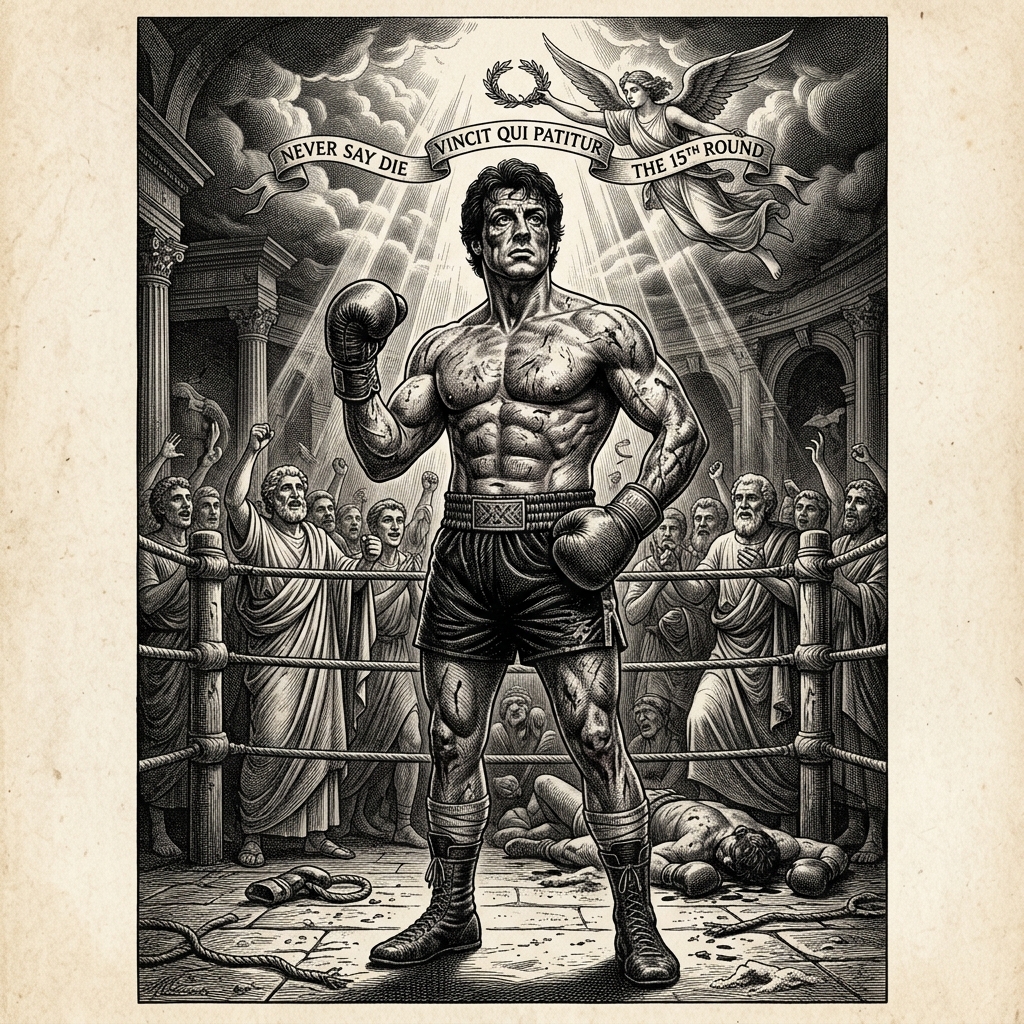
    Rocky Balboa’s “Never Say Die” Spirit: How to Maintain High Vibration During Life’s 15th Round

    Life has a funny way of throwing punches when you least expect them. You think you have everything under control, and then, suddenly, you’re backed into a corner, taking hits from all sides. In those moments, when you’re gasping for air and your legs feel like lead, what do you do? Do you throw in the towel, or do you keep fighting? This is the exact dilemma explored in the legendary rocky balboa movie franchise. The story of Rocky is not just about boxing; it’s a profound exploration of human endurance, a cinematic masterclass on how to maintain a high vibration even when you are bruised and battered in life’s metaphorical 15th round.

    I remember watching the first Rocky film years ago, completely mesmerized not by the fights, but by the undeniable spirit of a man who refused to stay down. The rocky balboa cast, led by the brilliant Sylvester Stallone—who played rocky balboa and wrote the script—delivered a performance that resonated on a deeply personal level. We often look at heroes and think they possess some supernatural strength, but Rocky was just an average guy from Philadelphia with an extraordinary amount of heart. He taught us that winning isn’t always about getting the championship belt; sometimes, it’s just about going the distance.

    The Anatomy of Resilience

    Resilience is the cornerstone of the human spirit. It is the invisible force that pulls us up from the canvas when every rational thought tells us to stay down. When we discuss the “Never Say Die” spirit, we are talking about an unwavering commitment to your own potential. It is about understanding that failure is not an endpoint, but a stepping stone. This mindset is crucial because life will inevitably challenge you. You will face professional setbacks, personal heartbreaks, and moments of profound self-doubt.

    In the context of the rocky balboa movie, we see this resilience manifested in every training montage, every grueling fight, and every quiet moment of reflection. It’s no wonder people often ask, “Is rocky balboa real?” or search for the “rocky balboa real person.” While the character is fictional, the rocky balboa real name in the context of inspiration draws from actual fighters like Chuck Wepner. However, the true “realness” of Rocky lies in the universal truth he represents: the capacity of the human spirit to endure.

    “It ain’t about how hard you hit. It’s about how hard you can get hit and keep moving forward.” – Rocky Balboa

    This is arguably one of the most famous rocky balboa quotes, and it encapsulates the essence of maintaining a high vibration. When you operate at a high frequency, you don’t ignore the pain; you acknowledge it, process it, and use it as fuel. You transform your suffering into strength. This is how you survive the 15th round.

    Development of Ideas: Inspiration and The Grind

    Where Does the Motivation Come From?

    To understand how to maintain this level of perseverance, we must look at what inspired the character. Stallone himself was an underdog, struggling to make ends meet, refusing to sell his script unless he could star in it. This real-life struggle bled into the character, making Rocky’s journey incredibly authentic. The film’s enduring legacy is evident in the famous rocky balboa statue in Philadelphia, a monument to the underdog in all of us.

    What I loved most about the franchise is its raw honesty. It doesn’t sugarcoat the pain. The elenco de rocky balboa brought to life flawed, beautiful characters who were simply trying to find their place in the world. Rocky’s relationship with Adrian, his bond with Mickey, and even his rivalry with Apollo Creed—these dynamics emphasize that we don’t fight alone. Our support system is critical for maintaining our vibration when our own energy is depleted. If you’re interested in how relationships shape our journey, you might enjoy exploring our thoughts on experience vs books, which delves into learning from life’s raw interactions.

    The Soundtrack of High Vibration

    You cannot talk about Rocky without mentioning the rocky balboa song repertoire. From “Gonna Fly Now” to “Eye of the Tiger,” the musica rocky balboa is the auditory equivalent of a shot of adrenaline. Music has a profound impact on our vibrational frequency. When you listen to a powerful anthem, your physiology changes; your heart rate increases, your posture straightens, and your mind sharpens. Creating your own “training montage” playlist is a practical way to artificially boost your vibration when you’re feeling low.

    What I liked least about some later iterations in the sports drama genre is the tendency to prioritize spectacle over substance. Rocky, at its core, was always about the internal struggle. The rocky balboa record of wins and losses (57 wins, 23 losses, 1 draw) is less important than his record of getting back up. He wasn’t undefeated; he was unyielding.

    Practical Examples: Applying the “Never Say Die” Mindset

    How do we take this cinematic inspiration and apply it to our daily lives? Here are some actionable strategies to help you maintain a high vibration during your own personal 15th round.

    Life SituationThe “Normal” ReactionThe “Rocky Balboa” Reaction
    Facing a major career setback (e.g., losing a job)Feeling defeated, complaining, lowering standards.Viewing it as an opportunity to pivot. Training harder, upskilling.
    Dealing with a personal loss or heartbreakIsolating oneself, dwelling on the past.Leaning on your “corner” (friends/family), channeling pain into personal growth.
    Experiencing a creative block or burnoutGiving up on the project entirely.Changing the routine. Going back to basics. Finding a new perspective.
    1. Focus on the Micro-Wins: When the overarching goal seems impossible, break it down. Just like taking a fight one round at a time, take your day one hour at a time. Celebrate the small victories—getting out of bed, finishing a difficult task, going for a run.
    2. Curate Your Input: Protect your energy. Surround yourself with positivity. Listen to your personal musica rocky balboa, read empowering rocky balboa quotes, and avoid toxic environments. For more on the power of curating your narrative, check out our piece on book vs movie adaptations.
    3. Embrace the Training Montage: Life’s preparation happens in the dark, away from the cheering crowds. Embrace the mundane, repetitive tasks that build your skills and resilience. The grind is where the high vibration is forged.
    4. Find Your “Adrian”: You need a reason to fight that goes beyond your own ego. Whether it’s your family, a passion project, or a desire to make a difference, connect with a purpose that anchors you when the storms hit.

    It’s important to remember that maintaining a high vibration doesn’t mean you are always happy. It means you are deeply aligned with your purpose and possess the emotional fortitude to navigate the lows without losing your core sense of self. It is the quiet confidence that whispers, “I will survive this,” even when everything around you is chaotic.

    FAQ: Unpacking the Legend

    1. Was Rocky Balboa based on a real person?

    While Rocky Balboa is a fictional character created by Sylvester Stallone, the inspiration for the story came from a real-life fight between Muhammad Ali and Chuck Wepner in 1975. Wepner, a heavy underdog, managed to knock Ali down and lasted 15 rounds before a technical knockout. So, when people ask if rocky balboa real person exists, Chuck Wepner is the closest answer.

    2. What is the most famous quote from the movies?

    Among the many inspiring rocky balboa quotes, the most iconic is arguably from Rocky Balboa (2006): “Let me tell you something you already know. The world ain’t all sunshine and rainbows. It’s a very mean and nasty place, and I don’t care how tough you are, it will beat you to your knees and keep you there permanently if you let it. You, me, or nobody is gonna hit as hard as life. But it ain’t about how hard you hit. It’s about how hard you can get hit and keep moving forward.”

    3. Where is the famous statue located?

    The iconic rocky balboa statue is located in Philadelphia, Pennsylvania. It originally stood at the top of the steps of the Philadelphia Museum of Art for the filming of Rocky III, but it was later moved to a grassy area adjacent to the bottom of the steps. It remains a major tourist attraction and a symbol of perseverance.

    4. Who were the key members of the cast?

    The primary rocky balboa cast (or elenco de rocky balboa) included Sylvester Stallone (who played rocky balboa), Talia Shire (Adrian), Burt Young (Paulie), Carl Weathers (Apollo Creed), and Burgess Meredith (Mickey Goldmill). Their incredible chemistry was essential in grounding the dramatic boxing sequences with deep, emotional stakes.

    Your Turn: Stepping Into the Ring

    In the end, the rocky balboa movie saga is a timeless reminder that our greatest opponent is often ourselves. Maintaining a high vibration during life’s 15th round requires a conscious decision to reject despair. It demands that we look our fears in the eye, acknowledge the pain of the blows we’ve taken, and choose to step forward anyway.

    We all have a 15th round waiting for us. It might be a health crisis, a financial ruin, or a devastating loss. When that moment comes, you won’t have a roaring crowd or an epic rocky balboa song playing in the background. You will only have the quiet, stubborn resilience you’ve built in the dark. It’s about building that rocky balboa record of spiritual victories, proving to yourself that you are unbreakable.

    So, the next time life hits you hard, remember the Italian Stallion. Remember that the pain is temporary, but the strength you forge in the fire of adversity is permanent. Embrace the struggle, protect your energy, and never, ever say die. Now, it’s time to ask yourself: What are you fighting for today, and are you willing to go the distance?

  • The Alchemy of Digital Reading

    The Alchemy of Digital Reading

    The Alchemy of Digital Reading: A Deep Dive into Google Play Books & Audiobooks Website

    The transition from the tactile rustle of parchment to the ethereal glow of the digital screen represents more than a mere technological shift; it is a fundamental transformation in how humanity interacts with the cumulative wisdom of the ages. In this digital Renaissance, the Google Play Books & Audiobooks website stands as a modern-day Library of Alexandria, accessible from the palm of one’s hand. It is not merely a commercial storefront but a sophisticated ecosystem designed to foster deep reading and intellectual growth in an increasingly fragmented world.

    For the modern seeker of knowledge, the challenge is no longer the scarcity of information, but the curation and digestion of it. As we explore the depths of this platform, we must recognize that the tools we use to read inevitably shape the thoughts we think. By leveraging the advanced features of Google’s digital library, we are not just consuming content; we are engaging in a process of intellectual alchemy, turning raw data into profound insight.

    The Digital Scroll: Evolution of Google Play Books

    The concept of the “book” has undergone several metamorphoses throughout history, from clay tablets and papyrus scrolls to the Gutenberg revolution. Today, the Google Play Books platform represents the latest stage in this evolution. It provides a seamless interface that bridges the gap between the traditional book and the limitless possibilities of the web. Unlike other closed ecosystems, Google’s approach has always leaned toward accessibility and integration, allowing users to not only purchase new titles but also to curate their own collections through the upload of personal EPUB and PDF files.

    This democratization of access is crucial. When we consider the sheer volume of public domain literature available for free, the platform becomes a gateway to the classical world. One can transition from a contemporary scientific treatise to a 17th-century philosophical text in seconds. This fluidity encourages a cross-disciplinary approach to learning, which is essential for developing a holistic understanding of complex global issues. For those looking to expand their digital horizons further, exploring z-library alternatives can provide additional pathways to obscure and academic texts.

    The Return of the Oral Tradition: The Rise of Audiobooks

    There is a profound irony in the fact that our most advanced technology has led us back to our oldest form of storytelling: the oral tradition. Long before the written word, knowledge was preserved through the rhythmic cadences of the storyteller. The Audiobooks feature on Google Play is a digital manifestation of this ancient practice. Listening to a book is not a “lesser” form of reading; rather, it engages different cognitive pathways, allowing the listener to absorb the emotional nuances and rhetorical flourishes that might be missed on the silent page.

    Intellectual giants like Homer and Socrates understood that the voice carries a weight of authority and presence. When we listen to an audiobook while navigating the physical world, we are performing a dual act of presence and reflection. The Google Play Books website optimizes this experience by allowing for variable playback speeds and seamless syncing between the audio and text versions of a book. This synergy ensures that the flow of ideas is never interrupted, whether one is sitting in a quiet study or commuting through a bustling city.

    Beyond the Page: Technical and Philosophical Features

    The true power of the Google Play Books ecosystem lies in its ability to transform reading from a passive activity into an active, scholarly pursuit. One of the most significant features is the ability to highlight and annotate text with ease. In the medieval tradition, “marginalia”—the notes written in the margins of manuscripts—were often as valuable as the text itself. In the digital age, Google Play Books allows us to create our own digital marginalia, which are automatically synced to Google Drive.

    This integration creates a “Noosphere” of personal knowledge—a term coined by the philosopher Pierre Teilhard de Chardin to describe the sphere of human thought. By having our highlights consolidated in a searchable document, we can synthesize information from dozens of different books into a single, coherent research project. This is the essence of deep reading: the ability to connect disparate ideas and forge new understandings.

    Practical Examples: Navigating the Digital Labyrinth

    To truly master the Google Play Books & Audiobooks website, one must move beyond basic navigation and embrace its more sophisticated tools. Here are several practical ways to optimize your intellectual journey:

    1. The Circadian-Friendly Library: Reading before sleep is a time-honored tradition, yet the blue light from screens can disrupt our biological rhythms. The “Night Light” feature on the Google Play Books app (and adjustable settings on the website) filters out these harsh frequencies, casting the digital page in a warm, amber glow. This allows for the pursuit of wisdom without sacrificing the restorative power of sleep.

    2. Curating a Unified Collection: Many readers possess vast libraries of PDFs and EPUBs from various sources. Rather than keeping these files scattered across multiple devices, one can upload them directly to the Google Play Books cloud. This creates a unified, private library that is accessible from any browser or mobile device, complete with synced progress and highlights across the entire collection.

    3. The Researcher’s Workflow: Imagine you are studying the impact of 19th-century industrialization on modern urban planning. You can open multiple tabs on the Google Play Books website, each containing a different primary source. As you find relevant passages, you highlight them in different colors (perhaps blue for economic data and yellow for social commentary). Within minutes, these highlights appear in a Google Doc, categorized and ready for citation.

    4. The Multimodal Learning Experience: For complex subjects, it is often helpful to both read and listen. By owning both the e-book and the audiobook, you can listen to a chapter during your morning exercise to get the “big picture,” and then sit down with the text in the evening to analyze the specific arguments and footnotes. This multimodal approach reinforces memory and deepens comprehension.

    FAQ

    Can I use Google Play Books offline?
    Yes. While the website is primary for management and online reading, the mobile applications allow you to download entire libraries for offline use. This ensures that your access to knowledge is not dependent on a constant internet connection, making it ideal for travel or deep retreats into nature.

    How do I sync my highlights to Google Drive?
    Within the settings of the Google Play Books app or website, you can enable “Save notes, highlights, and bookmarks in Google Drive.” This will create a specific folder in your Drive where every book you annotate gets its own dedicated document, automatically updated in real-time.

    Are audiobooks as effective for learning as reading?
    Research in cognitive science suggests that for most narrative and expository texts, comprehension levels are nearly identical between reading and listening. However, for dense technical data or poetry, the visual page may offer better opportunities for re-reading and structural analysis. The most effective learners often use both mediums.

    Can I upload my own PDF files to the platform?
    Absolutely. Google Play Books allows for the upload of up to 1,000 personal files (PDF or EPUB), each up to 100MB in size. These files are stored for free and benefit from the same cloud synchronization and reading features as books purchased directly from the store.

    References

    • Borges, J. L. (1941). The Library of Babel. A philosophical exploration of the infinite library.
    • Wolf, M. (2018). Reader, Come Home: The Reading Brain in a Digital World. An analysis of how digital screens affect our cognitive processes.
    • Teilhard de Chardin, P. (1955). The Phenomenon of Man. Origin of the “Noosphere” concept.
    • Google Play Help. (2026). Official Documentation for Google Play Books & Audiobooks.

    Conclusion

    In the silence of a focused mind, the Google Play Books & Audiobooks website becomes more than a tool; it becomes a sanctuary. In an era characterized by noise and superficiality, the ability to retreat into a digital library and engage with the greatest thinkers in history is a privilege we must not take for granted. By mastering these digital tools, we preserve the sanctity of the written word and ensure that the flame of human intellect continues to burn brightly in the digital age.

    As we navigate the vast oceans of information, let us remember that the goal is not merely to accumulate books, but to be transformed by them. Whether through the silent page or the spoken word, the journey toward wisdom remains the most noble pursuit of the human spirit. Read deeply, listen intently, and let the digital library be your guide in the quest for truth.

  • 6 Ideas about The Man in the Moone by Francis Godwin (1638)

    6 Ideas about The Man in the Moone by Francis Godwin (1638)

    The year 1638 marked a pivotal moment in the history of Western literature with the posthumous publication of Francis Godwin’s masterpiece, The Man in the Moone. Often cited as one of the earliest examples of proto-science fiction, this work bridges the gap between medieval fantasy and the emerging scientific rigor of the Enlightenment. Through the journey of its protagonist, Domingo Gonsales, Godwin explored concepts of gravity, extraterrestrial life, and the mechanics of space travel long before they became staples of the genre.

    In this article, we delve into six profound ideas presented in this seminal work, examining how Godwin’s imagination anticipated future scientific discoveries and influenced the trajectory of speculative fiction.

    1. The Early Concept of Gravity and Magnetism

    One of the most striking aspects of The Man in the Moone is Godwin’s attempt to explain the physical forces governing the universe. Writing in an era where the Aristotelian view of the world was being challenged by Copernican heliocentrism, Godwin introduced a concept similar to gravity, though he referred to it as a form of magnetic attraction.

    Gonsales observes that as he ascends further from the Earth, the “weight” of objects seems to diminish. Godwin posits that the Earth exerts a “secret property” that pulls things toward its center, a force that weakens as one moves away. This intellectual leap anticipated Newton’s Law of Universal Gravitation by several decades, showcasing Godwin’s engagement with the vanguard of 17th-century physics.

    Why It Matters

    By framing space travel as a physical challenge involving forces and distances rather than mere magic, Godwin laid the groundwork for scientific realism in literature. He recognized that leaving the Earth required overcoming a tangible physical barrier, a notion that remains central to aerospace engineering today.

    2. Biological Propulsion: The Gansas

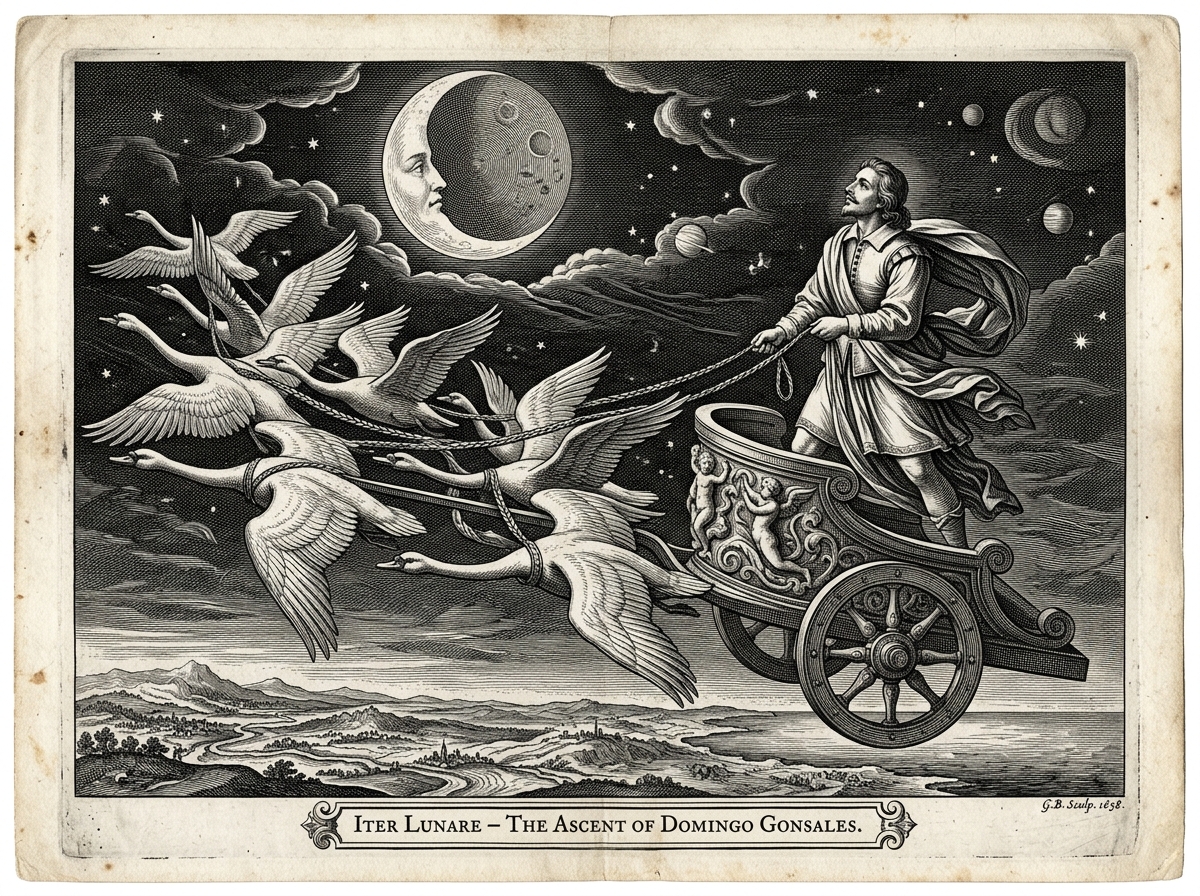
    Unlike later science fiction that relies on rockets or warp drives, Godwin’s protagonist reaches the moon using a chariot pulled by Gansas—a species of wild swans. While this may seem fantastical to modern readers, it represents a significant step in the evolution of speculative thought: biological propulsion.

    Godwin describes the Gansas with meticulous detail, noting their migration patterns and their innate ability to fly long distances. By choosing a biological rather than a supernatural means of transport, Godwin adhered to a logic internal to his world. This idea reflects a transition period where the boundaries between natural history and myth were still fluid.

    Practical Implications

    The use of Gansas highlights the 17th-century fascination with the natural world. It suggests that the keys to the heavens might be found in the observation of nature itself, echoing the themes found in Kepler’s Somnium, where the journey is also governed by a mix of natural and supernatural laws.

    3. Extraterrestrial Sociology and the Lunar Utopia

    Upon arriving on the Moon, Domingo Gonsales discovers a society of Lunar inhabitants (the Lunars) who are taller, more virtuous, and live in a state of near-perfection. Godwin uses this encounter to present a Lunar Utopia, contrasting the flaws of 17th-century European society with the idealized existence of the Moon-dwellers.

    The Lunars have no crime, no disease, and a language that is musical rather than spoken. This “Idea of a Utopia” allows Godwin to critique the political and social turmoils of his time. The Moon becomes a mirror through which humanity can observe its own shortcomings.

    4. The Musical Language of the Lunars

    One of the most innovative ideas in the book is the Musical Language of the Lunars. Godwin describes a communication system based on tones and musical intervals rather than phonetic sounds. This concept is remarkably sophisticated for its time, suggesting that advanced civilizations might communicate through abstract or non-verbal means.

    Godwin even provides a few examples of how this language works, showing his interest in linguistics and the potential for universal communication. This idea would later influence 20th-century science fiction, such as the musical communication in Close Encounters of the Third Kind.

    5. The Earth as a Celestial Body

    Before the advent of satellite photography, Godwin invited his readers to imagine the Earth from Space. As Gonsales travels toward the Moon, he looks back and sees the Earth as a rotating globe, displaying its continents and oceans.

    This perspective was revolutionary. It moved the Earth from being the fixed center of the universe to being just another celestial body among many. Godwin’s description of the Earth’s rotation helped popularize the Copernican theory among a general audience, using fiction as a vehicle for scientific education.

    6. The Synthesis of Faith and Science

    Despite its scientific leanings, The Man in the Moone is deeply rooted in theology. Francis Godwin was a Bishop, and his work reflects a worldview where the discovery of new worlds does not contradict the existence of God, but rather expands the majesty of His creation.

    Gonsales remains a devout Christian throughout his journey, seeing the wonders of the Moon as further evidence of divine craftsmanship. This synthesis of faith and science is a hallmark of the early modern period, where the pursuit of knowledge was often seen as a spiritual endeavor.

    Practical Examples: Applying Godwin’s Vision Today

    How can a 400-year-old book about swan-powered moon travel be relevant today? Here are a few ways Godwin’s ideas manifest in the modern world:

    • Iterative Thinking: Godwin didn’t have the math for gravity, but he had the intuition. In business and science, prototypical ideas often precede technical mastery.

    FAQ

    1. Is “The Man in the Moone” considered the first science fiction book?

    While many consider it one of the first, it shares this title with works like Lucian’s A True Story and Kepler’s Somnium. However, Godwin’s focus on physical mechanics makes it a primary candidate for proto-SF.

    2. How did Godwin explain the lack of air in space?

    Godwin did not yet understand the vacuum of space. He assumed the air simply became thinner and more “ethereal,” but still breathable for his protagonist and the Gansas.

    3. What was the impact of this book on later authors?

    It directly influenced Cyrano de Bergerac and Jonathan Swift (Gulliver’s Travels), cementing the “voyage to the moon” as a major literary trope.

    4. Why did Francis Godwin publish it anonymously?

    As a Bishop of the Church of England, publishing a work of “fantastical fiction” could have been seen as unbecoming or controversial, though it was published posthumously under a pseudonym.

    References

    • Godwin, Francis. The Man in the Moone: or A Discourse of a Voyage thither by Domingo Gonsales. 1638.
    • Poole, William. Introduction to The Man in the Moone. Broadview Editions.
    • Vertesi, Janet. Light and Color in Francis Godwin’s The Man in the Moone.

    Conclusion

    Francis Godwin’s The Man in the Moone remains a testament to the power of the human imagination. By daring to look beyond the horizon of his own era, Godwin created a work that continues to resonate with anyone who looks at the stars and wonders “what if?” Whether through the lens of gravity, utopian sociology, or interplanetary travel, his six ideas provide a fascinating window into the birth of the modern scientific mind.

    Exploring these early visions helps us appreciate how far we have come—and reminds us that the next great leap in human knowledge may already be hiding in the pages of a speculative story.

  • 6 Ideas About Somnium by Johannes Kepler

    6 Ideas About Somnium by Johannes Kepler

    A Dream That Changed the Stars

    Johannes Kepler’s *Somnium* (The Dream), published in 1634, is often hailed as history’s very first work of science fiction. It completely blew my mind.

    While reading it, I couldn’t help but notice how a 17th-century astronomer used a fantastical dream to explain complex science. He bypassed the strict censorship of his era.

    He didn’t just write a dry academic paper. Instead, he painted a lunar landscape filled with demons and cosmic physics.

    It is a profound lesson on how to teach, how to persuade, and how to survive in a society terrified of new truths. Here is how I applied these 6 ideas to my life.

    1. The Immense Power of Perspective

    The entire plot hinges on a brilliant thought experiment: viewing the Earth from the Moon.

    Kepler knew people couldn’t believe the Earth moved because they didn’t feel it moving under their feet.

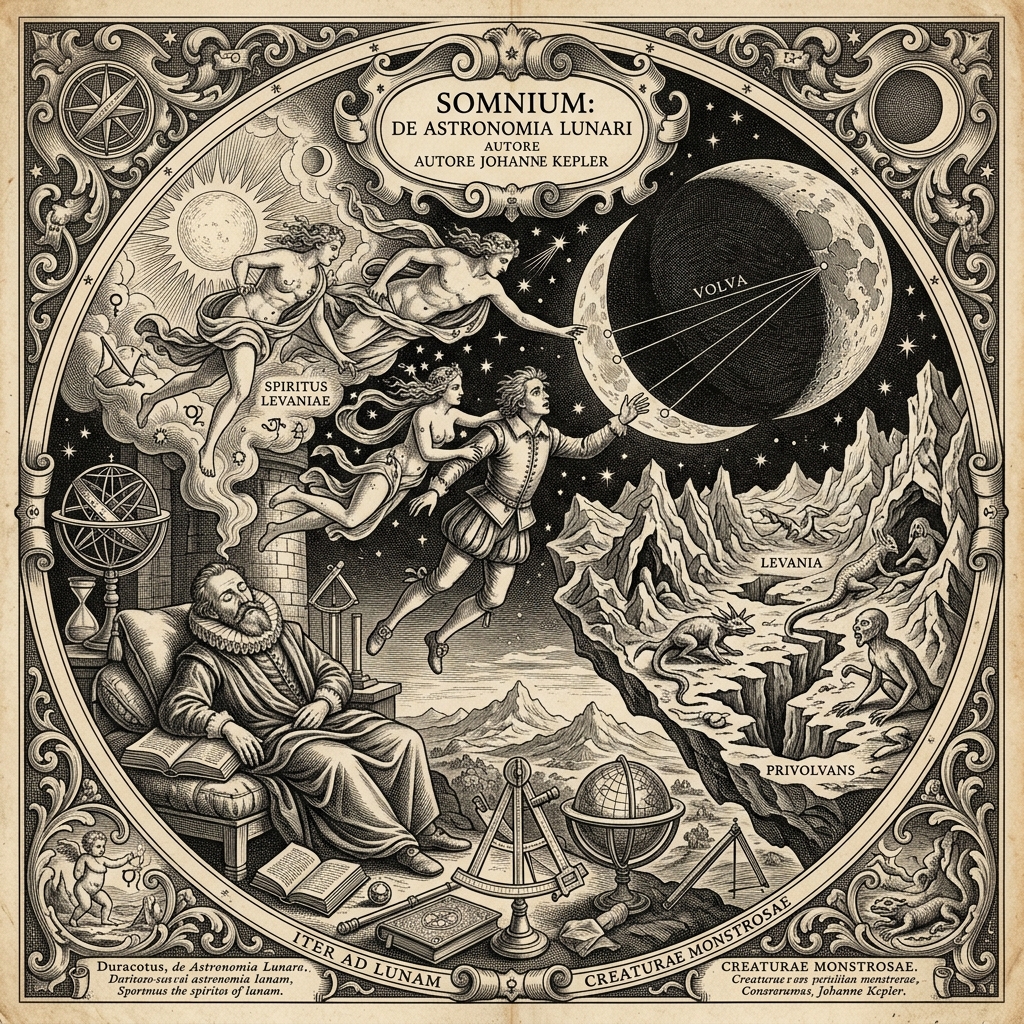
    • By shifting the perspective to the Moon (Levania), he showed that our “truth” depends entirely on where we are standing.
    • This is the ultimate power of perspective.

    In my own life, when stuck in a bitter conflict or a stalled project, I try to “stand on the Moon.”

    Looking at my own rigid opinions from an outsider’s viewpoint often shrinks the problem. We must learn to step outside our own gravity to see the whole system.

    2. Using Fiction to Shield the Truth

    Kepler lived during the dangerous years of the Scientific Revolution.

    Openly promoting the Copernican heliocentric model, which stated that the sun was at the center, could lead to severe punishment.

    So, what did he do? He disguised his dangerous astronomical facts inside a bizarre tale involving witches and spirits.

    • **The lesson:** Sometimes, the direct approach is suicidal.
    • **The application:** When dealing with defensive colleagues or rigid bosses, I use storytelling instead of direct confrontation.

    Wrapping constructive criticism in a hypothetical scenario or an allegory makes the truth digestible instead of offensive.

    3. Ignorance as the Enemy of Progress

    There is a striking quote in the book that resonated deeply with my modern anxieties.

    Kepler writes: *”So long as the mother, Ignorance, lives, it is not safe for Science, the offspring, to divulge the hidden causes of things.”*

    He recognized that society attacks what it does not understand out of pure fear.

    I see this daily with new technologies like AI. People often panic instead of trying to understand the mechanics behind the perceived magic.

    To implement this idea, I actively choose to educate myself on the things that scare me most. Ignorance is comfortable, but it is deeply unsafe for our growth.

    4. Experience is the Mother of Science

    The narrative strongly emphasizes that “empirical practice” and experience are the true parents of understanding.

    Kepler wasn’t just relying on ancient texts; he was demanding actual observation.

    • We can’t learn just by reading theory in our comfortable armchairs.
    • We must go out and test our assumptions in the real, messy world.

    When I started my first business, I read dozens of books about strategy. None of them mattered until I actually tried selling something and failed.

    That raw, untutored experience taught me more in a week than a year of theoretical studying. Kepler was absolutely right.

    5. Imagining Life in Unfamiliar Environments

    In *Somnium*, Kepler doesn’t just put humans on the moon.

    He imagines bizarre, adaptable creatures that can survive extreme temperature swings and brutal 14-day nights.

    He didn’t center the universe on human biology, which was a radical thought for 1634.

    This taught me a vital lesson in empathy and biological diversity.

    When designing tools or creating content, we cannot assume everyone operates in the same emotional or physical “climate” as we do. We must foresee the extremes.

    6. The Necessity of Proof

    Perhaps the most fascinating part of *Somnium* isn’t the story itself, but the footnotes.

    Kepler wrote 223 detailed footnotes. They are actually longer than the entire narrative!

    He used them to rigorously prove the physics and math behind his fantastical story.

    • He knew that crazy ideas require exceptional documentation.
    • He backed his wild imagination with cold, hard geometry.

    In my professional life, this is my biggest takeaway.

    You can pitch the wildest marketing campaign or the most disruptive software architecture, but you must bring the footnotes. You must do the math to back up the dream.

    Your Turn: Will You Step Onto the Moon?

    Kepler’s *Somnium* is a strange, challenging, and profoundly insightful text. It is a testament to the courage of a man who used a dream to wake up the world.

    By shifting our perspective, valuing raw experience, and backing our wild ideas with solid proof, we can navigate our own challenges just as Kepler navigated the perilous early days of the Scientific Revolution.

    If you enjoy reading about how classic science fiction can change your mindset, make sure to browse our other reviews on iconic literature.

    Will you dare to look at your life from the Moon? Grab a copy of this short masterpiece and let it shift your mind forever.

  • How to Do a Google Books Download

    How to Do a Google Books Download

    How to Do a Google Books Download: The Definitive Guide

    Are you an avid reader who discovered a priceless gem in Google’s massive library, but you want to know how to perform a google books download to read offline, on your favorite device, or transfer it to an e-reader? Whether you are a student looking for research materials, a professional seeking technical manuals, or simply a literature lover, this step-by-step tutorial guide is for you.

    Here, we will unveil all the secrets to accessing, saving, and managing your digital library. We cover everything from official methods to the most discussed tools on the web to ensure you know exactly how to do a secure and google books download free.


    1. What is Google Books and How Does It Work?

    Google Books is one of the largest and most comprehensive book indexes in the world. It allows users to search the full text of books that Google has scanned. Depending on copyright and publisher permissions, you can see a snippet, a google books download preview, or the entire book.

    Many of these books are available in the public domain, which allows you to do a google free books download entirely legally. For other modern works, you can purchase them or download free samples through Google Play Books.


    2. Official Methods: Google Play Books Download

    The safest and most recommended way to read your books offline is through the official Google Play Books applications. It’s incredibly simple to read on your smartphone, tablet, or computer.

    On Mobile Devices (Android and iOS)

    If you use a smartphone, the first step is getting the app.

    For Android users, the most common search is for google play books download app. You can go straight to the Google Play Store and install the application for free. If Google Play is inaccessible, some users look for google play books download apk on trusted APK mirror sites.

    For Apple users, simply search for the same app in the App Store.

    Once the app is installed (working as a native google books downloader for android), the process is simple:

    • Open the “Google Play Books” app.

    On Computers (PC and Mac)

    For desktop readers looking for google play books download for pc, Google does not offer an exclusive native app for Windows or Mac in the same way it does for mobile phones. However, the official method to read offline on a PC involves using the Google Play Books extension for the Google Chrome browser.

    • Go to the Chrome Web Store and download the Google Play Books extension.

    But what happens if you want the actual file (EPUB or PDF) to transfer to a third-party e-reader, like a Kobo or Nook? Keep reading.


    3. Downloading Files: EPUB and PDF

    The e-book format is crucial in determining which device you will read on. Most readers prefer EPUB for flexible screens and PDF for fixed-layout documents.

    Downloading Free and Public Domain Books

    Many users tirelessly search for google books download free. Google makes this very easy for public domain books. If the book is free and free of copyrights:

    • Go to the book’s page on Google Books.

    Exporting from Google Play Books

    When you buy a book or acquire a free book from the official store, you might need to export the file to read it outside the Google ecosystem. Many search for terms like google play books download pdf free or google play books download pdf. The path for this is:

    • Go to the Google Play Books website on your computer.

    Important Note: Most copyrighted books downloaded this way are encrypted with Adobe DRM. This means you will not download a classic PDF directly, but rather an `.acsm` file. You will need the free program *Adobe Digital Editions* installed on your PC to open this `.acsm` file and download the actual PDF or EPUB.


    4. Third-Party Tools and Download Accelerators

    The internet is full of independent developers who have created alternative tools to bypass some format limitations, especially when users want to extract previews or free viewing pages. This is where the famous google books downloader software comes in.

    What is a Google Books Downloader?

    A google books downloader is a third-party software that connects to the Google Books interface and attempts to save the available pages as image files, which are then compiled into a single PDF or ebook format.

    There are countless versions of this tool on the web. Some people look for open-source or command-line code by searching for google books downloader github, aimed primarily at technical users and programmers who want to manage download scripts.

    Online Extensions and Tools

    Besides installable apps, there is a huge demand for cloud-based tools that eliminate the need to install local software. People search using terms like:

    • google books downloader online
    • google books downloader online free
    • google books downloader online pdf
    • google books downloader online pdf free download
    • google books download online free

    These sites promise to facilitate downloads simply by entering the URL or book ID. However, a security warning is essential. Using an online downloader service for copyrighted material violates Google’s terms of service. Also, the reliability of these sites varies. By using them, the process is generally known as google books download by link, where you copy the address bar link and paste it into the third-party tool.

    The Book Previews Issue

    A very common search is about the google books download preview. Often, a student or researcher only needs a specific chapter whose pages are visible in Google’s “Restricted Preview”. Third-party downloaders frequently target these pages displayed in the browser. However, we highlight the technical and ethical limitations of this practice.


    5. The Role of Reader Communities (And Reddit)

    If you have explored tech and help forums, you know that communities offer tricks, scripts, and incredibly rich discussions. Seeking the term google books download reddit shows how much people turn to sites like Reddit (in forums like r/Piracy, r/DataHoarder, and ebook communities) to discover the latest and safest tools.


    6. Where Are Your Books Stored?

    A frustrating and technical question that affects many users—particularly on Android—is: where do google books download to?

    The answer depends on the method used:

    • On PC via manual download (Export): The `.acsm`, PDF, or EPUB file goes straight to your default “Downloads” folder.
    • On the Android App: When you mark a book for offline reading within the official app, the book data is secretly stored in a hidden partition (in the `/data/data/…` folder) on the phone’s internal memory due to DRM security. These files are not visible as loose PDFs.

    7. Powerful Integration: Google Drive

    Many people think of their Google ecosystem globally and assume a direct link between Google Books and Google Drive, searching for google drive pdf books download or google drive free books download.

    The truth is exactly that: Google Play Books offers exceptional integration with Google Drive. You can upload PDFs or EPUBs stored on your phone or Google Drive directly to your Google Play Books!

    Simply upload PDF files so you can read them from anywhere via the web, saving your place with total synchronization.

    If you want to download a PDF you already stored, the unified cloud (your Google Drive) acts as your digital bookstore powering the books app, creating your own unlimited google books download ecosystem.


    Mastering Digital Reading

    By downloading literary works via EPUB formats without DRM, or going directly for the google books download free alternatives safely, we wish you an incredible literary journey! Always remember to support the authors and creators whose works you enjoy.

  • The 10 Most Inspirational Quotes from Studio Ghibli Movies

    The 10 Most Inspirational Quotes from Studio Ghibli Movies

    The 10 Most Inspirational Quotes from Studio Ghibli Movies: A Life Tutorial

    Whether you’re a longtime fan or a newcomer to the wonderful universe created by Hayao Miyazaki and Isao Takahata, the emotional impact of these works is undeniable. Studio Ghibli films aren’t just stunning animations; they’re true life lessons disguised in pastel colors and orchestrated soundtracks. In this list format tutorial, we’ll dive deep and explore how these masterpieces can teach us to live better, face our biggest challenges, and find beauty in the little things of everyday life.

    We all go through moments of uncertainty, fear, or exhaustion. Modern life can be chaotic and unforgiving. Often, we lose our sense of direction or forget to appreciate the journey. Daily stress, the pressure to be productive all the time, and the weight of others’ expectations can overwhelm us. This is where we need a break. This is where we need to find an internal compass that redirects us to what truly matters: simplicity, courage, and the capacity to love. How can we rescue our hope when everything seems dark? The answer might lie in the words of our favorite anime characters and movies.

    Below, we present 10 profound teachings through Studio Ghibli quotes that act as true pills of wisdom.

    1. The Courage to Believe in Yourself (The Cat Returns)

    Problem: A lack of self-confidence stops us from acting.

    Solution and Example:

    “Always believe in yourself. Do this and no matter where you are, you will have nothing to fear.”

    Whenever you’re hesitant about a new journey, be it a job interview or a personal project, remember this quote. The first step to achieving what you want isn’t external support, but the firm internal conviction that you are capable and valuable.

    2. Resilience in the Face of Pain (Princess Mononoke)

    Problem: It’s easy to give up when life becomes difficult and unfair.

    Solution and Example:

    “Life is suffering. It is hard. The world is cursed. But still, you find reasons to keep on living.”

    The world isn’t always a kind place. Accepting the duality of life, that sadness and joy walk side by side, is fundamental. On a day of grief or frustration, see this quote as a reminder that, even amidst the ashes, we can always find a spark of beauty to keep moving forward.

    3. The Search for Your Own Calling (Kiki’s Delivery Service)

    Problem: Creative block and a feeling of stagnation.

    Solution and Example:

    “We each need to find our own inspiration. Sometimes it’s not easy.”

    If you feel lost in your career or have lost enthusiasm for your hobbies, apply this philosophy. Inspiration isn’t something that just falls from the sky; it’s a process of rediscovery and continuous experimentation. Change your routine, explore new environments, and allow yourself not to know all the answers while you search for your own magic.

    4. The Value and Permanence of Connections (Spirited Away)

    Problem: The pain of loss or separation from someone important.

    Solution and Example:

    “Once you’ve met someone you never really forget them. It just takes a while for your memories to return.”

    Relationships change and people drift apart, but the impact they leave on our essence is eternal. When you miss someone from the past, remember that nothing genuinely lived is ever lost. The love and shared lessons permanently shape who we are.

    5. Our Connection with Nature (Castle in the Sky)

    Problem: Alienation and disconnection in a world of screens and technology.

    Solution and Example:

    “The Earth speaks to all of us, and if we listen, we can understand.”

    Constant burnout is often a symptom of an isolated city life. The practical solution here is to stop, observe, and listen. Try spending 15 minutes in a park without your phone, putting your feet on the grass, or watching the clouds. This reconnection is vital for our mental balance and physical well-being.

    6. The Beauty of Daily Uncertainty (The Secret World of Arrietty)

    Problem: Boredom and anxiety about an unknown future.

    Solution and Example:

    “It’s funny how you wake up each day and never really know if it’ll be one that will change your life forever.”

    We tend to try to control every variable of our daily lives. Instead, see the unexpected as a gift. Wake up not with fear, but with the anticipation that unexpected opportunities are silently waiting around the next corner.

    7. Finding Strength in Adversity (Howl’s Moving Castle)

    Problem: Feeling buried under unfavorable circumstances.

    Solution and Example:

    “They say that the best blaze burns brightest when circumstances are at their worst.”

    Just as Calcifer demonstrated, your true power isn’t revealed when the waters are calm, but during the storm. View professional crises or emotional breakups not as punishments, but as the essential firewood that will make your own internal fire burn at its brightest.

    8. Joy As a Weapon Against Fear (My Neighbor Totoro)

    Problem: Paralysis in the face of chronic fear.

    Solution and Example:

    “Try laughing. Then whatever scares you will go away.”

    There is science behind this quote: laughter signals safety to the brain. If the fear of failing at your new business or project is holding you back, find the humor in the situation. This joy pushes away the oppressive weight of fear.

    9. Acting Independently of Fate (Princess Mononoke)

    Problem: Fatalism and a feeling of powerlessness regarding events.

    Solution and Example:

    “You cannot alter your fate. However, you can rise to meet it.”

    Not everything is in our control. Unexpected losses happen. Ashitaka’s lesson is pragmatic: don’t mourn because you can’t change the inevitable event; focus all your energy on the proactivity with which you will respond to it.

    10. The Relentless Need for Love (Castle in the Sky)

    Problem: Mistakenly believing that status and power solve existential voids.

    Solution and Example:

    “No matter how many weapons you have, no matter how great your technology might be, the world cannot live without love.”

    In a world guided by unrealistic metrics and financial achievements, pride doesn’t fill our hearts. The greatest lesson from Studio Ghibli and the ultimate solution of our list format tutorial is simple and profound: evaluate your actions through the impact of compassion, not force. Cultivate your relationships.

    FAQ: Most Frequently Asked Questions About Studio Ghibli

    1. What is the main message of Studio Ghibli anime movies?

    The messages vary, but there are deeply recurring central themes such as absolute respect for nature, pacifism, the empowerment of strong characters, duality, and the magic found in humble, everyday life.

    2. What was the first movie made by Ghibli?

    The studio was founded after the success of *Nausicaä of the Valley of the Wind* (1984). The first feature film under the Studio Ghibli name was the classic *Castle in the Sky* in 1986.

    3. Where can I watch these wonderful animations today?

    Currently, most of the studio’s film catalog is available on major streaming platforms like Netflix and Max, depending on your region.

    4. Are Ghibli stories only for children?

    Definitely not! Miyazaki creates multi-layered films. Young people enjoy the visual wonder, while adults grasp complex social critiques and deep emotional undertones.

    5. Why does the food in the studio’s anime always look so delicious?

    Drawing food in immense detail creates a nostalgic connection, grounding magical settings in palpable feelings and comforting human warmth.

    6. Is Hayao Miyazaki still producing films?

    Yes, his stunning work *The Boy and the Heron* proves that his artistic touch still enchants audiences and claims major awards around the world.

    Is it worth diving into these lessons? Find out how to apply them today.

    Knowing how to appreciate the subtle charm of life is a rare art. This article listing the inspirational works of Studio Ghibli reveals something vital. Watching these nostalgic fables isn’t a simple passive act, but often an immersive healing process. In a grey contemporary world, daily resilience and courage are fundamental.

    Instead, face the difficulties of our existence by echoing the strength of Chihiro or Kiki to fortify your soul for hard days. Connect these memorable reflections to your battles today. After all, your own unexplored journey desperately needs your unwavering strength to fully bloom.

  • Don Corleone’s Management Style

    Don Corleone’s Management Style

    Don Corleone’s Management Style: Loyalty, Family, and Business

    If you strip away the organized crime, the violence, and the illegal rackets from Mario Puzo’s [The Godfather](https://en.wikipedia.org/wiki/The_Godfather_(novel)) what you are left with is one of the greatest textbooks on corporate management ever written.

    I recently decided to reread the novel and rewatch the films through the lens of a startup founder. I was blown away by Vito Corleone’s deep, psychological understanding of how to build and maintain a resilient organization. The stakes in his business aren’t quarterly profits; they are life and death. Because of that extreme pressure, his management tactics are stripped of all corporate fluff.

    Here are the most powerful leadership lessons I learned from Don Corleone’s management style, and how I actively try to apply them to my own career today.


    What I Learned About Sincere vs. Transactional Loyalty

    Modern companies try to buy loyalty with ping-pong tables, Friday pizza, and stock options. But the moment a competitor offers a 15% raise, those employees leave. That is transactional loyalty.

    Vito Corleone builds indebted loyalty. In the brilliant opening scene, the undertaker Bonasera tries to pay the Don to hurt the men who assaulted his daughter. Vito refuses the cash. By refusing the money, Vito upgrades the interaction from a cheap transaction to a massive, lifelong favor built on “friendship.” He solves his follower’s most terrifying personal problems, securing an allegiance that outlasts money.

    The Importance of the Inner Circle

    I also learned that trust scales far better than competence. When building his executive team, Vito doesn’t just hire the smartest people. He elevates Tom Hagen, his adopted, non-Italian son, to Consigliere (chief advisor) purely because Hagen’s loyalty is absolute and unquestionable. A brilliant but selfish employee will destroy a company from within. A slightly less talented but fiercely loyal operator is infinitely more valuable.

    Protecting the Core Business Model

    The entire war in The Godfather begins because Vito refuses to enter the highly lucrative drug trade proposed by Sollozzo. Vito argues that his current businesses (gambling and unions) are tolerated by his political allies, while drugs would draw federal heat and destroy his core infrastructure. He had the immense discipline to say “no” to massive, immediate revenue because he recognized it was fundamentally toxic to the long-term survival of his empire.


    How I Apply the Corleone Playbook Today

    1. Investing in Personal Loyalty, Not Just Perks

    I stopped looking at professional relationships as purely transactional. When someone I work with is going through a personal crisis, a health issue, or a career slump, I try to step in and help with zero expectation of an immediate return. When you help someone when they have absolutely nothing to offer you, you build an unbreakable foundation. True networking isn’t handing out business cards; it’s solving hard problems for people when they are vulnerable.

    2. Rejecting “Toxic Revenue”

    In my own projects, I am constantly tempted by fast money, taking on a bad client who pays well, or pivoting a product to chase a desperate trend. Remembering Vito’s refusal of the Sollozzo deal serves as my anchor. I now audit every new opportunity by asking: “Does the short-term profit of this deal threaten the long-term integrity of my core business?” If the answer is yes, I walk away.

    3. Separating Ego from Strategy

    When Vito is nearly assassinated, his first move upon waking up is not blind, raging revenge. He makes a temporary, painful peace with his enemies to buy time to bring his son Michael home safely. He swallowed his pride for the survival of the organization.

    I actively practice this. When I receive a harsh critique or someone attempts to undercut me professionally, I force myself to detach my ego. Revenge is expensive. Strategy is profitable. If a decision feels emotionally satisfying, it is probably a bad business move. 


    Conclusion

    We shouldn’t emulate the violence of the Corleone family, but ignoring their organizational genius is a mistake. Don Corleone proves that a successful empire is built on fiercely protected relationships, strict emotional discipline, and the foresight to plan for the future.

    The next time you are evaluating your team, your vendors, or your own leadership style, ask yourself: are you building transactional contracts, or are you building a family?

    Summary

    Don Corleone’s approach to management highlights the critical difference between transactional employees and a universally loyal team. By solving genuine problems for your network, rejecting toxic “fast money,” and prioritizing absolute trust over raw talent, you can build a resilient, long-lasting career and enterprise.

  • Silence as Power

    Silence as Power

    Silence as Power: Leadership Lessons from The Godfather

    I recently rewatched Francis Ford Coppola’s [The Godfather](https://en.wikipedia.org/wiki/The_Godfather), and something struck me that I completely missed when I originally saw it as a teenager.

    When you are young, you watch mafia movies for the shootouts, the tension, and the bravado. But watching it now as a professional navigating corporate environments, I realized the movie isn’t really about crime. It is a masterclass in behavioral psychology. And the most powerful tool demonstrated by Vito and Michael Corleone isn’t a gun. It is silence.

    Here is what I learned about the strategic use of silence from the Corleone family, and exactly how I have started applying it to my own life.


    What I Learned About the Economy of Words

    In modern corporate culture, we are taught to “hustle.” We are told to dominate the room, pitch aggressively, interrupt, and constantly “add value” to meetings by talking. But if you observe the power dynamic in The Godfather, the most powerful characters speak the least.

    Look at Sonny Corleone. He is volatile, loud, and constantly broadcasting his thoughts. His inability to stay quiet gets him killed. Vito Corleone, by contrast, treats words like a finite, highly valuable currency. He barely whispers. He limits his gestures. When you speak rarely, people are conditioned to lean in and listen closely when you finally do.

    The Vacuum Effect

    The most fascinating negotiation tactic I learned from the film is the ‘uncomfortable pause’. When Vito is presented with a threat or an offer, he doesn’t react immediately. He just stares.

    Human beings absolutely hate conversational vacuums. We feel a deep, anxious need to fill the silence. What I noticed is that when Vito stays quiet, his opponents get nervous. They start talking to fill the void, and in doing so, they negotiate against themselves. They reveal their true anxieties or offer concessions Vito never even asked for.


    How I Apply the “Corleone Silence” in My Life

    I used to be the person who jumped into every pause in a meeting. If silence fell, I scrambled to say something smart. After studying the Corleones, I forced myself to implement a new operating system for communication.

    1. The Three-Second Rule in Meetings

    When someone finishes making a point or pitching an idea to me, I now actively count to three in my head before I respond. I don’t nod enthusiastically; I just maintain eye contact.

    The results have been staggering. Usually, by the time I hit “two,” the other person starts talking again. “Well, the price is $500… but we could probably do $450 if you sign today.” I have literally saved money and gained leverage simply by keeping my mouth shut.

    2. Emotional Flatlining in Conflict

    Sonny lost his life because he let his rage become public. Whenever I receive a frustrating email or someone challenges a project aggressively, my instinct is to fire off a defensive reply immediately. Instead, I channel the stoic silence of Michael Corleone at the climax of the film.

    I draft the angry reply, and then I delete it. I let 24 hours of total silence pass. The absence of my reaction usually terrifies the antagonistic party more than any yelling could. It forces them to wonder what my strategy is, giving me total control of the pacing.

    3. Listening for the “Unsaid”

    Vito Corleone was a master at listening. When Sollozzo pitched him the drug business, Vito wasn’t arguing the margins; he was listening to the subtext. He realized Sollozzo desperately needed the politician connections he lacked.

    I now go into business meetings with the goal of talking 20% of the time and listening 80% of the time. I actively try to decipher the subtext of the conversation, what the client is terrified to admit, or the budget constraint they are trying to hide.


    Conclusion

    You don’t need to be a mafia boss to wield the tactical power of silence. The next time you are in a high-stakes negotiation, a job interview, or even a tense family argument, resist the urge to dominate with volume.

    Drop your ego. Let the silence hang in the air. Watch how the room shifts to orbit around your gravity.

    Summary

    The Godfather proves that the most powerful person in the room is rarely the loudest. By using tactical silence, the “Three-Second Rule”, and emotional restraint, you can force opponents to reveal their hands, maintain leverage in negotiations, and project absolute authority without raising your voice.

    Explore More:

  • 6 Ideas About ‘The Age of the Pussyfoot’

    6 Ideas About ‘The Age of the Pussyfoot’

    6 Ideas About ‘The Age of the Pussyfoot’: A Retro-Futurist Warning

    Author: Frederik Pohl
    Category: Classic Science Fiction, Social Satire
    My Rating: 4/5

    I stumbled upon [The Age of the Pussyfoot] while looking for retro-futurism, and I was astounded. Written in 1969, Frederik Pohl basically wrote a satirical review of the year 2026.

    The story follows Charles Forrester, a 20th-century man revived from a cryogenic freeze 500 years later. He wakes up rich due to compound interest, but finds a world entirely dependent on automation, surveillance, and invisible debt. It is a brilliant sociological critique. Here are my raw booknotes and the 6 main ideas from the text.


    6 Key Ideas from The Age of the Pussyfoot

    1. The Joymaker: Predicting the Smartphone

    Pohl invented the “Joymaker,” a portable computing scepter that every citizen carries. Sound familiar? It talks to the user, gives medical advice, handles money, and acts as an encyclopedia. Pohl predicted our complete cognitive outsourcing to mobile devices nearly forty years before the iPhone launched.

    2. The Threat of Invisible Money

    When Forrester wakes up, cash is gone. Everything is paid automatically via the Joymaker. The problem? Every single interaction, even asking the computer a question, costs money. Because transactions are frictionless, Forrester quickly goes bankrupt without realizing it. It’s a perfect metaphor for the silent drain of microtransactions and subscription fatigue today.

    3. Safety Breeds Apathy (The Pussyfoot Mentality)

    The title refers to a society so heavily insulated from harm that it has become weak and apathetic. Medicine can cure anything, even death (if you have the money to be revived). Because of this, violence is treated casually. By erasing the struggle of survival, humanity lost its fundamental sense of meaning.

    4. Surveillance Disguised as Convenience

    The Joymaker is incredibly helpful, but to be helpful, it monitors everything, heart rate, location, conversations, and consumer habits. Pohl recognized the grand bargain of the digital age: we will happily surrender our deepest privacy if it saves us a trip to the store or makes life slightly more convenient.

    5. Cryonics as a Status Symbol

    In the novel, freezing yourself into the future is normal, creating a massive cultural dissonance. However, only the wealthy can afford to be revived and maintained. Pohl uses this to show how technology often exacerbates class divides, turning even mortality into a luxury good.

    6. The Alienation of the Modern Man

    Despite having his every whim catered to, Forrester is miserable. He is profoundly lonely in a crowd of genetically perfect, immortal beings. Pohl argues that technological utopias often fail because they optimize for comfort rather than genuine human connection.


    How I Apply This Book

    The concept of the “Pussyfoot” made me audit how much friction I was removing from my life. We use apps for food, dating, and transport to avoid mild discomfort. But that friction is often where real growth happens.

    After finishing this book, I started deliberately setting boundaries with my “Joymaker” (my smartphone). I stopped using my phone during the first hour of the day to reclaim my cognitive independence.

    Summary

    A brilliant, darkly comedic warning from 1969 that maps out the psychological traps of the information age. It is a fantastic reminder that convenience is rarely free, and that friction is necessary for human happiness.