Category: Booknotes

Explore comprehensive booknotes and chapter summaries. Get the core ideas, profound themes, and key takeaways from the world’s most influential books.

  • 6 Ideas about The Man in the Moone by Francis Godwin (1638)

    6 Ideas about The Man in the Moone by Francis Godwin (1638)

    The year 1638 marked a pivotal moment in the history of Western literature with the posthumous publication of Francis Godwin’s masterpiece, The Man in the Moone. Often cited as one of the earliest examples of proto-science fiction, this work bridges the gap between medieval fantasy and the emerging scientific rigor of the Enlightenment. Through the journey of its protagonist, Domingo Gonsales, Godwin explored concepts of gravity, extraterrestrial life, and the mechanics of space travel long before they became staples of the genre.

    In this article, we delve into six profound ideas presented in this seminal work, examining how Godwin’s imagination anticipated future scientific discoveries and influenced the trajectory of speculative fiction.

    1. The Early Concept of Gravity and Magnetism

    One of the most striking aspects of The Man in the Moone is Godwin’s attempt to explain the physical forces governing the universe. Writing in an era where the Aristotelian view of the world was being challenged by Copernican heliocentrism, Godwin introduced a concept similar to gravity, though he referred to it as a form of magnetic attraction.

    Gonsales observes that as he ascends further from the Earth, the “weight” of objects seems to diminish. Godwin posits that the Earth exerts a “secret property” that pulls things toward its center, a force that weakens as one moves away. This intellectual leap anticipated Newton’s Law of Universal Gravitation by several decades, showcasing Godwin’s engagement with the vanguard of 17th-century physics.

    Why It Matters

    By framing space travel as a physical challenge involving forces and distances rather than mere magic, Godwin laid the groundwork for scientific realism in literature. He recognized that leaving the Earth required overcoming a tangible physical barrier, a notion that remains central to aerospace engineering today.

    2. Biological Propulsion: The Gansas

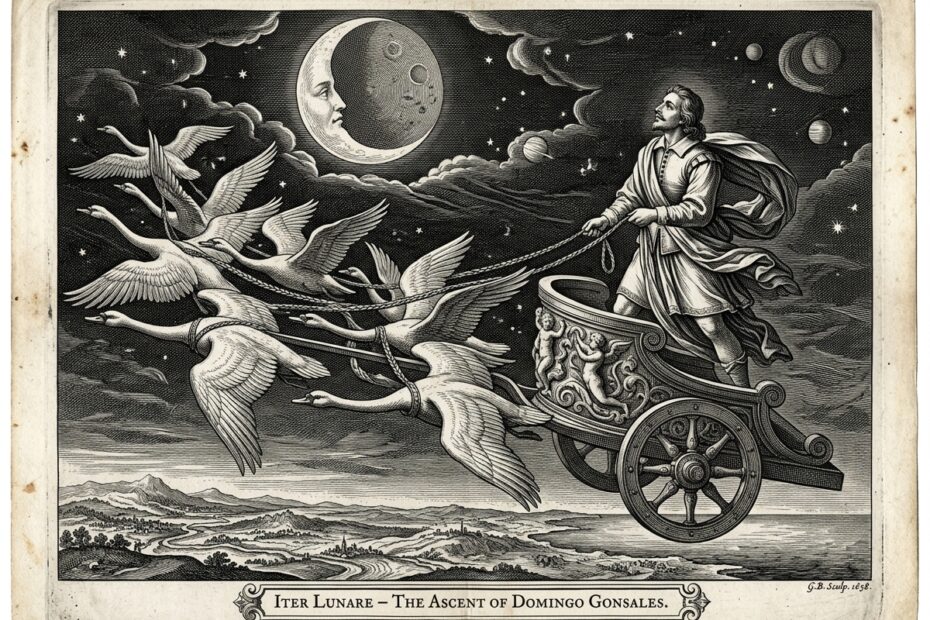
    Unlike later science fiction that relies on rockets or warp drives, Godwin’s protagonist reaches the moon using a chariot pulled by Gansas—a species of wild swans. While this may seem fantastical to modern readers, it represents a significant step in the evolution of speculative thought: biological propulsion.

    Godwin describes the Gansas with meticulous detail, noting their migration patterns and their innate ability to fly long distances. By choosing a biological rather than a supernatural means of transport, Godwin adhered to a logic internal to his world. This idea reflects a transition period where the boundaries between natural history and myth were still fluid.

    Practical Implications

    The use of Gansas highlights the 17th-century fascination with the natural world. It suggests that the keys to the heavens might be found in the observation of nature itself, echoing the themes found in Kepler’s Somnium, where the journey is also governed by a mix of natural and supernatural laws.

    3. Extraterrestrial Sociology and the Lunar Utopia

    Upon arriving on the Moon, Domingo Gonsales discovers a society of Lunar inhabitants (the Lunars) who are taller, more virtuous, and live in a state of near-perfection. Godwin uses this encounter to present a Lunar Utopia, contrasting the flaws of 17th-century European society with the idealized existence of the Moon-dwellers.

    The Lunars have no crime, no disease, and a language that is musical rather than spoken. This “Idea of a Utopia” allows Godwin to critique the political and social turmoils of his time. The Moon becomes a mirror through which humanity can observe its own shortcomings.

    4. The Musical Language of the Lunars

    One of the most innovative ideas in the book is the Musical Language of the Lunars. Godwin describes a communication system based on tones and musical intervals rather than phonetic sounds. This concept is remarkably sophisticated for its time, suggesting that advanced civilizations might communicate through abstract or non-verbal means.

    Godwin even provides a few examples of how this language works, showing his interest in linguistics and the potential for universal communication. This idea would later influence 20th-century science fiction, such as the musical communication in Close Encounters of the Third Kind.

    5. The Earth as a Celestial Body

    Before the advent of satellite photography, Godwin invited his readers to imagine the Earth from Space. As Gonsales travels toward the Moon, he looks back and sees the Earth as a rotating globe, displaying its continents and oceans.

    This perspective was revolutionary. It moved the Earth from being the fixed center of the universe to being just another celestial body among many. Godwin’s description of the Earth’s rotation helped popularize the Copernican theory among a general audience, using fiction as a vehicle for scientific education.

    6. The Synthesis of Faith and Science

    Despite its scientific leanings, The Man in the Moone is deeply rooted in theology. Francis Godwin was a Bishop, and his work reflects a worldview where the discovery of new worlds does not contradict the existence of God, but rather expands the majesty of His creation.

    Gonsales remains a devout Christian throughout his journey, seeing the wonders of the Moon as further evidence of divine craftsmanship. This synthesis of faith and science is a hallmark of the early modern period, where the pursuit of knowledge was often seen as a spiritual endeavor.

    Practical Examples: Applying Godwin’s Vision Today

    How can a 400-year-old book about swan-powered moon travel be relevant today? Here are a few ways Godwin’s ideas manifest in the modern world:

    • Iterative Thinking: Godwin didn’t have the math for gravity, but he had the intuition. In business and science, prototypical ideas often precede technical mastery.

    FAQ

    1. Is “The Man in the Moone” considered the first science fiction book?

    While many consider it one of the first, it shares this title with works like Lucian’s A True Story and Kepler’s Somnium. However, Godwin’s focus on physical mechanics makes it a primary candidate for proto-SF.

    2. How did Godwin explain the lack of air in space?

    Godwin did not yet understand the vacuum of space. He assumed the air simply became thinner and more “ethereal,” but still breathable for his protagonist and the Gansas.

    3. What was the impact of this book on later authors?

    It directly influenced Cyrano de Bergerac and Jonathan Swift (Gulliver’s Travels), cementing the “voyage to the moon” as a major literary trope.

    4. Why did Francis Godwin publish it anonymously?

    As a Bishop of the Church of England, publishing a work of “fantastical fiction” could have been seen as unbecoming or controversial, though it was published posthumously under a pseudonym.

    References

    • Godwin, Francis. The Man in the Moone: or A Discourse of a Voyage thither by Domingo Gonsales. 1638.
    • Poole, William. Introduction to The Man in the Moone. Broadview Editions.
    • Vertesi, Janet. Light and Color in Francis Godwin’s The Man in the Moone.

    Conclusion

    Francis Godwin’s The Man in the Moone remains a testament to the power of the human imagination. By daring to look beyond the horizon of his own era, Godwin created a work that continues to resonate with anyone who looks at the stars and wonders “what if?” Whether through the lens of gravity, utopian sociology, or interplanetary travel, his six ideas provide a fascinating window into the birth of the modern scientific mind.

    Exploring these early visions helps us appreciate how far we have come—and reminds us that the next great leap in human knowledge may already be hiding in the pages of a speculative story.

  • How to Use Archive.org

    How to Use Archive.org

    How to Use Archive.org to Borrow Modern Books Legally (Step-by-Step)

    For years, I had a specific reading problem: I read too fast to justify buying every new hardcover, but the waitlists at my local digital library via Libby were often months long. I resorted to downloading random, illegal PDF scans from sketchy websites. Not only did I feel bad about pirating from living authors, but those sites were riddled with malware.

    Then, I discovered the legal loophole that changed my reading life: The Internet Archive (Archive.org). Most people know it for the Wayback Machine, but it effectively functions as the world’s largest, fully legal digital public library.

    Here is what I learned about how the system works, and the exact step-by-step tutorial on how I use it to borrow modern books legally today.


    The Magic of Controlled Digital Lending (CDL)

    At first, I assumed Archive.org was just hosting pirated files. I was completely wrong.

    I learned they operate under a legal framework called Controlled Digital Lending (CDL). It is fascinatingly simple: if the Internet Archive owns one physical copy of a book in their warehouse, they are allowed to digitize it and loan out exactly one secure digital copy at a time. If someone checks it out, you have to wait in line. It mimics the exact artificial scarcity of a real brick-and-mortar library.

    This means you are ethically clear. You aren’t stealing. You are checking out a tightly regulated digital lease of a physical object.


    My Step-by-Step Workflow for Borrowing

    Here is the exact method I use to get books onto my devices legally without paying a dime.

    Step 1: Create a Free Account

    Go to [Archive.org](https://archive.org) and sign up. You just need an email address. Without an account, you can only read public domain books (like Dickens or Shakespeare). The account unlocks the modern, copyrighted library.

    Step 2: The Search Filter Hack

    The Archive has millions of files: concerts, MS-DOS games, you name it. To find books efficiently:

    1. Search your author or title.

    2. In the left-hand sidebar, immediately filter the Media Type to “Texts”.

    3. Look for the blue “Borrow” button under the cover. If it says “Join Waitlist,” just click it—they email you the second the person before you returns it.

    Step 3: Choose Your Borrow Time

    You have two options:

    1-Hour Borrow: I use this for academic books or cookbooks where I just need to check a specific fact or recipe quickly in my browser.
    14-Day Borrow: I use this for novels and deep non-fiction. This gives you the digital lease to read it offline.

    Step 4: The Secret to Offline Reading (Adobe Digital Editions)

    I hate reading full novels on an LCD computer monitor. To get the book onto an e-reader (like a Kobo) or my iPad, I use Adobe DRM.

    1. I downloaded Adobe Digital Editions (ADE) to my computer (it is free).

    2. I authorized the ADE app with a free Adobe account.

    3. After borrowing a book for 14 days on the Archive, I click the download button for the “Encrypted Adobe ePub”.

    4. It downloads a `.acsm` file. When I open this file in ADE, it securely downloads the real book, locking it so it deletes itself after 14 days.

    5. I then plug in my e-reader and drag the book over.


    How I Apply This System to My Life

    Since implementing this workflow, my reading anxiety is entirely gone. Whenever I hear a podcast recommending an obscure history book or an expensive, out-of-print business manual, I don’t run to Amazon. I immediately check Archive.org.

    This system has saved me thousands of dollars while allowing me to read guilt-free. It requires a bit of friction, downloading Adobe, managing waitlists, but I find that friction makes me value the books more than when I was hoarding folders of illegal PDFs.

    Stop pirating. Support the concept of the public library. Embrace the waitlist.

    Summary

    The Internet Archive uses Controlled Digital Lending to legally loan out modern ebooks. By setting up a free account and using Adobe Digital Editions, you can borrow almost any book and read it offline, ethically and affordably.

  • Rick Rubin’s ‘The Creative Act’

    Rick Rubin’s ‘The Creative Act’

    Rick Rubin’s ‘The Creative Act’: Why Talent is Overrated

    In 2023, Rick Rubin,  the man who produced albums for Johnny Cash, Jay-Z, Red Hot Chili Peppers, Adele, and Kanye West, released a book that had nothing to do with music. The Creative Act: A Way of Being is not a memoir, not a how-to guide, and not a business book. It is something stranger and more useful: a quiet, meditative argument that creativity is not a talent reserved for the exceptional. It is a posture, a practice, and a relationship with the world available to anyone willing to pay attention.

    This article explores the book’s most challenging and liberating ideas, and why its central thesis, that talent is overrated, might be the most important thing you hear this year. For another exploration of how mindset shapes outcome, see our piece on Griffith vs. Guts: the Stoic and the Machiavellian.


    What Rick Rubin Actually Believes About Creativity

    The opening premise of The Creative Act is disorienting if you expect Rubin to explain how he made great records. He does not. Instead, he argues that creativity is not something you do, it is something you are, when you are genuinely present and open to what the world is offering.

    “The universe is always sending us transmissions. The artist’s job is to be a good receiver.”

    This is not mysticism disguised as productivity advice. Rubin’s point is empirical: the creators he has worked with for five decades are not distinguished by superior raw ability. They are distinguished by their quality of attention. They notice what others walk past. They take their own responses seriously. They resist the urge to make something acceptable in favor of making something true.

    Rubin describes three categories of artist: those who follow trends, those who follow their own preferences, and those who follow the work itself, who subordinate personal taste to what the piece needs. The third category, he argues, produces the most enduring art. And it has almost nothing to do with talent.


    The Myth of the Gifted Creator

    Western culture has a deep investment in the idea of the gifted individual, the child prodigy, the natural, the visionary who simply arrived with abilities the rest of us lack. This story is flattering to those who succeed and consoling to those who do not. It explains outcomes without assigning effort or luck.

    Rubin dismantles this narrative not by denying that some people have exceptional raw ability, but by arguing that raw ability is the least interesting part of creative work. The musicians who produce records with lasting cultural impact are not always the most technically proficient. They are the ones who found a way to make the listener feel something they had not felt before, and that is a question of attention, honesty, and courage, not of instrumental virtuosity.

    He points to the phenomenon of artists who peak early and disappear: they had enormous natural talent but never developed the practice of creative attention. And then he points to artists who arrived late, worked slowly, and produced work that deepened over decades. The difference, consistently, was not talent. It was what they did with the silence between works.


    Creativity as a Practice, Not a Gift

    The book’s practical core is an extended argument that creativity functions like meditation or physical training: it requires daily showing up, tolerance for discomfort, and the willingness to produce bad work on the way to good work.

    1. The Seed vs. The Craft

    Rubin distinguishes between the seed of a work, the initial impulse, image, or feeling that ignites a project, and the craft that shapes it into form. Most people conflate these and believe the seed is the hard part. Rubin argues the opposite: seeds are abundant. What is rare is the willingness to sit with a seed until it becomes something. Most creative potential dies not in the absence of inspiration but in the absence of patience.

    2. The Inner Critic as a Tool

    Rather than treating self-doubt as an obstacle to be overcome, Rubin reframes the inner critic as information. The critic appears most aggressively when you are working close to something real. Learning to read the critic’s volume as a signal of proximity to truth is one of the book’s most counterintuitive and useful ideas.

    3. Awareness Before Execution

    Rubin insists that the most important creative skill is observational, learning to notice the texture of experience with unusual precision. You cannot manufacture this material. You can only cultivate the conditions for it.


    Why This Is Uncomfortable

    The Creative Act annoys some readers because it refuses to provide a checklist. There is no seven-step process for becoming more creative. What Rubin is really arguing is that the search for a technique, for a shortcut that makes creative work safe and predictable, is itself the enemy of creative work. The desire for a reliable process is a defense mechanism against the vulnerability of genuinely trying and potentially failing.

    This is why talent is overrated: it gives people a story. Either “I have it and will succeed” or “I don’t have it and therefore cannot succeed.” Rubin is removing that story and replacing it with something much harder, the invitation to simply try, repeatedly, without guarantee.


    What Rubin Shares About His Own Process

    Throughout the book, Rubin is careful not to present himself as a model. But certain details of his practice emerge:

    • He rarely plays an instrument in the studio. His role is to listen for what is working, what is missing, and what the artist is actually trying to say.
    • He has no fixed working hours. Creative work, for him, is inseparable from living, from conversations, books, walks, and time spent doing nothing in particular.
    • He deliberately works on many projects simultaneously, to avoid the pressure that accumulates when a single piece carries the weight of everything.
    • He considers boredom a creative state, a productive space in which the mind naturally drifts toward genuine preoccupations.

    The Political Argument Beneath the Surface

    Buried in The Creative Act is an argument that is quietly political: institutional gatekeepers do not determine who is creative. The MFA program, the record label, the publishing house, the film studio, these structures select for particular kinds of talent that fit their existing formats. Rubin’s model is, among other things, a decentralized model. It does not require validation. It does not require an audience. This connects directly with why we argue you should stop searching for free PDF downloads, the creative ecosystem only survives when it is supported.


    Read the Book!

    The Creative Act arrives at a moment when the cultural conversation about creativity is dominated by productivity metrics and algorithmic optimization. Its argument, that creativity is a way of being rather than a set of skills to be acquired, is profoundly countercultural. The most enduring creative work you have ever encountered was made by someone who was paying extraordinary attention to something that mattered to them. Not someone who was more talented than everyone else. Someone who showed up, stayed present, and did not look away.


    Frequently Asked Questions (FAQ)

    1. Is The Creative Act only for artists and musicians?
    No. Rubin explicitly frames the book for anyone who engages with the creative process, including writers, designers, entrepreneurs, and scientists.

    2. Is The Creative Act a practical book or a philosophical one?
    Both. It contains concrete observations about creative practice alongside philosophical reflections. It does not offer step-by-step instructions, which some readers find frustrating and others find liberating.

    3. Do you need to know about music to enjoy this book?
    Not at all. Music is occasionally used as a reference point, but the book’s arguments translate to any creative domain.

    4. How long is The Creative Act?
    Around 350 pages in a large, sparsely typeset format. It is designed to be read slowly and returned to, rather than consumed in a single sitting.

    5. What is Rick Rubin’s philosophy of talent in one sentence?
    Talent is the least important thing about a creative person; the quality of attention they bring to their work and the world is everything.

  • Triplanetary: 6 Ideas That Invented Space Opera

    Triplanetary: 6 Ideas That Invented Space Opera

    Triplanetary: 6 Ideas That Invented Space Opera

    Before Dune, before Foundation, before almost everything, there was Triplanetary. Originally written in 1934 as a standalone story and later revised by Edward E. “Doc” Smith to serve as the opening chapter of his Lensman series, it is a work of breathtaking ambition and staggering scope. Smith essentially invented the template for large-scale space opera. Here are 6 ideas from Triplanetary that defined the genre and still resonate today.

    1. Cosmic Conflict as Background History

    Triplanetary opens not with a hero, but with two godlike alien civilizations,  the Arisians and the Eddorians, locked in a secret war for control of the galaxy across millions of years. Humanity’s entire history is revealed to be a side effect of this conflict. Smith was among the first to propose deep time as a narrative frame: our wars, our empires, our species are just a chapter in a story far larger than we can perceive. This “gods playing chess with civilizations” structure would later influence Asimov, Herbert, and countless others.

    2. The Inertialess Drive

    Smith introduced the concept of inertialess faster-than-light travel, a drive that eliminates a ship’s inertia, allowing it to reach any velocity instantly without the usual physical consequences. This was not just a handwave; Smith thought through the implications. A ship without inertia would need to carefully manage its transition back to normal space. The idea seeded decades of science fiction engineering, influencing concepts from hyperdrives to jump drives, and represents one of the earliest serious attempts to rationalize FTL travel in fiction.

    3. Space as a Three-Dimensional Battlefield

    Before Triplanetary, space combat in fiction was mostly naval warfare transplanted into the void. Smith made it genuinely three-dimensional and tactical. His battles involve flanking maneuvers in all directions, using planetary bodies for cover, and the terrifying challenge of tracking enemies across a volume, not just a surface. The genre has never fully returned to two-dimensional space combat since Smith made it feel absurd. His descriptions of massed fleet engagements remain kinetically vivid nearly a century later. Compare this with the grand fleet battles imagined in Ringworld‘s universe.

    4. The Inevitability of Empire — and Its Corruption

    The novel cycles through human history; Atlantis, Rome, World War I, showing that every empire follows the same arc: rise through ambition, expansion through strength, corruption through power, collapse through decadence. Smith is not nostalgic or moralistic about this; he presents it as almost mechanistic. The same human drives that build civilizations destroy them. This cyclical pessimism, embedded in what reads as a pulp adventure story, gives Triplanetary an unexpected philosophical weight, one that Cities in Flight later develops much further through Spenglerian theory.

    5. Women as Agents, Not Just Prizes

    For 1934, Triplanetary is surprisingly progressive in one specific area: Clio Marsden, the female lead, actively drives plot. She is not simply rescued; she makes decisions, shows courage under pressure, and is treated as a full participant in the adventure rather than a reward for the male hero. This was far from universal in pulp fiction of the era. Smith’s female characters are not complex by modern standards, but they act,  they are agents, not objects.

    6. The Arms Race as a Natural Law

    Perhaps the most chilling idea in Triplanetary is that technological escalation is inevitable. Every new weapon demands a new defense; every new defense demands a new weapon. Smith dramatizes this as an arms race between factions first on Earth (submarines vs. depth charges, gas vs. gas masks) and then in space (screens vs. beams). He seems to suggest that this escalation is not a political failure but a physical law,  the nature of any universe where power is possible. This proto-game-theory insight anticipates the Cold War’s mutual destruction logic by over a decade.

    Start Now

    Triplanetary is rough, pulpy, and unapologetically grand. But its ideas, cosmic time scales, inertialess drives, three-dimensional warfare, cyclical empire, provided the foundation on which modern space opera was built. Reading it today is like touring the archaeological site of your favorite genre. Everything starts somewhere, and much of science fiction starts here.


    Frequently Asked Questions (FAQ)

    1. Do I need to read Triplanetary before the Lensman series?
    It helps for context, but the core Lensman series (starting with Galactic Patrol) can be read independently. Triplanetary serves as an extended prologue.

    2. Is Doc Smith’s writing dated?
    Yes, in prose style and some social attitudes. But the ideas are remarkably durable, and the sense of scale and excitement is unmatched in pulp science fiction.

    3. What is the connection between Triplanetary and the Skylark series?
    They are separate series by the same author. The Skylark series was written first; the Lensman series (which includes Triplanetary) is generally considered Smith’s more ambitious and mature work.

  • Why You Should Stop Searching for ‘Free PDF Downloads’

    Why You Should Stop Searching for ‘Free PDF Downloads’

    Why You Should Stop Searching for ‘Free PDF Downloads’ (Risk & Ethics)

    Every day, millions of people type some variation of the same search query: “[book title] free PDF download”. The intent is understandable. Books are expensive. Some are out of print. Some are locked behind paywalls that most people cannot access. The desire to read should not be a luxury reserved for those with disposable income.

    But what actually happens when you click those links? What are you putting at risk, in legal, financial, security, and ethical terms? And crucially: what alternatives exist that most people don’t know about? This article is practical information that the sites hosting those PDFs do not want you to have. For a broader perspective on why supporting creative work matters, see our analysis of Rick Rubin’s philosophy of the creative act.


    What “Free PDF Download” Sites Actually Are

    1. Shadow Libraries (Large-Scale Operations)

    These are large, organized repositories, formerly sites like Library Genesis (LibGen), Z-Library, and similar operations. They host millions of titles and present themselves as libraries in the tradition of open knowledge. Z-Library was seized by the FBI in 2022 and its operators arrested. Mirror sites continue to operate, but in a state of permanent legal precarity, and the risk is now yours, not theirs.

    2. Content Farm PDF Sites

    These are the sites that appear most prominently in Google results, pages with names like “freebookpdf.com” that promise a free PDF after you complete a survey or create an account. In the vast majority of cases, there is no PDF. The goal is to harvest your email, install tracking cookies, or direct you to download a file containing ransomware, keyloggers, or spyware. These sites are extraordinarily profitable because a small percentage of victims generate significant revenue.

    3. Torrent and P2P Networks

    Your IP address is visible to other participants in the swarm, including to copyright holders who actively monitor these networks for infringement. Publishers regularly send DMCA notices to ISPs based on this data. In some jurisdictions, this is sufficient for a lawsuit.


    The Security Risks in Detail

    The most immediate danger from PDF piracy is not legal, it is technical.

    Malware-Infected Files

    A PDF is not a passive document. It is a complex file format capable of executing JavaScript, triggering automatic downloads, and exploiting vulnerabilities in PDF readers. Malicious actors routinely embed ransomware, keyloggers, and trojans in pirated documents. These payloads are often invisible to standard antivirus software. The cost of a single ransomware infection, in time, data loss, and potential payment, far exceeds the cost of the most expensive book you will ever want to read.

    Credential Harvesting

    Sites that require account creation to “unlock” the PDF frequently harvest credentials. If you use the same email and password combination for other services, which most people do, a compromised account can cascade into compromised banking, email, and social media accounts.


    The Legal Risks

    In the United States, copyright infringement is governed by the Digital Millennium Copyright Act (DMCA) and Title 17 of the US Code. Downloading a copyrighted book without authorization is infringement, regardless of whether you pay for the file. Individual prosecutions are rare, but receiving a formal DMCA notice through your ISP creates a legal record that complicates your position in any future action.


    The Ethical Argument

    The arguments for piracy deserve honest acknowledgment:

    • Knowledge should be free: information locked behind paywalls creates epistemic inequality.
    • Out-of-print books: when a book is commercially unavailable, the author receives nothing anyway.
    • Global access: readers in countries where a book costs a week’s wages cannot fairly be asked to pay market prices.

    But the counterarguments are equally real: most books are not from major corporations. They are from individual authors whose income depends on sales. A pirated download of a debut novel does not harm Penguin Random House, it harms a person who spent years writing something and is trying to determine whether they can afford to write more.

    The honest position: it depends on what you are downloading and from whom. But the blanket habit of searching for free PDFs causes real harm to the people least able to absorb it. As we explore in our piece on Griffith and Guts, the ethical cost of treating people as means rather than ends always surfaces eventually.


    Better Alternatives (That Most People Don’t Know About)

    1. Open Library (archive.org)

    The Internet Archive’s Open Library has over 4 million digitized books available for free borrowing. Many contemporary titles are available through controlled digital lending.

    2. Project Gutenberg

    Project Gutenberg offers over 70,000 books whose copyright has expired, the vast majority of classic literature, available legally and for free in multiple formats. Dostoevsky, Austen, Nietzsche, Conrad: all here, for nothing.

    3. Libby (OverDrive) — Your Library Card

    Most public libraries offer digital borrowing through Libby (OverDrive) and Hoopla. These services are free with a library card and offer enormous catalogues of contemporary titles. Most people do not know their library card unlocks digital borrowing.

    4. Kindle Unlimited and Scribd

    For consistent readers, these subscription services offer access to hundreds of thousands of titles for less than the cost of one or two books per month.


    Conclusion

    Searching for “free PDF downloads” of copyrighted books is, in most cases, simultaneously more dangerous, more legally risky, and less necessary than people assume. The security risks are immediate and severe. The legal risks are real even if infrequently enforced. The ethical costs fall disproportionately on the people who can least afford to absorb them, independent authors and small publishers.

    The alternatives, from Open Library to Libby to Project Gutenberg, are genuinely excellent. The goal is to read more. There are ways to do that which do not put your computer, your legal standing, or a writer’s livelihood at risk.


    Frequently Asked Questions (FAQ)

    1. Is it illegal to download a free PDF of a book?
    In most countries, yes, if the book is still under copyright. Downloading copyrighted material without authorization constitutes infringement, regardless of whether you pay for it.

    2. Has anyone actually been sued for downloading a single book?
    Individual prosecutions are rare, but they do happen. The legal risk is real even if enforcement is inconsistent.

    3. Is Z-Library safe to use?
    Z-Library was seized by the FBI in 2022 and its operators arrested. Mirror sites continue to operate, but using them carries legal and security risks that have increased significantly since the takedown.

    4. What is the safest legal way to read books for free?
    A public library card that unlocks Libby/OverDrive is the most effective legal option for most users. Open Library (Internet Archive) is also excellent.

    5. Are classic books available for free legally?
    Yes. Books published before 1928 are generally in the public domain in the United States and available through Project Gutenberg and Standard Ebooks in professionally formatted editions.

  • Ringworld: 6 Ideas That Changed How We Think About Space

    Ringworld: 6 Ideas That Changed How We Think About Space

    Introduction

    Published in 1970 and winner of both the Hugo and Nebula Awards, Ringworld by Larry Niven is one of the most audacious feats of imagination in science fiction. A gigantic ring structure, one million miles wide, orbiting a sun — built not by gods, but by engineers. More than a thrilling adventure, Ringworld is a philosophical and scientific sandbox packed with radical ideas. Here are 6 of the most thought-provoking.

    1. Engineering on a Civilizational Scale

    The Ringworld itself is the central idea: a habitable band 600 million miles in circumference, built from a material stronger than any known substance (called scrith). Its inner surface has an area equivalent to three million Earths. Niven asks us to consider: what does a species do after it has colonized an entire solar system? It builds. The Ringworld is a monument to what post-scarcity engineering could look like — and a warning about what happens to a civilization that stops questioning why it builds.

    2. Luck as an Evolutionary Force

    Louis Wu’s companion, Teela Brown, was selected for the expedition partly because of a theory: the Puppeteers have been secretly breeding humans for good luck over generations, by manipulating who gets Earth’s overcrowded birth lottery tickets. Niven plays this almost as a biological joke — luck as a heritable trait, natural selection working on probability itself. The idea is absurd and brilliant: if a lucky individual survives more often, their genes (and their luck) propagate. Evolution, in this view, is not just about strength or intelligence, but about fortune.

    3. The Puppeteers and Risk-Averse Civilization

    The Pierson’s Puppeteers are among science fiction’s most memorable alien species. They are cowards by biology — their survival instinct is so overwhelming that any individual willing to take risks is considered clinically insane by their society. Yet they are immensely powerful and manipulative, engineering entire civilizations from a safe distance. Niven’s insight is sharp: a civilization can be extraordinarily advanced and still be paralyzed by fear. The Puppeteers are a mirror for any society (or institution) that mistakes caution for wisdom.

    4. A Civilization That Forgot Itself

    The humanoid inhabitants discovered on Ringworld have completely regressed. Once the engineers of the greatest structure ever built, they have lost all knowledge of technology, living as primitive tribes on its surface. The machinery that maintains the Ringworld is failing — the shadow squares are breaking down — and no one knows how to fix it. This is Niven’s darkest idea: that civilizational collapse is not dramatic; it is gradual and total. A species can forget itself. The Ringworld is an enormous ruin, still technically functional, inhabited by people who worship it as a god. This theme connects powerfully with ideas explored in Cities in Flight, where decay is also treated as an inevitable historical force.

    5. Superstition Born from Technology

    Following from the above, the novel explores how sufficiently advanced technology becomes religion. The Ringworld’s failing systems — automated repair drones, weather control mechanisms — are interpreted by the inhabitants as divine will. This echoes Arthur C. Clarke’s famous third law, but Niven gives it a tragic weight: these are the descendants of the builders, and they no longer recognize their own ancestors’ work. In a world of functional magic, reason gives way entirely to mythology.

    6. The Problem of the Rim Wall

    One of the novel’s cleverest hard-science details: the Ringworld has thousand-mile-high walls along its edges to prevent the atmosphere from spilling into space. But what do those walls mean for the people who live near them? Niven thinks through the second- and third-order consequences of his creation with unusual rigor. The walls cast enormous shadows. The ocean currents behave differently. The climate zones follow strange latitudinal patterns. This commitment to following the physics of an impossible structure is what separates Ringworld from lesser “Big Dumb Object” stories. For another example of rigorous speculative world-building from the same era, see our notes on Triplanetary.

    Conclusion

    Ringworld endures because Niven never lets the wonder of the setting overwhelm the questions it raises: about ambition, decay, luck, fear, and the fate of knowledge. It is a novel that rewards engineers and philosophers equally. If you have not read it, the Ringworld is waiting — enormous, ancient, and slowly falling apart.


    Frequently Asked Questions (FAQ)

    1. Is Ringworld scientifically plausible?
    The concept is physically possible but requires materials with properties far beyond anything we can currently produce. The physics of spin-gravity, atmosphere retention, and solar energy are handled with surprising rigor.

    2. Are there sequels to Ringworld?
    Yes. Larry Niven wrote three direct sequels: The Ringworld Engineers, The Ringworld Throne, and Ringworld’s Children, which expand the lore and address structural problems raised by readers.

    3. What is “scrith”?
    Scrith is the fictional ultra-strong material from which the Ringworld is built. It must withstand stresses far beyond any known substance, making it a useful thought experiment in meta-materials science.

  • Project Gutenberg vs. Open Library

    Project Gutenberg vs. Open Library

    Project Gutenberg vs. Open Library: The Best Sites for Classic Literature

    In the digital age, access to classic literature has never been easier. For students, researchers, and book lovers, two titans stand out in the quest for free, public domain knowledge: Project Gutenberg and Open Library. While both offer millions of books for free, they operate on fundamentally different philosophies and serve different needs.

    Which one should you use? Are they safe? And which offers the best reading experience? In this comparison, we break down the strengths and weaknesses of these two literary giants.

    Project Gutenberg: The Pioneer of Digital Books

    Founded in 1971 by Michael Hart, Project Gutenberg is the oldest digital library in the world. Its mission is simple: to encourage the creation and distribution of eBooks.

    Pros:

    • No Registration Required: You can download any book instantly without creating an account.
    • Quality Control: Books are proofread by volunteers (Distributed Proofreaders), resulting in clean, typo-free text formats suited for e-readers.
    • Format Flexibility: Offers EPUB, Kindle, and plain text formats that work on almost any device without DRM (Digital Rights Management).
    • Truly Free: Every book is in the US public domain, meaning you own the file you download forever.

    Cons:

    • Visual Aesthetics: The books often lack original covers or illustrations, prioritizing text over design.
    • Limited Scope: Strictly limited to books in the US public domain (published before 1929), so you won’t find modern bestsellers here.

    Open Library: The Wikipedia of Books

    A project of the Internet Archive, Open Library has a more ambitious goal: “One web page for every book ever published.” It functions partly as a library and partly as a database.

    Pros:

    • Modern Books: Unlike Gutenberg, Open Library offers a “lending” system for copyrighted modern books, allowing you to borrow digital copies for 1 hour or 14 days.
    • Scanned Originals: Many books are high-quality scans of physical library books, preserving the original typography, illustrations, and marginalia.
    • Vast Catalog: It includes millions of records, including obscure editions and out-of-print works that aren’t yet in the public domain.

    Cons:

    • Waitlists: Popular books require joining a waitlist, just like a physical library.
    • Reading Experience: Scanned PDFs can be harder to read on small screens (like phones or Kindles) compared to Gutenberg’s reflowable text.
    • Legal Controversy: The Internet Archive has faced legal challenges from publishers regarding its lending practices, making its future slightly less certain than Gutenberg’s.

    The Verdict: Which is Better?

    The answer depends on what you are looking for:

    Choose Project Gutenberg if:
    You want to read Pride and Prejudice or Dracula on your Kindle or phone. The files are lightweight, clean, and yours to keep. It is the gold standard for pure text reading of classics.

    Choose Open Library if:
    You are researching a specific edition, looking for a book published after 1930, or want to see the original layout and illustrations of a text. It is indispensable for academic research and finding books that are out of print but not yet public domain.

    Choose yours

    Ultimately, we don’t have to choose. Both projects are monuments to human knowledge, ensuring that culture remains accessible to everyone, everywhere. Whether you prefer the pristine text of Gutenberg or the digital shelves of Open Library, the winner is the reader.

    Frequently Asked Questions (FAQ)

    1. Is Project Gutenberg legal?
    Yes, completely. They only publish books that have entered the public domain in the United States.

    2. Can I read Open Library books on Kindle?
    It’s difficult. Open Library uses Adobe DRM for borrowed books, which requires extra steps to transfer to a Kindle, whereas Gutenberg files work natively.

    3. Why does Project Gutenberg look so old-school?
    The site prioritizes function, speed, and accessibility over modern web design, ensuring it works on even the oldest computers and connections.

    4. Are these sites safe to download from?
    Yes, both are reputable non-profit organizations. They do not host malware or pirate content.

    5. How can I help these projects?
    Both rely on donations and volunteers. You can donate money or volunteer to proofread pages (for Gutenberg) or correct book records (for Open Library).

  • David Brin’s Earth: 6 Radical Ideas

    David Brin’s Earth: 6 Radical Ideas

    David Brin’s Earth: 6 Radical Ideas About Our Planet’s Future

    Published in 1990, David Brin’s monumental novel Earth is more than just a science fiction thriller about a microscopic black hole devouring the planet’s core. It is a dense, prophetic exploration of ecology, technology, and society in the near future (2038). Brin weaves together hard science with sociological speculation, presenting a world that feels eerily similar to our own present-day reality.

    Here are 6 key ideas from Earth that challenge how we think about our planet, our privacy, and our survival.

    1. The Transparent Society

    One of Brin’s most famous concepts, which he later expanded into a non-fiction book, is the idea that privacy is disappearing and cannot be saved. In Earth, cameras are ubiquitous, worn by citizens and mounted on every street corner. Instead of fighting for secrecy (which only benefits the powerful), Brin argues for reciprocal transparency (sousveillance). If the police can watch us, we must be able to watch the police. In the novel, this total information awareness is a double-edged sword, but one that is essential for holding power accountable in a crowded world.

    2. The Gaia Hypothesis as Fact

    Brin takes James Lovelock’s Gaia Hypothesis, that the Earth acts as a single, self-regulating superorganism, and makes it literal. The planet in the novel is stressed to the breaking point by human activity. The “character” of Earth is not a mystical goddess but a complex, suffering biological system reacting to infection (us). The story suggests that humanity is the nervous system of the planet, potentially its way of achieving consciousness, but currently acting more like a cancer that needs to evolve or be excised.

    3. The “World Wide Web” Prediction

    Written before the web was public, Earth features “The Net,” a global hypertext system where information is linked, forum discussions (similar to Reddit or Usenet) drive public opinion, and data can be accessed by anyone. Brin startlingly predicts the dangers of misinformation, spam, and computer worms spreading through this network, anticipating the cybersecurity battles of the 21st century decades in advance.

    4. Endangered Species Arks

    In the novel’s timeline, ecological collapse has led to the extinction of many large mammals. To save what remains, humanity has created “Arks”, not ships, but genetic libraries and protected preserves. This highlights a desperate pragmatic approach to conservation: when you can’t save everything, you must choose what to save. It reflects a shift from “conservation” to “preservation management,” a grim necessity that is becoming increasingly relevant today.

    5. Gravity Technology and Energy

    The central plot device, a microscopic singularity used for energy production that falls into the Earth’s core, explores the double-edged sword of advanced physics. While it offers unlimited clean energy (solving the climate crisis), it carries existential risks. This mirrors our current debates about nuclear power, geoengineering, and AI: is the solution to our problems more dangerous than the problems themselves?

    6. Planetary Engineering

    Ultimately, Earth is about the transition of humans from inhabitants to engineers of their own planet. We see characters manipulating weather, tectonics, and ecosystems. Brin posits that we have passed the point of no return; we cannot simply “leave nature alone” because we have already altered it too much. We must now accept the responsibility of actively managing the planetary life support system if we want to survive.

    Conclusion

    David Brin’s Earth serves as a “booknote” for the 21st century, a warning and a roadmap. It asks us to consider whether our technological tools will destroy the biosphere or become the means by which the Earth itself wakes up. As we face climate change and the loss of privacy, Brin’s 1990 vision remains one of the most relevant and provocative thought experiments in science fiction.

    Frequently Asked Questions (FAQ)

    1. Is the science in ‘Earth’ accurate?
    Much of it is based on solid theoretical physics (like microscopic black holes) and ecology, though obviously speculative. Brin is an astrophysicist, so the science is “harder” than most sci-fi.

    2. Did David Brin really predict the internet?
    He predicted the *shape* of the modern web, hyperlinks, forums, and the social impact of instant global communication, remarkably well before it became mainstream.

    3. What is the “Transparent Society”?
    It’s the concept that in a world of cameras and data, the only way to preserve freedom is to ensure that surveillance goes both ways, citizens watching the watchers.

  • The Genghis Khan Mindset

    The Genghis Khan Mindset

    The Genghis Khan Mindset: 5 Ruthless Strategies for Modern Success

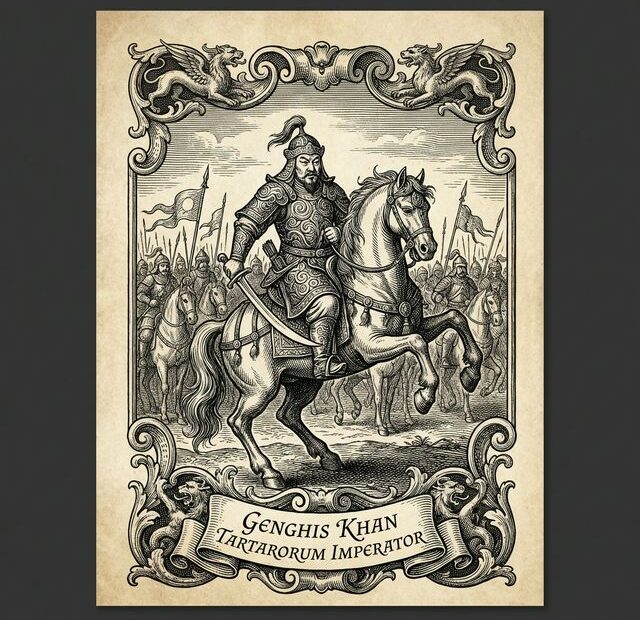
    When we think of Genghis Khan, the image that usually comes to mind is that of a ruthless barbarian leaving a trail of destruction in his wake. However, this is a simplistic and incomplete view. Behind the sword was a brilliant strategic mind that unified warring tribes and created the largest contiguous empire in human history. The “Genghis Khan Mindset” is not about violence, but about ruthless efficiency, adaptation, and long-term vision.

    For the modern entrepreneur or leader, the lessons left by the Great Khan are surprisingly current. He didn’t inherit an empire; he built it from scratch, overcoming adversities that would break most people. Here are five essential strategies we can extract from his life and apply to the pursuit of success today.

    1. Radical Meritocracy over Aristocracy

    Value Competence, Not Blood

    Unlike the feudal armies of Europe or China, where position was determined by birth, the Mongol army operated under a strict meritocracy. Genghis Khan promoted generals based solely on skill and loyalty, often elevating men from humble backgrounds or even former enemies who demonstrated value.

    The Modern Lesson

    In the corporate world and in business, results must speak louder than titles or connections. Build a team where the best ideas win, regardless of who proposed them. A culture that rewards real performance creates a high-performance environment impossible to replicate by organizations stuck in rigid hierarchies and nepotism.

    2. Adaptation and Technological Adoption

    Learn from the Enemy

    The Mongols were originally steppe warriors, masters of cavalry and archery, but ignorant of siege warfare. When they encountered the fortified cities of China and Persia, they didn’t give up. Instead, they captured Chinese and Muslim engineers and learned to build catapults and use gunpowder. They turned the enemy’s technology into their own advantage.

    The Modern Lesson

    Don’t stick to “how we’ve always done things”. The market changes fast. If a competitor has superior technology or processes, don’t ignore it out of pride; study it, adapt it, and improve it. The ability to pivot and integrate new tools (like AI nowadays) is what separates empires that grow from those that fall.

    3. Unwavering Loyalty and Iron Discipline

    The Power of Unity

    The greatest crime in the Mongol army was not defeat, but betrayal and abandoning one’s companions. Genghis Khan instilled a sense of loyalty so deep that his units fought as a single organism. Discipline wasn’t just about following orders, but about protecting the integrity of the group.

    The Modern Lesson

    Organizational culture is your greatest defense. A team united by shared values and mutual loyalty will outperform a group of individualist “stars” any day. Invest in building trust. When your team knows you “have their back”, they will fight your battles with the same intensity as you do.

    4. Information Warfare and Psychology

    Win Before the Battle Begins

    Before invading a territory, Genghis Khan sent spies (merchants, travelers) to map routes, understand local politics, and spread terrifying rumors about the size and ferocity of his army. Many cities surrendered before even seeing a Mongol soldier, defeated by fear and reputation.

    The Modern Lesson

    Information is power. Know your market, your customers, and your competitors better than they know themselves. Use marketing and branding to position your brand dominantly in the consumer’s mind before the “sale” even happens. The perception of authority and inevitability can open doors that brute force could not.

    5. Long-Term Vision and Legacy

    Planting Trees You Won’t See

    Genghis Khan didn’t fight just for immediate riches; he had a vision of a “universal peace” under the eternal sky (which would become the Pax Mongolica, allowing safe trade along the Silk Road). He established laws (the Yassa) and writing systems that ensured his empire would survive and prosper long after his death.

    The Modern Lesson

    Don’t just build for the next quarter. Ask yourself: “What am I building that will last 10, 50 years?”. True success is creating systems and values that transcend your physical presence. Whether in investments or brand building, long-term thinking is the ultimate competitive advantage in an immediate world.

    Frequently Asked Questions (FAQ)

    Wasn’t Genghis Khan a cruel tyrant?
    Yes, his conquests were bloody. However, the “Mindset” here focuses on strategies of efficiency and leadership. We can learn from the strategic effectiveness of historical figures without endorsing their moral actions. Separating technique from morality is crucial for objective historical study.

    How to apply “siege warfare” to small businesses?
    Think of “besieging” a market niche. Instead of attacking the market leader head-on, dominate distribution channels, build barriers to entry, and isolate the customer’s problem until your solution is the only viable one.

    What was the Pax Mongolica?
    It was a period of relative peace and stability that followed the Mongol conquests, where trade, technologies, and ideas (such as printing and gunpowder) flowed freely between East and West, facilitating the beginning of the Renaissance.

    What is the best book to learn more?
    We strongly recommend “Genghis Khan and the Making of the Modern World” by Jack Weatherford, which deconstructs myths and focuses on the administrative and cultural genius of the Mongols.

    Think Big

    Genghis Khan’s legacy teaches us that success depends not only on brute force but on intelligence, adaptability, and unity. In a volatile modern world, adopting this mindset of continuous learning, meritocracy, and strategic vision can be the difference between being conquered by circumstances or leading your own destiny. Be ruthless in the pursuit of excellence, but wise enough to always adapt.


    Did you like this applied historical analysis? Check out our other articles on great strategy books.

  • 6 Transformative Ideas from The Birth of Tragedy

    6 Transformative Ideas from The Birth of Tragedy

    6 Transformative Ideas from The Birth of Tragedy by Friedrich Nietzsche

    Friedrich Nietzsche’s first book, The Birth of Tragedy (1872), is an explosion of ideas that challenged the academic view of the time about Ancient Greece. Far from being just a civilization of “serenity and light,” Nietzsche reveals a Greek world driven by dark, ecstatic, and irrational forces. This work is not continuously a philological study, but a profound reflection on culture, art, and the meaning of existence. Here are six essential ideas from this philosophical classic.

    1. The Apollonian and Dionysian Duality

    Order vs. Chaos

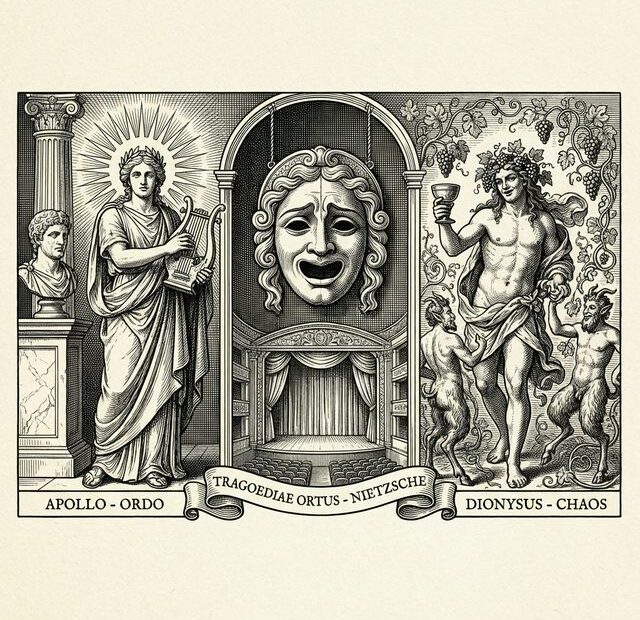
    Nietzsche introduces two fundamental artistic impulses based on Greek gods: Apollo and Dionysus. The Apollonian represents order, reason, form, dream, and individuality (as in sculpture). The Dionysian represents chaos, intoxication, the dissolution of boundaries, music, and the primordial unity with nature.

    The Lesson

    Life requires the balance between structure and passion. A purely Apollonian existence is sterile and rigid; a purely Dionysian life is destructive. True art (and a full life) arises from the creative tension between these two opposing forces.

    Application: In your life and work, do not reject chaos or order. Use structure (Apollo) to give form to your passions and creative instincts (Dionysus). Acknowledge that moments of “losing control” or deep intuition are just as vital as rational planning.

    2. Tragedy as Reconciliation

    The Peak of Greek Art

    For Nietzsche, Attic tragedy (like that of Sophocles and Aeschylus) was the supreme moment of Greek culture because it managed to perfectly unite the Apollonian and the Dionysian. On stage, the tragic hero (Apollonian, individual) is destroyed by fate, but the chorus (Dionysian, collective) remains, celebrating indestructible life.

    The Lesson

    Tragic art allows us to face suffering. The ancient Greek knew the terror and absurdity of existence but did not surrender to pessimism. Through tragedy, he transformed this horror into something sublime, affirming life despite pain.

    Application: Do not use art or entertainment merely as an escape (escapism). Seek works that confront you with the difficult truths of human life, for it is in this aesthetic confrontation that we find deeper resilience and a joyful acceptance of fate.

    3. Existence as an Aesthetic Phenomenon

    The Justification of Life

    One of the most famous phrases in the book is: “Only as an aesthetic phenomenon are existence and the world eternally justified.” Nietzsche argues that, morally, the world is unjustifiable (full of senseless cruelty and suffering). But, seen as a work of art, suffering gains meaning and beauty.

    The Lesson

    We must look at our lives with the eyes of an artist. If we try to judge life only by moral criteria (“good” or “bad”), we will fall into nihilism. But if we view it as an aesthetic creation, even personal tragedies compose the beauty of the whole.

    Application: Try to reframe your failures and pains not as moral punishments, but as necessary “shadows” in the painting of your biography. Cultivate an aesthetic perspective that values the intensity and complexity of lived experience.

    4. Socratic Optimism and the Death of Tragedy

    The Rise of Reason

    Nietzsche blames Socrates (and Euripides in art) for the decline of tragedy. With Socrates, the belief arises that “the virtuous is happy” and that reason can correct all the evils of existence. This theoretical optimism destroys myth and tragic depth, replacing instinct with conscious logic.

    The Lesson

    Excessive rationalism kills cultural vitality. The belief that science and logic can explain and solve everything is an illusion that disconnects us from the deep roots of life (the Dionysian). A purely rational culture becomes superficial.

    Application: Be wary of purely logical solutions to complex human problems. Acknowledge that there is wisdom in myths, traditions, and instincts that pure analytical reason cannot capture. Do not try to overly “explain” the magic of life.

    5. Music as Pure Will

    The Influence of Schopenhauer

    Following Schopenhauer, Nietzsche views music as the most direct form of art. While plastic arts (Apollonian) show us images of the world, music (Dionysian) is the direct expression of the universal Will, the beating heart of reality, before any form or concept.

    The Lesson

    Music connects us with the universal essence. It has the power to dissolve our individuality and make us feel part of a greater whole. It is through music (the spirit of music) that tragic myth is reborn.

    Application: Value music not just as background entertainment, but as a tool for spiritual and emotional connection. Allow yourself to be carried by music to states of mind that words cannot describe.

    6. Myth as Cultural Protection

    The Necessity of Illusion

    Nietzsche argues that every vibrant culture needs a horizon of myths to survive. The modern theoretical man, destroying all myths with his historical and critical science, is left “naked” and unprotected against the cold of the universe.

    The Lesson

    Science without myth leads to nihilism. When we scientifically dissect everything, we lose the sacred sense that binds a community together. Myth is not a “lie,” but a necessary symbolic truth for cultural health.

    Application: Acknowledge the importance of “sacred stories” that give meaning to your personal life or your community, even if they are not scientific “fact.” We need narratives that protect us and give us a sense of home in the universe. Fiction and myth are vital for mental health.

    Conclusion

    The Birth of Tragedy is an invitation to embrace the totality of life — light and shadow, reason and instinct. Nietzsche warns us against a sterile world dominated only by utilitarian logic and points the way back to a richer, more tragic, and artistically justified existence.

    By recognizing the eternal dance between Apollo and Dionysus, we can live not as mere rational spectators but as active participants in the great work of art that is the cosmos.


    Have you read Nietzsche? do you feel more Apollonian or Dionysian? Share your thoughts in the comments below!

  • Where to Start with Stephen King

    Where to Start with Stephen King

    Where to Start with Stephen King: A Beginner’s Guide

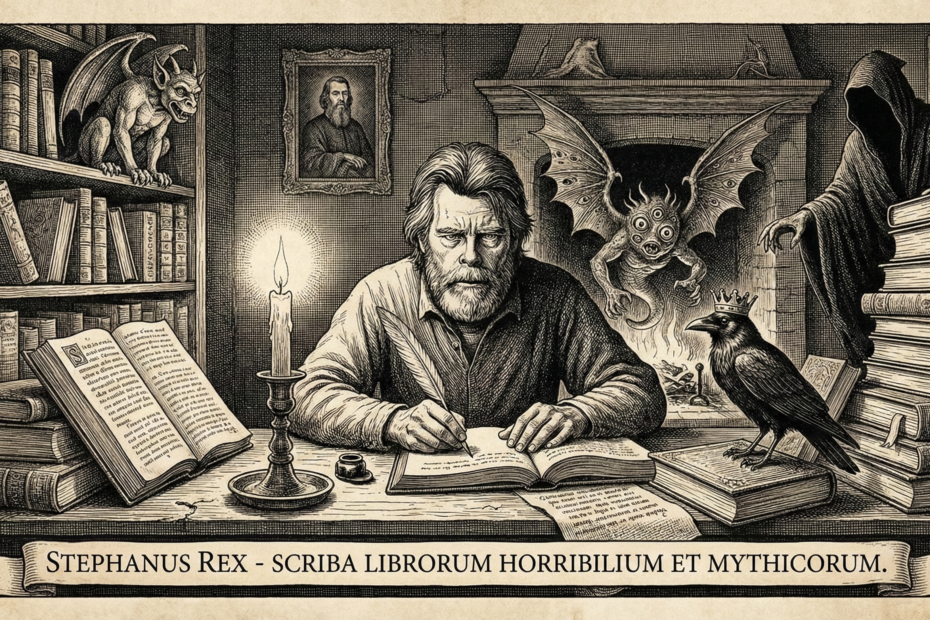
    Stephen King has written over 60 novels and 200 short stories, making him one of the most prolific authors of our time. For newcomers, this vast bibliography can feel overwhelming. Where should you begin your journey into King’s universe? This comprehensive guide presents the top 10 Stephen King books perfect for beginners, carefully selected to showcase his range, storytelling prowess, and ability to terrify and captivate readers.

    Whether you’re drawn to supernatural horror, psychological thrillers, or character-driven drama, Stephen King has something for everyone. These ten books represent the best entry points into his work, offering accessible narratives, compelling characters, and the masterful storytelling that has made King a household name for over four decades.

    Why Stephen King Remains the King of Horror

    Before diving into our recommendations, it’s essential to understand what makes Stephen King’s work so enduring. King’s genius lies not just in his ability to scare readers, but in his deep understanding of human nature. His characters feel real, their fears relatable, and their struggles authentic. King writes about ordinary people facing extraordinary circumstances, which makes his horror all the more terrifying.

    King’s influence extends far beyond literature. His works have been adapted into countless films, television series, and even comic books. From The Shining to It, from The Shawshank Redemption to The Green Mile, King’s stories have become part of our cultural fabric. His ability to tap into universal fears ensures his work remains relevant across generations.

    Top 10 Stephen King Books for Beginners

    1. Carrie (1974)

    King’s debut novel remains one of his most accessible and powerful works. Carrie tells the story of Carrie White, a shy, bullied high school girl with telekinetic powers. When a cruel prank at her senior prom pushes her too far, Carrie unleashes her abilities with devastating consequences.

    Why start here? At just over 200 pages, Carrie is a quick read that showcases King’s talent for creating sympathetic characters and building tension. The novel explores themes of bullying, religious fanaticism, and the dangers of repressed anger, issues that remain relevant today. The epistolary format adds depth to the narrative and demonstrates King’s experimental side.

    2. The Shining (1977)

    Perhaps King’s most famous novel, The Shining follows Jack Torrance, a recovering alcoholic and aspiring writer who takes a job as the winter caretaker of the isolated Overlook Hotel. As winter sets in and the hotel becomes snowbound, Jack’s sanity begins to deteriorate, threatening his wife Wendy and psychic son Danny.

    Why start here? The Shining is a masterclass in psychological horror. King expertly blends supernatural elements with the very real horrors of addiction, domestic violence, and mental illness. The Overlook Hotel itself becomes a character, its malevolent presence seeping into every page.

    This novel showcases King’s ability to create claustrophobic tension and explore the darkness within seemingly ordinary people. The relationship between Jack and his son Danny provides emotional depth, while the hotel’s ghosts and mysteries deliver genuine scares. Similar to how Harry Potter explores magical worlds, King creates an immersive universe that feels both fantastical and terrifyingly real.

    3. The Stand (1978)

    The Stand is King’s epic post-apocalyptic masterpiece. After a weaponized strain of influenza wipes out 99% of humanity, the survivors are drawn into a final confrontation between good and evil, represented by Mother Abagail and the demonic Randall Flagg.

    Why start here? While The Stand is King’s longest novel (over 1,100 pages in the uncut edition), it’s also one of his most rewarding. The book features an ensemble cast of memorable characters, each with their own story arc and journey. King’s world-building is exceptional, creating a believable post-pandemic America that feels eerily prescient.

    This novel is perfect for readers who enjoy epic fantasy or sprawling narratives. It demonstrates King’s ability to juggle multiple storylines, create complex characters, and explore profound themes about the nature of good and evil, free will, and the rebuilding of society.

    4. Misery (1987)

    Misery tells the terrifying story of Paul Sheldon, a romance novelist who crashes his car during a blizzard and is “rescued” by Annie Wilkes, his self-proclaimed “number one fan.” When Annie discovers that Paul has killed off her favorite character, she holds him captive and forces him to write a new novel bringing the character back to life.

    Why start here? Misery is pure psychological thriller, with minimal supernatural elements. The horror comes from the very real threat of Annie Wilkes, one of King’s most memorable villains. The novel explores themes of artistic integrity, obsession, and the relationship between creators and their audiences.

    At under 400 pages, Misery is a taut, focused narrative that maintains relentless tension from beginning to end. King’s portrayal of the creative process and the physical and psychological torture Paul endures makes this one of his most visceral works.

    5. The Green Mile (1996)

    Originally published as a serial novel in six parts, The Green Mile is set in a Depression-era Southern prison’s death row. Paul Edgecombe, the head guard, encounters John Coffey, a massive man convicted of murdering two young girls, who possesses mysterious healing powers.

    Why start here? The Green Mile showcases King’s softer side, blending elements of magical realism with profound meditations on justice, mercy, and the nature of miracles. While the setting is grim, the novel is ultimately about compassion and redemption.

    This book demonstrates that King is more than just a horror writer. His character development is exceptional, and the emotional impact of the story is powerful. The serial format makes it easy to read in manageable chunks, and the narrative’s episodic structure keeps readers engaged.

    6. 11/22/63 (2011)

    In this time-travel thriller, Jake Epping discovers a portal to 1958 and embarks on a mission to prevent the assassination of President John F. Kennedy. However, as Jake becomes immersed in the past, he discovers that changing history comes with unexpected consequences.

    Why start here? 11/22/63 is one of King’s most accessible recent novels, combining historical fiction, romance, and thriller elements. The book requires no knowledge of King’s other works and stands completely on its own. King’s research into the Kennedy assassination and late 1950s/early 1960s America is meticulous, creating an immersive historical setting.

    The novel explores fascinating questions about fate, the butterfly effect, and whether we should change the past even if we could. Much like Neuromancer’s exploration of technology and reality, King examines how our actions ripple through time.

    7. Pet Sematary (1983)

    Pet Sematary follows the Creed family as they move to rural Maine and discover a mysterious burial ground in the woods behind their home. When tragedy strikes, Louis Creed makes a terrible decision that unleashes horrifying consequences.

    Why start here? King himself has called Pet Sematary his scariest book, and many readers agree. The novel taps into primal fears about death, grief, and the lengths parents will go to protect their children. The horror is both supernatural and deeply psychological.

    This book is relatively short (around 400 pages) and moves at a brisk pace. King’s exploration of grief and the denial of death’s finality gives the novel emotional weight beyond its scares.

    8. The Dead Zone (1979)

    After a car accident leaves him in a coma for five years, Johnny Smith awakens with psychic abilities that allow him to see the past and future of anyone he touches. When he shakes hands with a charismatic politician and sees a vision of nuclear apocalypse, Johnny must decide whether to become an assassin to save the world.

    Why start here? The Dead Zone is one of King’s most tightly plotted novels, combining elements of science fiction, political thriller, and moral philosophy. The central question,would you kill one person to save millions?, provides rich material for contemplation.

    Johnny Smith is one of King’s most sympathetic protagonists, and his struggle with his abilities and the isolation they bring feels authentic. The novel’s political elements remain relevant, and King’s exploration of power, corruption, and moral responsibility gives the book depth beyond its genre trappings.

    9. Different Seasons (1982)

    This collection contains four novellas, each set in a different season: “Rita Hayworth and Shawshank Redemption” (Hope Springs Eternal), “Apt Pupil” (Summer of Corruption), “The Body” (Fall from Innocence), and “The Breathing Method” (A Winter’s Tale).

    Why start here? Different Seasons demonstrates King’s versatility and proves he’s not just a horror writer. Three of these four novellas have been adapted into acclaimed films (The Shawshank Redemption, Stand by Me, and Apt Pupil). Each story is distinct in tone and theme, offering readers a sampler of King’s range.

    “The Body,” which became the film Stand by Me, is a beautiful coming-of-age story about friendship and loss. “Rita Hayworth and Shawshank Redemption” is an inspiring tale of hope and perseverance. Similar to how some books translate beautifully to film, these novellas showcase King’s cinematic storytelling.

    10. It (1986)

    King’s epic horror novel follows a group of childhood friends in Derry, Maine, who encounter a shape-shifting entity that preys on children, often appearing as Pennywise the Dancing Clown. Twenty-seven years later, the friends must return to Derry to face their childhood nightmare once again.

    Why start here? While It is over 1,000 pages long, it’s also one of King’s most beloved and accessible novels. The dual timeline structure, alternating between the characters’ childhood in the 1950s and their adult lives in the 1980s, creates a compelling narrative rhythm. The Losers’ Club, the group of misfit friends at the story’s heart, are among King’s most memorable characters.

    It explores themes of childhood trauma, the power of friendship, and the nature of evil. King’s portrayal of childhood is both nostalgic and honest, capturing the intensity of childhood fears and friendships. The novel works as both a coming-of-age story and a horror epic.

    How to Choose Your First Stephen King Book

    Selecting your first Stephen King book depends on your personal preferences and reading habits. Here’s a quick guide:

    • If you prefer short, intense reads: Start with Carrie or Misery. Both are under 400 pages and showcase King’s ability to create tension and memorable characters.
    • If you enjoy epic, sprawling narratives: The Stand or It will satisfy your appetite for complex plots and large casts of characters.
    • If you’re skeptical about horror: Try The Green Mile or 11/22/63. These books demonstrate King’s range beyond horror and feature more hopeful, uplifting themes.
    • If you want to sample King’s versatility: Different Seasons offers four distinct stories in one volume.
    • If you want classic King horror: The Shining and Pet Sematary represent King at his most terrifying.
    • If you enjoy psychological thrillers: Misery and The Dead Zone focus on human evil and moral dilemmas.

    Practical Tips for Reading Stephen King

    Start with Standalone Novels

    While King has written several series and interconnected books (particularly those set in his fictional town of Castle Rock or involving the Dark Tower mythology), the books recommended in this guide are all standalone novels. You don’t need to read them in any particular order or have knowledge of King’s other works to enjoy them.

    Don’t Be Intimidated by Length

    Many of King’s books are long, but his conversational writing style and compelling characters make them page-turners. King himself has said he writes long books because he enjoys spending time with his characters. If you’re concerned about length, start with one of his shorter works like Carrie or Misery, then work your way up to the epics.

    Embrace the Slow Build

    King is known for taking his time to establish characters and setting before the horror begins. This slow build creates investment in the characters and makes the scary moments more impactful. Trust the process, the payoff is worth the patience.

    Much like learning through experience, reading King requires patience and immersion to fully appreciate his craft.

    Join a Reading Community

    Stephen King has one of the most passionate fan communities in literature. Consider joining online forums, book clubs, or social media groups dedicated to King’s work. Discussing the books with other readers enhances the experience and provides new perspectives.

    Watch the Adaptations (After Reading)

    Many of King’s books have been adapted for film and television. While some adaptations are excellent (The Shawshank Redemption, The Green Mile, Stand by Me), others take significant liberties with the source material. Reading the book first allows you to form your own vision of the story before seeing someone else’s interpretation.

    Common Themes in Stephen King’s Work

    As you explore King’s bibliography, you’ll notice recurring themes and motifs:

    Small Town America: Many of King’s stories are set in small Maine towns, often fictional places like Castle Rock, Derry, or Jerusalem’s Lot. These settings allow King to create tight-knit communities where everyone knows everyone, making the horror more intimate and personal.

    Childhood and Coming of Age: King frequently writes about children and the transition from childhood to adulthood. Books like It, The Body, and Carrie explore how childhood experiences shape us and how we carry childhood traumas into adulthood.

    Addiction and Recovery: King’s own struggles with addiction inform many of his works. Characters dealing with alcoholism or drug addiction appear frequently, most notably in The Shining and Doctor Sleep.

    The Nature of Evil: King explores whether evil is supernatural or human, external or internal. His villains range from demonic entities to ordinary people capable of terrible acts. Similar to Berserk’s philosophical exploration of morality, King questions the very nature of good and evil.

    The Power of Friendship and Community: Despite the darkness in his work, King often celebrates the bonds between people and the strength found in community and friendship.

    Frequently Asked Questions

    Do I need to read Stephen King’s books in order?

    No, most of Stephen King’s books are standalone novels that can be read in any order. While some books are connected (like the Dark Tower series or books set in Castle Rock), the novels recommended in this guide can all be enjoyed independently. Start with whichever book sounds most interesting to you.

    Are Stephen King’s books too scary for beginners?

    King’s books vary widely in their horror content. Some, like Pet Sematary, are genuinely terrifying, while others, like The Green Mile or 11/22/63, focus more on drama, character development, and emotional storytelling. If you’re concerned about horror content, start with one of his less scary works and work your way up to the more intense novels.

    Why are Stephen King’s books so long?

    King is known for his detailed character development and world-building, which requires space to unfold. He believes in fully developing his characters and settings before introducing the horror elements, creating a slow-burn effect that makes the scary moments more impactful. His conversational writing style and engaging plots make even his longest books feel like page-turners for most readers.

    What makes Stephen King different from other horror writers?

    King’s genius lies in his ability to create deeply human characters facing extraordinary circumstances. His horror is effective because readers care about his characters and can relate to their fears and struggles. King also excels at blending genres—his books often combine horror with elements of science fiction, fantasy, crime fiction, and literary drama. His cultural impact and prolific output have made him not just a horror writer, but a significant figure in American literature.

    External Resources

    • King, Stephen. On Writing: A Memoir of the Craft. Scribner, 2000.
    • Magistrale, Tony. Stephen King: America’s Storyteller. Praeger, 2010.
    • Beahm, George. The Stephen King Companion. Andrews McMeel Publishing, 1995.
    • Stephen King Official Website – The author’s official site with news and updates
    • Stephen King on Goodreads – Complete bibliography and reader reviews
    • Stephen King at Penguin Random House – Publisher’s page with book information

    Start Today!

    Stephen King’s vast bibliography offers something for every reader, from supernatural horror to heartfelt drama, from psychological thrillers to epic fantasy. The ten books recommended in this guide provide excellent entry points into King’s work, showcasing his range, storytelling ability, and the themes that have made him one of the most beloved authors of our time.

    Don’t be intimidated by King’s reputation or the length of his books. His accessible writing style, memorable characters, and compelling plots make his work engaging for readers of all levels. Whether you start with the compact terror of Carrie, the psychological intensity of Misery, the epic scope of The Stand, or the emotional depth of The Green Mile, you’re beginning a journey into one of the richest literary universes in modern fiction.

    Remember, there’s no wrong way to approach Stephen King’s work. Choose a book that sounds interesting, settle in, and prepare to be entertained, frightened, moved, and thoroughly absorbed. Welcome to the world of Stephen King, you’re in for an unforgettable ride.

    As King himself often says: “Books are a uniquely portable magic.” His books have transported millions of readers to terrifying, beautiful, and unforgettable places. Now it’s your turn to experience that magic. If you’re interested in exploring more literary journeys, check out our guides on dark academia books or enemies to lovers fantasy novels.

    Explore More:

  • Methuselah’s Children

    Methuselah’s Children

    Methuselah’s Children: A Journey of Immortality and Freedom

    Science fiction illustration showing the starship New Frontiers traveling through space with alien planets and DNA patterns, representing Methuselah's Children by Robert Heinlein
    Methuselah’s Children – The epic journey of the Howard Families through the cosmos

    Author: Robert A. Heinlein
    Original Publication: 1941 (serialized), 1958 (expanded novel)
    Series: Future History

    About the Book

    Methuselah’s Children is a science fiction classic that introduces one of Heinlein’s most iconic characters: Lazarus Long. The work explores profound questions about longevity, social prejudice, and the search for freedom in a vast and unknown universe.

    The Premise: The Howard Families

    It all begins with Ira Howard, a man who, lamenting his own premature death, establishes the Howard Foundation with an audacious goal: to prolong human life. Through a selective breeding program spanning generations, the Howard Families achieve lifespans exceeding 150 years, sometimes surpassing 200 years, while maintaining a youthful appearance.

    To protect their secret from the general population, the Howards maintain “The Masquerade” , faking their deaths and assuming new identities repeatedly. But in the 22nd century, their secret is revealed, and the consequences are devastating.

    The Conflict: Persecution and Flight

    When the existence of the Howards becomes known, the “Ephemerals”, short-lived humans, react with resentment and envy. Believing that the Howards are hiding a secret to immortality rather than acknowledging their genetic origins, Earth’s society plans forced interrogations and systematic persecution.

    Led by Lazarus Long, the eldest member of the Families, the Howards make a radical decision: hijack the colony ship New Frontiers and embark on an interstellar journey in search of a new home where they can live in peace.

    The Space Odyssey: Alien Encounters

    The Howards’ journey takes them to extraordinary and disturbing worlds:

    First Planet: They encounter humanoids domesticated by a higher intelligence. Resisting submission, they are expelled at faster-than-light speeds.

    Second Planet: They discover a lush environment inhabited by the “Little People”, beings with a collective mind capable of manipulating their environment at genetic and molecular levels. Initially fascinating, the experience becomes a nightmare when the collective mind genetically transforms a human baby into an alien form. Mary Sperling, one of their own, is assimilated by the collective consciousness, losing her individuality forever.

    Horrified by the loss of individual autonomy, the Howards use FTL technology learned from the aliens to return to Earth.

    The Return: A Transformed World

    After 74 years (due to time dilation), the Howards return to an unrecognizable Earth. Earth’s science has independently developed artificial means to extend human lifespan. No longer unique or persecuted for their longevity, they are now welcomed, especially for bringing the discovery of FTL travel.

    Lazarus Long, along with Andrew “Slipstick” Libby, decides to recruit other Howards and venture into space again, embracing a future of infinite possibilities and seeking new meaning for their long lives.

    Central Themes

    Longevity and Identity: The novel confronts the consequences of extended lives, both for individuals and for society. It questions the purpose of existence when you have centuries ahead.

    Prejudice and Social Alienation: The hostility of the Ephemerals reveals how differences can generate fear, envy, and attempts at control. The refusal to accept the simple genetic truth illustrates human nature’s tendency to seek conspiracies where there is only biology.

    Freedom versus Conformity: The Howards’ journey is essentially a quest for freedom, the right to exist without persecution, to maintain their individuality against forces demanding conformity.

    Humanity and Consciousness: Encounters with aliens force reflections on what it means to be human. Mary Sperling’s assimilation by the collective mind represents the horror of losing individuality, a theme that resonates deeply in Heinlein’s work.

    Ethics of Genetic Manipulation: Implicitly, the book questions the ethical implications of genetic engineering and its social impacts.

    Relevance and Legacy

    Methuselah’s Children remains relevant for its timeless questions: How does society deal with biological inequalities? What do we do with extraordinarily long lives? When does the pursuit of security justify the oppression of minorities?

    The work subtly critiques the “tyranny of the majority” and how democratic processes can, paradoxically, lead to oppression. It suggests that mere existence is not enough, a long life must have purpose, exploration, and meaning.

    Lazarus Long became one of science fiction’s most enduring characters, appearing in several of Heinlein’s later works, always representing the indomitable spirit of exploration and the refusal to accept limitations.

    Conclusion

    Methuselah’s Children is more than a space adventure, it’s a meditation on mortality, freedom, and what it means to be human in a vast and indifferent universe. Heinlein invites us to question our prejudices, value our individuality, and never stop exploring, whether the outer cosmos or the depths of human experience.