Methuselah’s Children: A Journey of Immortality and Freedom
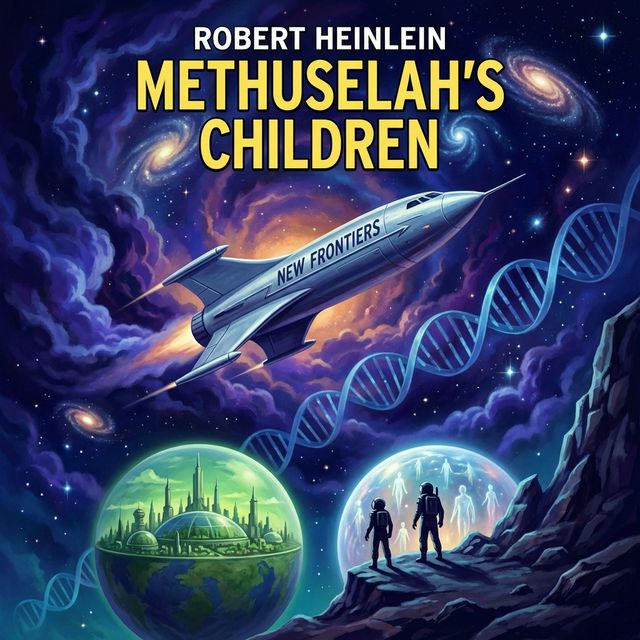
Author: Robert A. Heinlein
Original Publication: 1941 (serialized), 1958 (expanded novel)
Series: Future History
About the Book
Methuselah’s Children is a science fiction classic that introduces one of Heinlein’s most iconic characters: Lazarus Long. The work explores profound questions about longevity, social prejudice, and the search for freedom in a vast and unknown universe.
The Premise: The Howard Families
It all begins with Ira Howard, a man who, lamenting his own premature death, establishes the Howard Foundation with an audacious goal: to prolong human life. Through a selective breeding program spanning generations, the Howard Families achieve lifespans exceeding 150 years, sometimes surpassing 200 years, while maintaining a youthful appearance.
To protect their secret from the general population, the Howards maintain “The Masquerade” , faking their deaths and assuming new identities repeatedly. But in the 22nd century, their secret is revealed, and the consequences are devastating.
The Conflict: Persecution and Flight
When the existence of the Howards becomes known, the “Ephemerals”, short-lived humans, react with resentment and envy. Believing that the Howards are hiding a secret to immortality rather than acknowledging their genetic origins, Earth’s society plans forced interrogations and systematic persecution.
Led by Lazarus Long, the eldest member of the Families, the Howards make a radical decision: hijack the colony ship New Frontiers and embark on an interstellar journey in search of a new home where they can live in peace.
The Space Odyssey: Alien Encounters
The Howards’ journey takes them to extraordinary and disturbing worlds:
First Planet: They encounter humanoids domesticated by a higher intelligence. Resisting submission, they are expelled at faster-than-light speeds.
Second Planet: They discover a lush environment inhabited by the “Little People”, beings with a collective mind capable of manipulating their environment at genetic and molecular levels. Initially fascinating, the experience becomes a nightmare when the collective mind genetically transforms a human baby into an alien form. Mary Sperling, one of their own, is assimilated by the collective consciousness, losing her individuality forever.
Horrified by the loss of individual autonomy, the Howards use FTL technology learned from the aliens to return to Earth.
The Return: A Transformed World
After 74 years (due to time dilation), the Howards return to an unrecognizable Earth. Earth’s science has independently developed artificial means to extend human lifespan. No longer unique or persecuted for their longevity, they are now welcomed, especially for bringing the discovery of FTL travel.
Lazarus Long, along with Andrew “Slipstick” Libby, decides to recruit other Howards and venture into space again, embracing a future of infinite possibilities and seeking new meaning for their long lives.
Central Themes
Longevity and Identity: The novel confronts the consequences of extended lives, both for individuals and for society. It questions the purpose of existence when you have centuries ahead.
Prejudice and Social Alienation: The hostility of the Ephemerals reveals how differences can generate fear, envy, and attempts at control. The refusal to accept the simple genetic truth illustrates human nature’s tendency to seek conspiracies where there is only biology.
Freedom versus Conformity: The Howards’ journey is essentially a quest for freedom, the right to exist without persecution, to maintain their individuality against forces demanding conformity.
Humanity and Consciousness: Encounters with aliens force reflections on what it means to be human. Mary Sperling’s assimilation by the collective mind represents the horror of losing individuality, a theme that resonates deeply in Heinlein’s work.
Ethics of Genetic Manipulation: Implicitly, the book questions the ethical implications of genetic engineering and its social impacts.
Relevance and Legacy
Methuselah’s Children remains relevant for its timeless questions: How does society deal with biological inequalities? What do we do with extraordinarily long lives? When does the pursuit of security justify the oppression of minorities?
The work subtly critiques the “tyranny of the majority” and how democratic processes can, paradoxically, lead to oppression. It suggests that mere existence is not enough, a long life must have purpose, exploration, and meaning.
Lazarus Long became one of science fiction’s most enduring characters, appearing in several of Heinlein’s later works, always representing the indomitable spirit of exploration and the refusal to accept limitations.
Conclusion
Methuselah’s Children is more than a space adventure, it’s a meditation on mortality, freedom, and what it means to be human in a vast and indifferent universe. Heinlein invites us to question our prejudices, value our individuality, and never stop exploring, whether the outer cosmos or the depths of human experience.
| Era / Concept | Technological Feature | Societal Consequence |
|---|---|---|
| Howard Families | Selective Breeding | Longevity and public envy |
| Starship Exile | Torch Ships | Search for autonomous diaspora |
| Jockaira & Little People | Post-Human Intelligence | Humbling of human arrogance |
📺 Recommended YouTube Channels
- Quinn’s Ideas – Deep sci-fi lore and Robert Heinlein retrospectives.
- Isaac Arthur (SFIA) – Futurism, space habitats, and immortality science.

I write things about books, animes and movies. I am passionate about this topics and want to share with you my impressions.