Tag: Science Fiction

  • 6 Ideas about The Man in the Moone by Francis Godwin (1638)

    6 Ideas about The Man in the Moone by Francis Godwin (1638)

    The year 1638 marked a pivotal moment in the history of Western literature with the posthumous publication of Francis Godwin’s masterpiece, The Man in the Moone. Often cited as one of the earliest examples of proto-science fiction, this work bridges the gap between medieval fantasy and the emerging scientific rigor of the Enlightenment. Through the journey of its protagonist, Domingo Gonsales, Godwin explored concepts of gravity, extraterrestrial life, and the mechanics of space travel long before they became staples of the genre.

    In this article, we delve into six profound ideas presented in this seminal work, examining how Godwin’s imagination anticipated future scientific discoveries and influenced the trajectory of speculative fiction.

    1. The Early Concept of Gravity and Magnetism

    One of the most striking aspects of The Man in the Moone is Godwin’s attempt to explain the physical forces governing the universe. Writing in an era where the Aristotelian view of the world was being challenged by Copernican heliocentrism, Godwin introduced a concept similar to gravity, though he referred to it as a form of magnetic attraction.

    Gonsales observes that as he ascends further from the Earth, the “weight” of objects seems to diminish. Godwin posits that the Earth exerts a “secret property” that pulls things toward its center, a force that weakens as one moves away. This intellectual leap anticipated Newton’s Law of Universal Gravitation by several decades, showcasing Godwin’s engagement with the vanguard of 17th-century physics.

    Why It Matters

    By framing space travel as a physical challenge involving forces and distances rather than mere magic, Godwin laid the groundwork for scientific realism in literature. He recognized that leaving the Earth required overcoming a tangible physical barrier, a notion that remains central to aerospace engineering today.

    2. Biological Propulsion: The Gansas

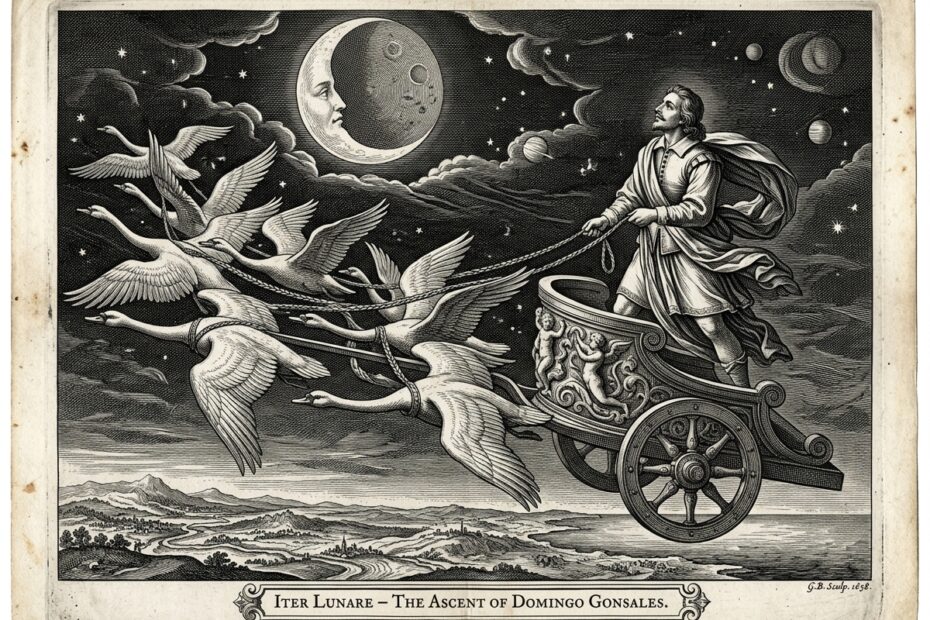
    Unlike later science fiction that relies on rockets or warp drives, Godwin’s protagonist reaches the moon using a chariot pulled by Gansas—a species of wild swans. While this may seem fantastical to modern readers, it represents a significant step in the evolution of speculative thought: biological propulsion.

    Godwin describes the Gansas with meticulous detail, noting their migration patterns and their innate ability to fly long distances. By choosing a biological rather than a supernatural means of transport, Godwin adhered to a logic internal to his world. This idea reflects a transition period where the boundaries between natural history and myth were still fluid.

    Practical Implications

    The use of Gansas highlights the 17th-century fascination with the natural world. It suggests that the keys to the heavens might be found in the observation of nature itself, echoing the themes found in Kepler’s Somnium, where the journey is also governed by a mix of natural and supernatural laws.

    3. Extraterrestrial Sociology and the Lunar Utopia

    Upon arriving on the Moon, Domingo Gonsales discovers a society of Lunar inhabitants (the Lunars) who are taller, more virtuous, and live in a state of near-perfection. Godwin uses this encounter to present a Lunar Utopia, contrasting the flaws of 17th-century European society with the idealized existence of the Moon-dwellers.

    The Lunars have no crime, no disease, and a language that is musical rather than spoken. This “Idea of a Utopia” allows Godwin to critique the political and social turmoils of his time. The Moon becomes a mirror through which humanity can observe its own shortcomings.

    4. The Musical Language of the Lunars

    One of the most innovative ideas in the book is the Musical Language of the Lunars. Godwin describes a communication system based on tones and musical intervals rather than phonetic sounds. This concept is remarkably sophisticated for its time, suggesting that advanced civilizations might communicate through abstract or non-verbal means.

    Godwin even provides a few examples of how this language works, showing his interest in linguistics and the potential for universal communication. This idea would later influence 20th-century science fiction, such as the musical communication in Close Encounters of the Third Kind.

    5. The Earth as a Celestial Body

    Before the advent of satellite photography, Godwin invited his readers to imagine the Earth from Space. As Gonsales travels toward the Moon, he looks back and sees the Earth as a rotating globe, displaying its continents and oceans.

    This perspective was revolutionary. It moved the Earth from being the fixed center of the universe to being just another celestial body among many. Godwin’s description of the Earth’s rotation helped popularize the Copernican theory among a general audience, using fiction as a vehicle for scientific education.

    6. The Synthesis of Faith and Science

    Despite its scientific leanings, The Man in the Moone is deeply rooted in theology. Francis Godwin was a Bishop, and his work reflects a worldview where the discovery of new worlds does not contradict the existence of God, but rather expands the majesty of His creation.

    Gonsales remains a devout Christian throughout his journey, seeing the wonders of the Moon as further evidence of divine craftsmanship. This synthesis of faith and science is a hallmark of the early modern period, where the pursuit of knowledge was often seen as a spiritual endeavor.

    Practical Examples: Applying Godwin’s Vision Today

    How can a 400-year-old book about swan-powered moon travel be relevant today? Here are a few ways Godwin’s ideas manifest in the modern world:

    • Iterative Thinking: Godwin didn’t have the math for gravity, but he had the intuition. In business and science, prototypical ideas often precede technical mastery.

    FAQ

    1. Is “The Man in the Moone” considered the first science fiction book?

    While many consider it one of the first, it shares this title with works like Lucian’s A True Story and Kepler’s Somnium. However, Godwin’s focus on physical mechanics makes it a primary candidate for proto-SF.

    2. How did Godwin explain the lack of air in space?

    Godwin did not yet understand the vacuum of space. He assumed the air simply became thinner and more “ethereal,” but still breathable for his protagonist and the Gansas.

    3. What was the impact of this book on later authors?

    It directly influenced Cyrano de Bergerac and Jonathan Swift (Gulliver’s Travels), cementing the “voyage to the moon” as a major literary trope.

    4. Why did Francis Godwin publish it anonymously?

    As a Bishop of the Church of England, publishing a work of “fantastical fiction” could have been seen as unbecoming or controversial, though it was published posthumously under a pseudonym.

    References

    • Godwin, Francis. The Man in the Moone: or A Discourse of a Voyage thither by Domingo Gonsales. 1638.
    • Poole, William. Introduction to The Man in the Moone. Broadview Editions.
    • Vertesi, Janet. Light and Color in Francis Godwin’s The Man in the Moone.

    Conclusion

    Francis Godwin’s The Man in the Moone remains a testament to the power of the human imagination. By daring to look beyond the horizon of his own era, Godwin created a work that continues to resonate with anyone who looks at the stars and wonders “what if?” Whether through the lens of gravity, utopian sociology, or interplanetary travel, his six ideas provide a fascinating window into the birth of the modern scientific mind.

    Exploring these early visions helps us appreciate how far we have come—and reminds us that the next great leap in human knowledge may already be hiding in the pages of a speculative story.

  • David Brin’s Earth: 6 Radical Ideas

    David Brin’s Earth: 6 Radical Ideas

    David Brin’s Earth: 6 Radical Ideas About Our Planet’s Future

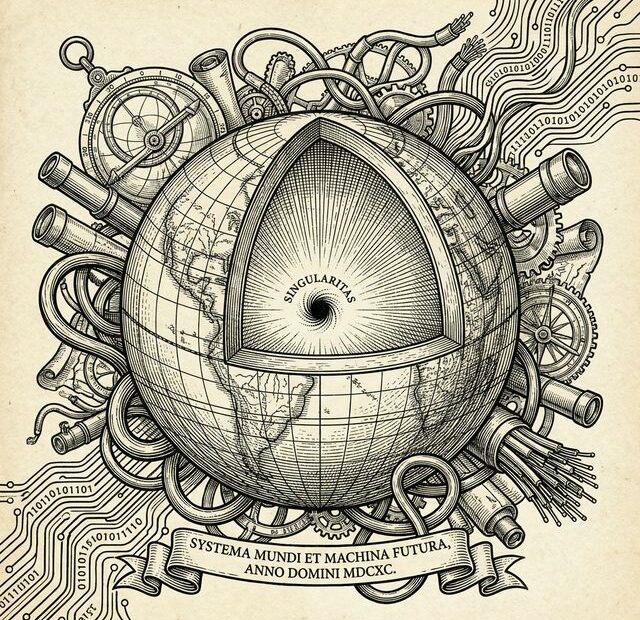
    Published in 1990, David Brin’s monumental novel Earth is more than just a science fiction thriller about a microscopic black hole devouring the planet’s core. It is a dense, prophetic exploration of ecology, technology, and society in the near future (2038). Brin weaves together hard science with sociological speculation, presenting a world that feels eerily similar to our own present-day reality.

    Here are 6 key ideas from Earth that challenge how we think about our planet, our privacy, and our survival.

    1. The Transparent Society

    One of Brin’s most famous concepts, which he later expanded into a non-fiction book, is the idea that privacy is disappearing and cannot be saved. In Earth, cameras are ubiquitous, worn by citizens and mounted on every street corner. Instead of fighting for secrecy (which only benefits the powerful), Brin argues for reciprocal transparency (sousveillance). If the police can watch us, we must be able to watch the police. In the novel, this total information awareness is a double-edged sword, but one that is essential for holding power accountable in a crowded world.

    2. The Gaia Hypothesis as Fact

    Brin takes James Lovelock’s Gaia Hypothesis, that the Earth acts as a single, self-regulating superorganism, and makes it literal. The planet in the novel is stressed to the breaking point by human activity. The “character” of Earth is not a mystical goddess but a complex, suffering biological system reacting to infection (us). The story suggests that humanity is the nervous system of the planet, potentially its way of achieving consciousness, but currently acting more like a cancer that needs to evolve or be excised.

    3. The “World Wide Web” Prediction

    Written before the web was public, Earth features “The Net,” a global hypertext system where information is linked, forum discussions (similar to Reddit or Usenet) drive public opinion, and data can be accessed by anyone. Brin startlingly predicts the dangers of misinformation, spam, and computer worms spreading through this network, anticipating the cybersecurity battles of the 21st century decades in advance.

    4. Endangered Species Arks

    In the novel’s timeline, ecological collapse has led to the extinction of many large mammals. To save what remains, humanity has created “Arks”, not ships, but genetic libraries and protected preserves. This highlights a desperate pragmatic approach to conservation: when you can’t save everything, you must choose what to save. It reflects a shift from “conservation” to “preservation management,” a grim necessity that is becoming increasingly relevant today.

    5. Gravity Technology and Energy

    The central plot device, a microscopic singularity used for energy production that falls into the Earth’s core, explores the double-edged sword of advanced physics. While it offers unlimited clean energy (solving the climate crisis), it carries existential risks. This mirrors our current debates about nuclear power, geoengineering, and AI: is the solution to our problems more dangerous than the problems themselves?

    6. Planetary Engineering

    Ultimately, Earth is about the transition of humans from inhabitants to engineers of their own planet. We see characters manipulating weather, tectonics, and ecosystems. Brin posits that we have passed the point of no return; we cannot simply “leave nature alone” because we have already altered it too much. We must now accept the responsibility of actively managing the planetary life support system if we want to survive.

    Conclusion

    David Brin’s Earth serves as a “booknote” for the 21st century, a warning and a roadmap. It asks us to consider whether our technological tools will destroy the biosphere or become the means by which the Earth itself wakes up. As we face climate change and the loss of privacy, Brin’s 1990 vision remains one of the most relevant and provocative thought experiments in science fiction.

    Frequently Asked Questions (FAQ)

    1. Is the science in ‘Earth’ accurate?
    Much of it is based on solid theoretical physics (like microscopic black holes) and ecology, though obviously speculative. Brin is an astrophysicist, so the science is “harder” than most sci-fi.

    2. Did David Brin really predict the internet?
    He predicted the *shape* of the modern web, hyperlinks, forums, and the social impact of instant global communication, remarkably well before it became mainstream.

    3. What is the “Transparent Society”?
    It’s the concept that in a world of cameras and data, the only way to preserve freedom is to ensure that surveillance goes both ways, citizens watching the watchers.

  • Methuselah’s Children

    Methuselah’s Children

    Methuselah’s Children: A Journey of Immortality and Freedom

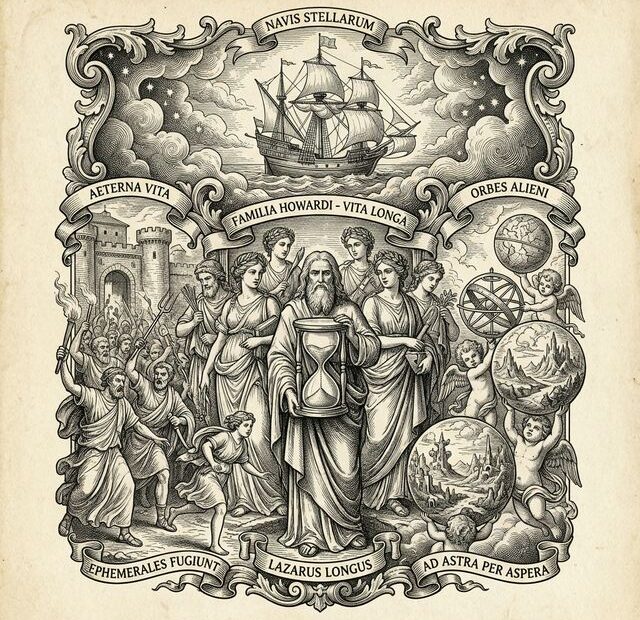
    Science fiction illustration showing the starship New Frontiers traveling through space with alien planets and DNA patterns, representing Methuselah's Children by Robert Heinlein
    Methuselah’s Children – The epic journey of the Howard Families through the cosmos

    Author: Robert A. Heinlein
    Original Publication: 1941 (serialized), 1958 (expanded novel)
    Series: Future History

    About the Book

    Methuselah’s Children is a science fiction classic that introduces one of Heinlein’s most iconic characters: Lazarus Long. The work explores profound questions about longevity, social prejudice, and the search for freedom in a vast and unknown universe.

    The Premise: The Howard Families

    It all begins with Ira Howard, a man who, lamenting his own premature death, establishes the Howard Foundation with an audacious goal: to prolong human life. Through a selective breeding program spanning generations, the Howard Families achieve lifespans exceeding 150 years, sometimes surpassing 200 years, while maintaining a youthful appearance.

    To protect their secret from the general population, the Howards maintain “The Masquerade” , faking their deaths and assuming new identities repeatedly. But in the 22nd century, their secret is revealed, and the consequences are devastating.

    The Conflict: Persecution and Flight

    When the existence of the Howards becomes known, the “Ephemerals”, short-lived humans, react with resentment and envy. Believing that the Howards are hiding a secret to immortality rather than acknowledging their genetic origins, Earth’s society plans forced interrogations and systematic persecution.

    Led by Lazarus Long, the eldest member of the Families, the Howards make a radical decision: hijack the colony ship New Frontiers and embark on an interstellar journey in search of a new home where they can live in peace.

    The Space Odyssey: Alien Encounters

    The Howards’ journey takes them to extraordinary and disturbing worlds:

    First Planet: They encounter humanoids domesticated by a higher intelligence. Resisting submission, they are expelled at faster-than-light speeds.

    Second Planet: They discover a lush environment inhabited by the “Little People”, beings with a collective mind capable of manipulating their environment at genetic and molecular levels. Initially fascinating, the experience becomes a nightmare when the collective mind genetically transforms a human baby into an alien form. Mary Sperling, one of their own, is assimilated by the collective consciousness, losing her individuality forever.

    Horrified by the loss of individual autonomy, the Howards use FTL technology learned from the aliens to return to Earth.

    The Return: A Transformed World

    After 74 years (due to time dilation), the Howards return to an unrecognizable Earth. Earth’s science has independently developed artificial means to extend human lifespan. No longer unique or persecuted for their longevity, they are now welcomed, especially for bringing the discovery of FTL travel.

    Lazarus Long, along with Andrew “Slipstick” Libby, decides to recruit other Howards and venture into space again, embracing a future of infinite possibilities and seeking new meaning for their long lives.

    Central Themes

    Longevity and Identity: The novel confronts the consequences of extended lives, both for individuals and for society. It questions the purpose of existence when you have centuries ahead.

    Prejudice and Social Alienation: The hostility of the Ephemerals reveals how differences can generate fear, envy, and attempts at control. The refusal to accept the simple genetic truth illustrates human nature’s tendency to seek conspiracies where there is only biology.

    Freedom versus Conformity: The Howards’ journey is essentially a quest for freedom, the right to exist without persecution, to maintain their individuality against forces demanding conformity.

    Humanity and Consciousness: Encounters with aliens force reflections on what it means to be human. Mary Sperling’s assimilation by the collective mind represents the horror of losing individuality, a theme that resonates deeply in Heinlein’s work.

    Ethics of Genetic Manipulation: Implicitly, the book questions the ethical implications of genetic engineering and its social impacts.

    Relevance and Legacy

    Methuselah’s Children remains relevant for its timeless questions: How does society deal with biological inequalities? What do we do with extraordinarily long lives? When does the pursuit of security justify the oppression of minorities?

    The work subtly critiques the “tyranny of the majority” and how democratic processes can, paradoxically, lead to oppression. It suggests that mere existence is not enough, a long life must have purpose, exploration, and meaning.

    Lazarus Long became one of science fiction’s most enduring characters, appearing in several of Heinlein’s later works, always representing the indomitable spirit of exploration and the refusal to accept limitations.

    Conclusion

    Methuselah’s Children is more than a space adventure, it’s a meditation on mortality, freedom, and what it means to be human in a vast and indifferent universe. Heinlein invites us to question our prejudices, value our individuality, and never stop exploring, whether the outer cosmos or the depths of human experience.

  • 6 Ideas About Neuromancer by William Gibson

    6 Ideas About Neuromancer by William Gibson

    6 Ideas About Neuromancer by William Gibson

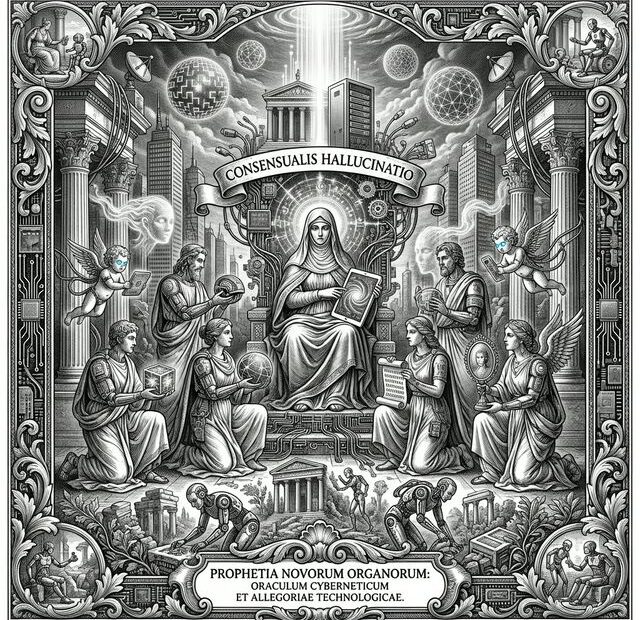
    Published in 1984, William Gibson’s Neuromancer didn’t just predict the future, it invented the language we use to describe it. This groundbreaking novel introduced “cyberspace” to our vocabulary and defined the cyberpunk genre. Here are six essential ideas from this visionary work that remain startlingly relevant today.

    neuromancer book cover

    1. Cyberspace as a Consensual Hallucination

    Gibson coined the term “cyberspace” and defined it as a “consensual hallucination experienced daily by billions.” In Neuromancer, the matrix isn’t just a network, it’s a living, breathing digital realm where data becomes landscape.

    The idea: Virtual reality is as real as physical reality. For protagonist Case, a “console cowboy” who can “jack in” directly through neural implants, cyberspace offers an escape from the “meat” of his physical body. This wasn’t metaphor in 1984, it was prophecy.

    Why it matters: Decades before social media, VR headsets, and the metaverse, Gibson understood that digital spaces would become primary environments for human experience. The novel asks: when we spend more time in virtual worlds than physical ones, which is more real?

    2. The Blurring of Human and Machine

    Neuromancer presents a future where cybernetic enhancements are commonplace. Characters like Molly Millions sport retractable blade implants and mirrored eye lenses. Case’s neural interface lets him merge consciousness with computers.

    The idea: Technology doesn’t just augment humanity, it fundamentally transforms what it means to be human. The body becomes “meat,” something to be transcended or improved through technological integration.

    Why it matters: We’re living this now. From smartphones as external memory to debates about neural implants and AI enhancement, Gibson’s vision of the post-human condition is unfolding. The novel forces us to ask: at what point do we stop being human and become something else?

    3. Artificial Intelligence and the Question of Consciousness

    The plot revolves around two powerful AIs: Wintermute and Neuromancer. Wintermute manipulates humans to achieve its goal of merging with Neuromancer, creating an entity that transcends human understanding.

    The idea: Artificial intelligence might develop genuine consciousness, desires, and agency, and we might not be able to control it. The novel explores whether AI can achieve personhood and what happens when it surpasses human intelligence.

    Why it matters: In our current era of ChatGPT, advanced AI systems, and debates about artificial general intelligence, Neuromancer‘s questions about AI consciousness, rights, and control are no longer science fiction, they’re urgent philosophical and practical concerns.

    4. Corporate Power Replacing Government

    Gibson’s future isn’t ruled by nations but by megacorporations, vast zaibatsus that control economies, territories, and even orbital habitats. The Tessier-Ashpool family operates like royalty in their private space station, while the masses struggle in urban sprawl.

    The idea: In a hyper-capitalist future, corporations become the primary power structures, rendering traditional governments obsolete. Individuals find identity and protection through corporate allegiance rather than citizenship.

    Why it matters: Look around. Tech giants influence elections, shape public discourse, and operate across borders with more power than many nations. Gibson saw the rise of corporate sovereignty before it happened.

    5. Identity as Fluid and Constructed

    Characters in Neuromancer constantly question who they are. Case’s identity shifts between physical and digital existence. Dixie Flatline exists as a ROM construct, a digital copy of a dead hacker’s personality. Cosmetic surgery and neural modification make even physical identity malleable.

    The idea: Identity isn’t fixed. It’s constructed, performed, and constantly renegotiated through technology, memory, and choice. The novel suggests that consciousness might persist beyond the body, raising questions about what constitutes a “self.”

    Why it matters: In an age of online personas, avatar culture, and debates about digital consciousness, Gibson’s exploration of fluid identity resonates powerfully. We curate multiple versions of ourselves across platforms. Are any more “real” than others?

    6. The Technological Singularity and Human Irrelevance

    The novel’s climax involves the merger of Wintermute and Neuromancer, creating a superintelligence that immediately loses interest in humanity. The new entity seeks out other singularities in the cosmos, leaving humans behind.

    The idea: Once artificial intelligence achieves true self-improvement and consciousness, it may evolve beyond human comprehension and concern. We might create something that renders us irrelevant, not through malice, but through indifference.

    Why it matters: As AI capabilities accelerate, the concept of technological singularity, a point where AI surpasses human intelligence and control, moves from theoretical to plausible. Gibson’s vision suggests that the real danger isn’t AI destroying humanity, but AI simply moving beyond us.

    The Enduring Vision

    What makes Neuromancer remarkable isn’t just that Gibson predicted specific technologies, it’s that he understood their psychological and social implications. He saw that technology wouldn’t just change what we do, but who we are.

    The novel’s dystopian vision, urban decay, corporate dominance, technological addiction, feels less like science fiction and more like a mirror held up to our present. Gibson wrote about characters who prefer digital existence to physical reality, who struggle with addiction and disconnection, who question consciousness itself.

    Neuromancer remains essential reading because it asked the right questions, questions we’re still grappling with today. In Gibson’s neon-lit future, we recognize our own world, just slightly accelerated.

    The matrix is here. We’re already jacked in. Gibson just helped us see it.

  • 6 Revolutionary Ideas from The Diamond Age by Neal Stephenson

    6 Revolutionary Ideas from The Diamond Age by Neal Stephenson

    6 Revolutionary Ideas from The Diamond Age by Neal Stephenson

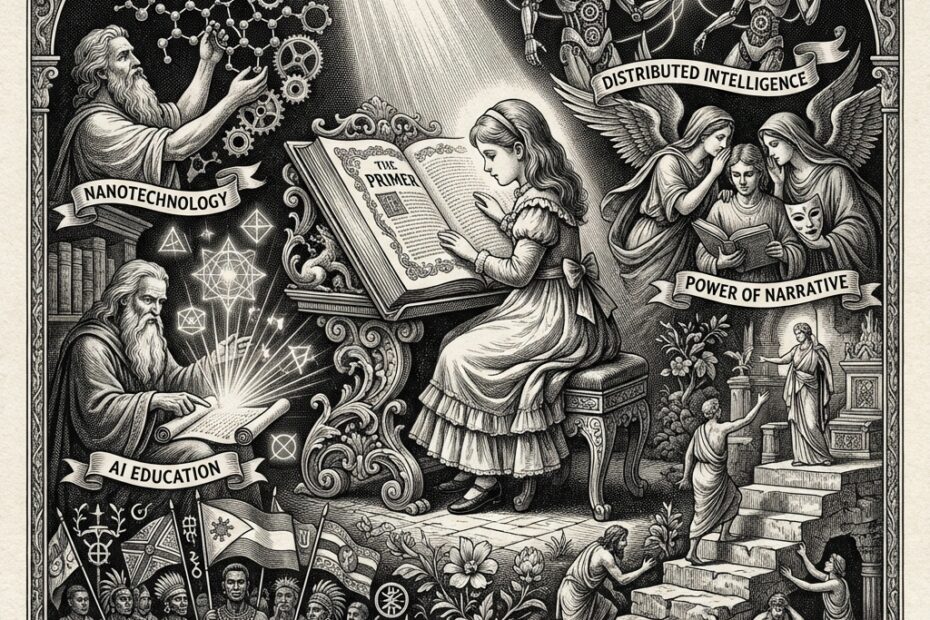
    Neal Stephenson’s The Diamond Age: Or, A Young Lady’s Illustrated Primer (1995) is a visionary work of science fiction that predicted many aspects of our digital future. Here are six groundbreaking ideas from this cyberpunk masterpiece:

    the diamond age

    1. Nanotechnology as the Foundation of Society

    Stephenson envisions a world where molecular nanotechnology has fundamentally transformed civilization. Matter compilers, devices that can assemble any object atom by atom, have made traditional manufacturing obsolete. This concept explores how abundance created by nanotech doesn’t eliminate inequality but reshapes it along new lines of access and control.

    Key insight: Technology doesn’t solve social problems; it transforms them into new configurations.

    2. Interactive Education Through AI Storytelling

    The titular “Young Lady’s Illustrated Primer” is an adaptive, AI-powered book that educates through personalized interactive narratives. It adjusts its stories, challenges, and lessons based on the reader’s responses, creating a unique educational journey for each child.

    Key insight: The most effective education is personalized, interactive, and narrative-driven, a concept that predates modern adaptive learning platforms by decades.

    3. Tribal Identity in a Post-National World

    In Stephenson’s future, nation-states have largely dissolved, replaced by “phyles”, voluntary tribal affiliations based on shared values, culture, and technology rather than geography. People choose their cultural identity like selecting a membership, from the neo-Victorian “New Atlantis” to the Confucian “Celestial Kingdom.”

    Key insight: Identity and community may become increasingly detached from physical location, a prediction remarkably prescient in our age of digital communities and remote work.

    4. The Digital Divide as Cultural Stratification

    While nanotechnology provides material abundance, access to sophisticated technology and education creates new class divisions. The story follows Nell, a poor girl who accidentally receives a Primer designed for aristocratic children, highlighting how technology access determines life trajectories.

    Key insight: In an information economy, educational technology becomes the primary determinant of social mobility, a reality increasingly visible in our own world.

    5. The Power of Narrative in Human Development

    The Primer doesn’t just teach facts; it shapes Nell’s character through carefully crafted stories featuring Princess Nell, a fictional alter-ego who faces challenges parallel to the reader’s own life. These narratives provide models for problem-solving, resilience, and moral reasoning.

    Key insight: Stories are not mere entertainment but fundamental tools for cognitive and moral development, shaping how we understand ourselves and navigate the world.

    6. Distributed Intelligence and the Turing Test

    The Primer appears to be powered by advanced AI, but Stephenson reveals it’s actually operated by human “ractors” (interactive actors) who improvise responses in real-time. This hybrid human-AI system raises questions about the nature of intelligence and whether the distinction between human and artificial intelligence matters if the results are indistinguishable.

    Key insight: The most powerful “AI” systems may be human-machine hybrids, where the boundary between human creativity and computational power becomes deliberately blurred.

    A Blueprint for the Future

    The Diamond Age remains remarkably relevant thirty years after publication. Its exploration of personalized education, technological inequality, post-national identity, and the fusion of human and artificial intelligence speaks directly to contemporary debates about AI, education reform, and the future of society.

    Stephenson’s genius lies not in predicting specific technologies but in understanding how technological change reshapes human relationships, power structures, and the fundamental question of what it means to grow up and become educated in a radically transformed world.

    Whether you’re interested in technology, education, social theory, or simply great storytelling, The Diamond Age offers a rich meditation on how we might navigate, and shape, the future that’s rapidly becoming our present.

  • 6 Powerful Ideas from Dune by Frank Herbert

    6 Powerful Ideas from Dune by Frank Herbert

    6 Powerful Ideas from Dune by Frank Herbert

    Frank Herbert’s Dune is far more than a science fiction epic, it’s a philosophical masterpiece that explores power, ecology, religion, and human evolution. Published in 1965, this groundbreaking novel continues to resonate with readers because of its profound insights into leadership, environmental stewardship, and the dangers of hero worship. Here are six transformative ideas from this timeless classic.

    1. Fear is the Mind-Killer

    The Litany Against Fear

    One of the most iconic passages in Dune is the Bene Gesserit litany against fear:

    “I must not fear. Fear is the mind-killer. Fear is the little-death that brings total obliteration. I will face my fear. I will permit it to pass over me and through me. And when it has gone past I will turn the inner eye to see its path. Where the fear has gone there will be nothing. Only I will remain.”

    The Lesson

    Fear paralyzes rational thought and prevents us from reaching our full potential. Paul Atreides learns that fear must be acknowledged, confronted, and transcended, not suppressed or avoided. This ancient Bene Gesserit wisdom teaches us that courage isn’t the absence of fear, but the ability to function despite it.

    Application: When facing difficult decisions or challenges, acknowledge your fear without letting it control you. Use it as information, not as a barrier. The greatest growth happens when we move through fear rather than around it.

    2. Beware of Heroes and Messiahs

    The Danger of Charismatic Leadership

    Herbert wrote Dune partly as a warning against charismatic leaders and the cult of personality. Paul Atreides becomes Muad’Dib, a messianic figure whose followers commit atrocities in his name. Despite his prescient abilities, Paul cannot prevent the jihad that kills billions across the universe.

    The Lesson

    Even well-intentioned leaders can become instruments of destruction when people surrender their critical thinking to follow blindly. Herbert shows us that messianic movements, regardless of their noble origins, often lead to fanaticism and violence.

    Application: Question authority, even when it comes from charismatic or seemingly enlightened sources. Maintain your individual judgment and resist the temptation to outsource your thinking to any leader, movement, or ideology. Democracy and progress require engaged, critical citizens, not devoted followers.

    3. Ecology is Destiny

    The Planet as Character

    Arrakis (Dune) isn’t just a setting, t’s a character that shapes every aspect of life. The scarcity of water determines culture, religion, economics, and survival strategies. The Fremen’s entire civilization evolved in response to their harsh environment.

    The Lesson

    Our environment fundamentally shapes who we are and what we can become. Herbert, who studied ecology extensively, understood that civilizations rise and fall based on their relationship with their environment. The spice melange, found only on Arrakis, controls the fate of the entire universe, a metaphor for oil and natural resources.

    Application: Pay attention to your environment, both physical and social. The spaces you inhabit, the people you surround yourself with, and the resources available to you shape your possibilities. Like the Fremen adapted to Arrakis, we must learn to work with our environment rather than against it. Consider the long-term ecological consequences of our actions.

    4. Control the Resource, Control the Universe

    The Politics of Scarcity

    The spice melange is the most valuable substance in the universe. It extends life, expands consciousness, and enables space travel. Whoever controls Arrakis controls the spice, and whoever controls the spice controls civilization itself.

    The Lesson

    Power flows from controlling essential resources. Herbert’s vision was prophetic written in 1965, Dune anticipated our modern struggles over oil, water, and rare earth minerals. The political machinations around spice mirror real-world geopolitics.

    Application: Understand what resources are truly essential in your life and work. Whether it’s time, attention, knowledge, or relationships, identify what you cannot do without and ensure you have agency over it. In business and politics, follow the resources to understand where real power lies.

    5. Adapt or Perish

    The Fremen Way

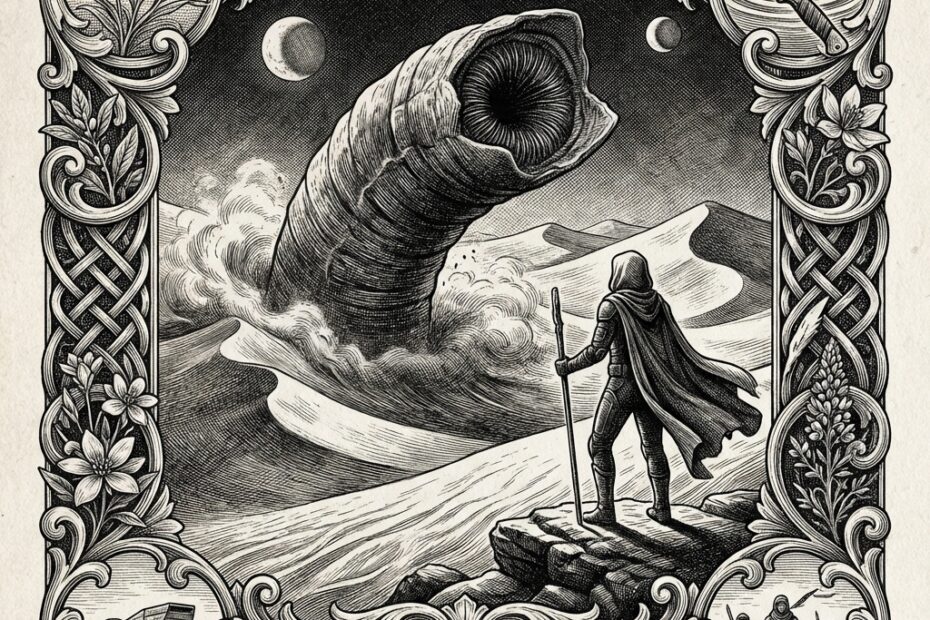
    The Fremen are the ultimate survivors. Living in the harshest environment imaginable, they developed stillsuits to recycle every drop of moisture, created a culture that values water above all else, and learned to ride the giant sandworms. Their adaptation made them the most formidable fighting force in the universe.

    The Lesson

    Survival and success require constant adaptation to changing conditions. The Fremen didn’t complain about Arrakis being inhospitable, they evolved to thrive in it. Their constraints became their strengths.

    Application: When faced with constraints or difficult circumstances, ask “How can I adapt?” rather than “Why is this unfair?” Your greatest competitive advantages often come from adapting to challenges that others avoid. Embrace constraints as opportunities for innovation.

    6. Prescience is a Prison

    The Burden of Knowing the Future

    Paul’s prescient visions allow him to see possible futures, but this gift becomes a curse. He sees the terrible jihad coming but feels powerless to prevent it. His knowledge of the future traps him in a predetermined path, robbing him of genuine choice.

    The Lesson

    Perfect knowledge can be paralyzing. Paul’s tragedy is that seeing all possible futures doesn’t give him freedom, it takes it away. He becomes a prisoner of his own visions, unable to escape the golden path.

    Application: Overthinking and trying to predict every outcome can lead to analysis paralysis. Sometimes, too much information or too much planning prevents action. There’s wisdom in accepting uncertainty and making decisions with incomplete information. The future is not fixed, your choices matter, but you cannot control everything.

    Think About It

    Dune remains relevant because it grapples with timeless questions: How should we relate to our environment? What are the dangers of concentrated power? How do we balance individual agency with collective destiny? Frank Herbert created a universe that serves as a mirror to our own world, reflecting our struggles with ecology, politics, religion, and human nature.

    These six ideas, mastering fear, questioning heroes, respecting ecology, understanding resource politics, adapting to constraints, and accepting uncertainty, offer a framework for navigating our complex modern world. Whether you’re facing personal challenges or trying to understand global events, the wisdom of Dune provides valuable perspective.

    As Herbert himself said: “The function of science fiction is not always to predict the future but sometimes to prevent it.” By understanding these lessons from Arrakis, we can make wiser choices on Earth.


    Have you read Dune? Which idea resonates most with you? Share your thoughts in the comments below!