6 Revolutionary Ideas from The Diamond Age by Neal Stephenson
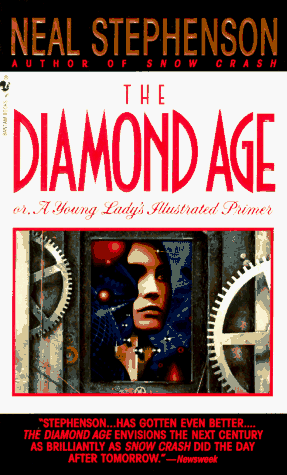
Neal Stephenson’s The Diamond Age: Or, A Young Lady’s Illustrated Primer (1995) is a visionary work of science fiction that predicted many aspects of our digital future. Here are six groundbreaking ideas from this cyberpunk masterpiece:
1. Nanotechnology as the Foundation of Society
Stephenson envisions a world where molecular nanotechnology has fundamentally transformed civilization. Matter compilers, devices that can assemble any object atom by atom, have made traditional manufacturing obsolete. This concept explores how abundance created by nanotech doesn’t eliminate inequality but reshapes it along new lines of access and control.
Key insight: Technology doesn’t solve social problems; it transforms them into new configurations.
2. Interactive Education Through AI Storytelling
The titular “Young Lady’s Illustrated Primer” is an adaptive, AI-powered book that educates through personalized interactive narratives. It adjusts its stories, challenges, and lessons based on the reader’s responses, creating a unique educational journey for each child.
Key insight: The most effective education is personalized, interactive, and narrative-driven, a concept that predates modern adaptive learning platforms by decades.
3. Tribal Identity in a Post-National World
In Stephenson’s future, nation-states have largely dissolved, replaced by “phyles”, voluntary tribal affiliations based on shared values, culture, and technology rather than geography. People choose their cultural identity like selecting a membership, from the neo-Victorian “New Atlantis” to the Confucian “Celestial Kingdom.”
Key insight: Identity and community may become increasingly detached from physical location, a prediction remarkably prescient in our age of digital communities and remote work.
4. The Digital Divide as Cultural Stratification
While nanotechnology provides material abundance, access to sophisticated technology and education creates new class divisions. The story follows Nell, a poor girl who accidentally receives a Primer designed for aristocratic children, highlighting how technology access determines life trajectories.
Key insight: In an information economy, educational technology becomes the primary determinant of social mobility, a reality increasingly visible in our own world.
5. The Power of Narrative in Human Development
The Primer doesn’t just teach facts; it shapes Nell’s character through carefully crafted stories featuring Princess Nell, a fictional alter-ego who faces challenges parallel to the reader’s own life. These narratives provide models for problem-solving, resilience, and moral reasoning.
Key insight: Stories are not mere entertainment but fundamental tools for cognitive and moral development, shaping how we understand ourselves and navigate the world.
6. Distributed Intelligence and the Turing Test
The Primer appears to be powered by advanced AI, but Stephenson reveals it’s actually operated by human “ractors” (interactive actors) who improvise responses in real-time. This hybrid human-AI system raises questions about the nature of intelligence and whether the distinction between human and artificial intelligence matters if the results are indistinguishable.
Key insight: The most powerful “AI” systems may be human-machine hybrids, where the boundary between human creativity and computational power becomes deliberately blurred.
A Blueprint for the Future
The Diamond Age remains remarkably relevant thirty years after publication. Its exploration of personalized education, technological inequality, post-national identity, and the fusion of human and artificial intelligence speaks directly to contemporary debates about AI, education reform, and the future of society.
Stephenson’s genius lies not in predicting specific technologies but in understanding how technological change reshapes human relationships, power structures, and the fundamental question of what it means to grow up and become educated in a radically transformed world.
Whether you’re interested in technology, education, social theory, or simply great storytelling, The Diamond Age offers a rich meditation on how we might navigate, and shape, the future that’s rapidly becoming our present.
| Idea / Technology | Diamond Age Vision | Modern 2026 Parallel |
|---|---|---|
| The Matter Compiler | Molecular nanotechnology manufacturing | 3D Printing & Synthetic Bio |
| The Young Lady’s Primer | Interactive AI mentor book | Generative AI Tutors |
| Phyles & Neo-Victorians | Culture-based micro-states | Digital Network States |
📺 Recommended YouTube Channels
- Quinn’s Ideas – Cyberpunk literature breakdowns.
- Isaac Arthur – Nanotechnology and future society.

I write things about books, animes and movies. I am passionate about this topics and want to share with you my impressions.