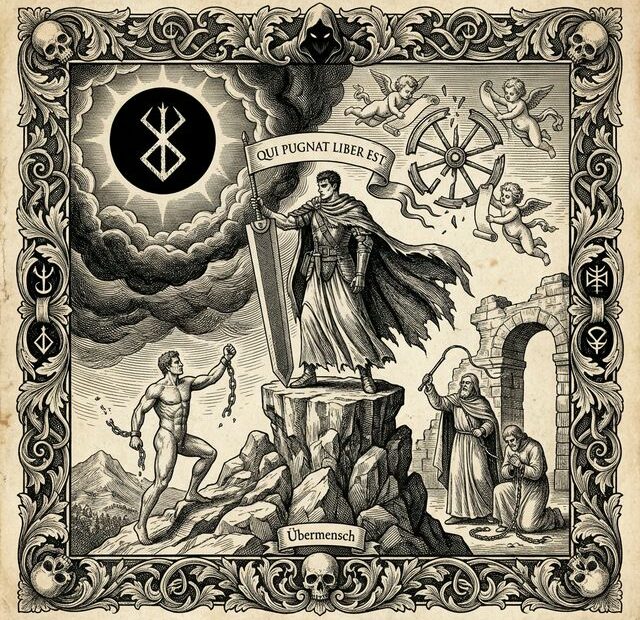

Beyond Good and Evil: A Deep Dive into Berserk’s Philosophy of Struggle
Kentaro Miura’s Berserk is more than a dark fantasy manga, it’s a profound philosophical meditation on human existence, morality, and the nature of struggle itself. At its core, Berserk engages deeply with Nietzschean philosophy, particularly concepts from “Beyond Good and Evil,” transforming them into a visceral narrative about one man’s war against fate.
The Struggler Against Causality
In the world of Berserk, causality reigns supreme. This metaphysical force governs all events like an inexorable river, carrying most characters helplessly along its predetermined course. The God Hand, demonic beings who enforce this cosmic order, represent causality’s terrifying power, the universe itself conspiring to ensure certain outcomes.
Yet Guts, the protagonist known as “The Struggler,” exists partially outside this flow. The Skull Knight observes that Guts is like a fish that can breach the surface of causality’s river, creating ripples that alter what should be inevitable. Even his birth from a corpse symbolizes a rejection of fate’s unalterable flow.
This struggle against predetermined destiny is fundamentally existentialist. Guts refuses to accept that his life’s meaning is written by external forces, whether gods, demons, or cosmic law. Instead, he embodies the existentialist principle that existence precedes essence: we are not born with a set purpose but must create our own meaning through action.
Beyond Good and Evil: The Morality of Guts and Griffith
Nietzsche’s “Beyond Good and Evil” challenges conventional morality, arguing that traditional notions of “good” and “evil” are human constructs that often serve the powerful. Berserk dramatizes this philosophy through its two central characters: Guts and Griffith.
Griffith: The False Übermensch
Griffith initially appears to embody Nietzschean ideals. He creates his own values, pursues his dream with unwavering will, and refuses to be bound by conventional morality. His ambition and charisma seem to mark him as an Übermensch, Nietzsche’s ideal of the self-overcoming individual who transcends herd morality.
But Griffith’s transformation into Femto reveals the hollowness of his philosophy. His “Will to Power” is parasitic, derived from the devotion of others rather than his own intrinsic strength, a manifestation of what Nietzsche called “slave morality” in disguise. By sacrificing his comrades to achieve godhood, Griffith doesn’t transcend humanity; he abandons it entirely, becoming something inhuman and ultimately empty.
Guts: The True Master of Himself
Guts, conversely, begins as a nihilistic antihero indifferent to conventional morality. His traumatic past has stripped away any naive belief in cosmic justice or inherent meaning. Yet through his journey, Guts evolves into something closer to Nietzsche’s true Übermensch.
He creates his own values not through domination but through self-determination. His Dragonslayer sword represents his “Will to Power”, not power over others, but the power to protect his own existence and those he chooses to care for. Unlike Griffith, Guts’s strength is his own, forged through relentless struggle rather than borrowed from followers.
Most crucially, Guts shifts from a path of pure revenge to one of protection. This evolution demonstrates the Nietzschean concept of self-overcoming: he doesn’t simply react to his trauma but actively chooses a new purpose. He becomes a master of himself, defining his own meaning in a meaningless universe.
The Idea of Evil: Humanity’s Need for Meaning
Perhaps Berserk‘s most profound philosophical concept is the “Idea of Evil”, a god-like entity born from humanity’s collective unconscious desire for meaning in suffering. This being manipulates causality to give humans what they desperately crave: a reason for their pain.
This concept brilliantly inverts traditional theodicy. Rather than asking “why does a good God allow evil?”, Berserk suggests that humans created “evil” itself to explain their suffering. The Idea of Evil exists because humanity cannot bear a universe without purpose, even if that purpose is malevolent.
This aligns with Nietzsche’s critique of religion and metaphysics. Humans invent cosmic narratives, gods, fate, karma, to avoid confronting the terrifying freedom of a meaningless existence. The Idea of Evil is humanity’s ultimate act of bad faith: creating a demon to avoid responsibility for creating their own meaning.
Struggle as Life-Affirmation
Nietzsche argued that life’s meaning comes not from avoiding suffering but from affirming it, saying “yes” to existence despite its pain. Guts embodies this philosophy completely.
His life is an unending series of tragedies: childhood trauma, betrayal, the Eclipse, the Brand that marks him for eternal torment. By any rational measure, Guts should despair. Yet he continues to fight, not because he expects ultimate victory or reward, but because the struggle itself has become his meaning.
This is Nietzschean life-affirmation in its purest form. Guts doesn’t struggle for something; he struggles because struggle is what makes him human, what gives his existence weight and significance. His famous declaration, “If there’s no place for me in this world, then I’ll make one with my own hands”, is a perfect expression of creating meaning through will alone.
The Eternal Return and Perpetual Struggle
Nietzsche’s concept of eternal return asks: if you had to live your life exactly as it is, over and over forever, would you affirm it? For most people, this is a horrifying thought. For the Übermensch, it’s liberating.
Guts’s struggle has no clear endpoint. The causality he fights may be unbeatable. The God Hand may be immortal. His quest might be eternal. Yet he continues, suggesting that he would choose this struggle even knowing it might never end, the ultimate affirmation of his existence.
Companions and Authentic Connection
While Nietzsche emphasized individual will, Berserk adds a crucial dimension: authentic human connection. Guts’s evolution from solitary warrior to protector of his companions doesn’t weaken his philosophy, it enriches it.
His relationships with Casca, Schierke, Farnese, and others aren’t dependencies but chosen bonds. They don’t diminish his self-determination; they’re expressions of it. Guts chooses to care, to protect, to connect, and these choices are as much acts of will as swinging his sword.
This suggests that the Übermensch need not be isolated. Creating one’s own values can include valuing others, not from weakness or need, but from strength and choice.
The Philosophical Legacy
Berserk‘s philosophy of struggle resonates because it addresses fundamental human questions: How do we find meaning in suffering? Can we be free in a deterministic universe? What does it mean to be truly human?
Through Guts, Miura suggests that meaning isn’t found, it’s forged. Freedom isn’t the absence of constraints but the will to struggle against them. And humanity isn’t defined by divine spark or rational soul, but by the choice to keep fighting when every reason says to surrender.
In a world governed by causality, where gods are born from human weakness and fate seems inescapable, Guts’s struggle becomes a radical act of defiance. Not defiance against evil, but against meaninglessness itself. He fights not because he’s destined to win, but because the fight itself is his answer to existence.
This is Berserk‘s ultimate philosophical statement: in a universe beyond good and evil, where traditional morality crumbles and cosmic justice is a lie, the struggle to create your own meaning, to become who you choose to be, is the only authentic human response.
The Struggler struggles on. And in that struggle, he becomes free.

I write things about books, animes and movies. I am passionate about this topics and want to share with you my impressions.