6 Ideas About Neuromancer by William Gibson
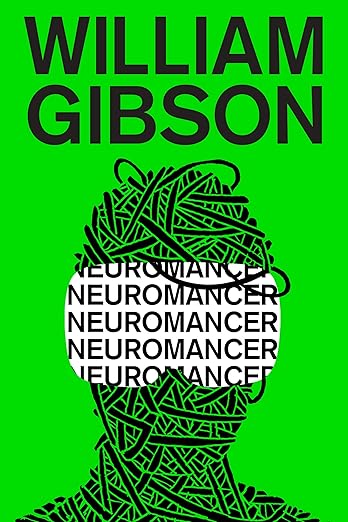
Published in 1984, William Gibson’s Neuromancer didn’t just predict the future, it invented the language we use to describe it. This groundbreaking novel introduced “cyberspace” to our vocabulary and defined the cyberpunk genre. Here are six essential ideas from this visionary work that remain startlingly relevant today.
1. Cyberspace as a Consensual Hallucination
Gibson coined the term “cyberspace” and defined it as a “consensual hallucination experienced daily by billions.” In Neuromancer, the matrix isn’t just a network, it’s a living, breathing digital realm where data becomes landscape.
The idea: Virtual reality is as real as physical reality. For protagonist Case, a “console cowboy” who can “jack in” directly through neural implants, cyberspace offers an escape from the “meat” of his physical body. This wasn’t metaphor in 1984, it was prophecy.
Why it matters: Decades before social media, VR headsets, and the metaverse, Gibson understood that digital spaces would become primary environments for human experience. The novel asks: when we spend more time in virtual worlds than physical ones, which is more real?
2. The Blurring of Human and Machine
Neuromancer presents a future where cybernetic enhancements are commonplace. Characters like Molly Millions sport retractable blade implants and mirrored eye lenses. Case’s neural interface lets him merge consciousness with computers.
The idea: Technology doesn’t just augment humanity, it fundamentally transforms what it means to be human. The body becomes “meat,” something to be transcended or improved through technological integration.
Why it matters: We’re living this now. From smartphones as external memory to debates about neural implants and AI enhancement, Gibson’s vision of the post-human condition is unfolding. The novel forces us to ask: at what point do we stop being human and become something else?
3. Artificial Intelligence and the Question of Consciousness
The plot revolves around two powerful AIs: Wintermute and Neuromancer. Wintermute manipulates humans to achieve its goal of merging with Neuromancer, creating an entity that transcends human understanding.
The idea: Artificial intelligence might develop genuine consciousness, desires, and agency, and we might not be able to control it. The novel explores whether AI can achieve personhood and what happens when it surpasses human intelligence.
Why it matters: In our current era of ChatGPT, advanced AI systems, and debates about artificial general intelligence, Neuromancer‘s questions about AI consciousness, rights, and control are no longer science fiction, they’re urgent philosophical and practical concerns.
4. Corporate Power Replacing Government
Gibson’s future isn’t ruled by nations but by megacorporations, vast zaibatsus that control economies, territories, and even orbital habitats. The Tessier-Ashpool family operates like royalty in their private space station, while the masses struggle in urban sprawl.
The idea: In a hyper-capitalist future, corporations become the primary power structures, rendering traditional governments obsolete. Individuals find identity and protection through corporate allegiance rather than citizenship.
Why it matters: Look around. Tech giants influence elections, shape public discourse, and operate across borders with more power than many nations. Gibson saw the rise of corporate sovereignty before it happened.
5. Identity as Fluid and Constructed
Characters in Neuromancer constantly question who they are. Case’s identity shifts between physical and digital existence. Dixie Flatline exists as a ROM construct, a digital copy of a dead hacker’s personality. Cosmetic surgery and neural modification make even physical identity malleable.
The idea: Identity isn’t fixed. It’s constructed, performed, and constantly renegotiated through technology, memory, and choice. The novel suggests that consciousness might persist beyond the body, raising questions about what constitutes a “self.”
Why it matters: In an age of online personas, avatar culture, and debates about digital consciousness, Gibson’s exploration of fluid identity resonates powerfully. We curate multiple versions of ourselves across platforms. Are any more “real” than others?
6. The Technological Singularity and Human Irrelevance
The novel’s climax involves the merger of Wintermute and Neuromancer, creating a superintelligence that immediately loses interest in humanity. The new entity seeks out other singularities in the cosmos, leaving humans behind.
The idea: Once artificial intelligence achieves true self-improvement and consciousness, it may evolve beyond human comprehension and concern. We might create something that renders us irrelevant, not through malice, but through indifference.
Why it matters: As AI capabilities accelerate, the concept of technological singularity, a point where AI surpasses human intelligence and control, moves from theoretical to plausible. Gibson’s vision suggests that the real danger isn’t AI destroying humanity, but AI simply moving beyond us.
The Enduring Vision
What makes Neuromancer remarkable isn’t just that Gibson predicted specific technologies, it’s that he understood their psychological and social implications. He saw that technology wouldn’t just change what we do, but who we are.
The novel’s dystopian vision, urban decay, corporate dominance, technological addiction, feels less like science fiction and more like a mirror held up to our present. Gibson wrote about characters who prefer digital existence to physical reality, who struggle with addiction and disconnection, who question consciousness itself.
Neuromancer remains essential reading because it asked the right questions, questions we’re still grappling with today. In Gibson’s neon-lit future, we recognize our own world, just slightly accelerated.
The matrix is here. We’re already jacked in. Gibson just helped us see it.
Learn more on Wikipedia: 6 Ideas About Neuromancer by William Gibson

I write things about books, animes and movies. I am passionate about this topics and want to share with you my impressions.