Tag: Lensman Series

  • Triplanetary: 6 Ideas That Invented Space Opera

    Triplanetary: 6 Ideas That Invented Space Opera

    Triplanetary: 6 Ideas That Invented Space Opera

    Before Dune, before Foundation, before almost everything, there was Triplanetary. Originally written in 1934 as a standalone story and later revised by Edward E. “Doc” Smith to serve as the opening chapter of his Lensman series, it is a work of breathtaking ambition and staggering scope. Smith essentially invented the template for large-scale space opera. Here are 6 ideas from Triplanetary that defined the genre and still resonate today.

    1. Cosmic Conflict as Background History

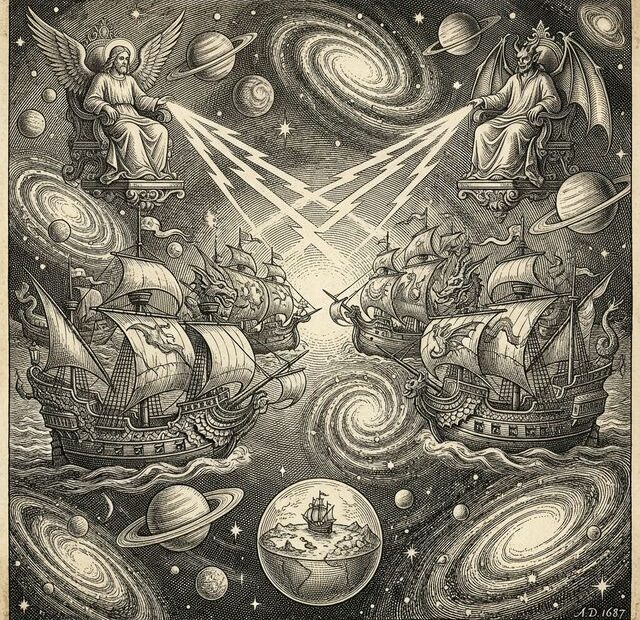
    Triplanetary opens not with a hero, but with two godlike alien civilizations,  the Arisians and the Eddorians, locked in a secret war for control of the galaxy across millions of years. Humanity’s entire history is revealed to be a side effect of this conflict. Smith was among the first to propose deep time as a narrative frame: our wars, our empires, our species are just a chapter in a story far larger than we can perceive. This “gods playing chess with civilizations” structure would later influence Asimov, Herbert, and countless others.

    2. The Inertialess Drive

    Smith introduced the concept of inertialess faster-than-light travel, a drive that eliminates a ship’s inertia, allowing it to reach any velocity instantly without the usual physical consequences. This was not just a handwave; Smith thought through the implications. A ship without inertia would need to carefully manage its transition back to normal space. The idea seeded decades of science fiction engineering, influencing concepts from hyperdrives to jump drives, and represents one of the earliest serious attempts to rationalize FTL travel in fiction.

    3. Space as a Three-Dimensional Battlefield

    Before Triplanetary, space combat in fiction was mostly naval warfare transplanted into the void. Smith made it genuinely three-dimensional and tactical. His battles involve flanking maneuvers in all directions, using planetary bodies for cover, and the terrifying challenge of tracking enemies across a volume, not just a surface. The genre has never fully returned to two-dimensional space combat since Smith made it feel absurd. His descriptions of massed fleet engagements remain kinetically vivid nearly a century later. Compare this with the grand fleet battles imagined in Ringworld‘s universe.

    4. The Inevitability of Empire — and Its Corruption

    The novel cycles through human history; Atlantis, Rome, World War I, showing that every empire follows the same arc: rise through ambition, expansion through strength, corruption through power, collapse through decadence. Smith is not nostalgic or moralistic about this; he presents it as almost mechanistic. The same human drives that build civilizations destroy them. This cyclical pessimism, embedded in what reads as a pulp adventure story, gives Triplanetary an unexpected philosophical weight, one that Cities in Flight later develops much further through Spenglerian theory.

    5. Women as Agents, Not Just Prizes

    For 1934, Triplanetary is surprisingly progressive in one specific area: Clio Marsden, the female lead, actively drives plot. She is not simply rescued; she makes decisions, shows courage under pressure, and is treated as a full participant in the adventure rather than a reward for the male hero. This was far from universal in pulp fiction of the era. Smith’s female characters are not complex by modern standards, but they act,  they are agents, not objects.

    6. The Arms Race as a Natural Law

    Perhaps the most chilling idea in Triplanetary is that technological escalation is inevitable. Every new weapon demands a new defense; every new defense demands a new weapon. Smith dramatizes this as an arms race between factions first on Earth (submarines vs. depth charges, gas vs. gas masks) and then in space (screens vs. beams). He seems to suggest that this escalation is not a political failure but a physical law,  the nature of any universe where power is possible. This proto-game-theory insight anticipates the Cold War’s mutual destruction logic by over a decade.

    Start Now

    Triplanetary is rough, pulpy, and unapologetically grand. But its ideas, cosmic time scales, inertialess drives, three-dimensional warfare, cyclical empire, provided the foundation on which modern space opera was built. Reading it today is like touring the archaeological site of your favorite genre. Everything starts somewhere, and much of science fiction starts here.


    Frequently Asked Questions (FAQ)

    1. Do I need to read Triplanetary before the Lensman series?
    It helps for context, but the core Lensman series (starting with Galactic Patrol) can be read independently. Triplanetary serves as an extended prologue.

    2. Is Doc Smith’s writing dated?
    Yes, in prose style and some social attitudes. But the ideas are remarkably durable, and the sense of scale and excitement is unmatched in pulp science fiction.

    3. What is the connection between Triplanetary and the Skylark series?
    They are separate series by the same author. The Skylark series was written first; the Lensman series (which includes Triplanetary) is generally considered Smith’s more ambitious and mature work.