Tag: “Francis Godwin”

  • 6 Ideas about The Man in the Moone by Francis Godwin (1638)

    6 Ideas about The Man in the Moone by Francis Godwin (1638)

    The year 1638 marked a pivotal moment in the history of Western literature with the posthumous publication of Francis Godwin’s masterpiece, The Man in the Moone. Often cited as one of the earliest examples of proto-science fiction, this work bridges the gap between medieval fantasy and the emerging scientific rigor of the Enlightenment. Through the journey of its protagonist, Domingo Gonsales, Godwin explored concepts of gravity, extraterrestrial life, and the mechanics of space travel long before they became staples of the genre.

    In this article, we delve into six profound ideas presented in this seminal work, examining how Godwin’s imagination anticipated future scientific discoveries and influenced the trajectory of speculative fiction.

    1. The Early Concept of Gravity and Magnetism

    One of the most striking aspects of The Man in the Moone is Godwin’s attempt to explain the physical forces governing the universe. Writing in an era where the Aristotelian view of the world was being challenged by Copernican heliocentrism, Godwin introduced a concept similar to gravity, though he referred to it as a form of magnetic attraction.

    Gonsales observes that as he ascends further from the Earth, the “weight” of objects seems to diminish. Godwin posits that the Earth exerts a “secret property” that pulls things toward its center, a force that weakens as one moves away. This intellectual leap anticipated Newton’s Law of Universal Gravitation by several decades, showcasing Godwin’s engagement with the vanguard of 17th-century physics.

    Why It Matters

    By framing space travel as a physical challenge involving forces and distances rather than mere magic, Godwin laid the groundwork for scientific realism in literature. He recognized that leaving the Earth required overcoming a tangible physical barrier, a notion that remains central to aerospace engineering today.

    2. Biological Propulsion: The Gansas

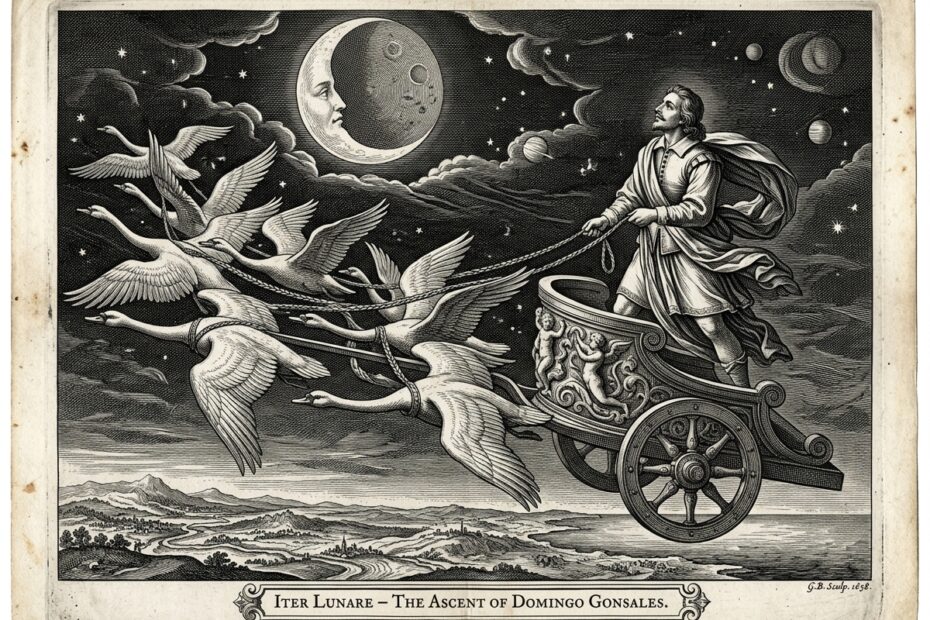
    Unlike later science fiction that relies on rockets or warp drives, Godwin’s protagonist reaches the moon using a chariot pulled by Gansas—a species of wild swans. While this may seem fantastical to modern readers, it represents a significant step in the evolution of speculative thought: biological propulsion.

    Godwin describes the Gansas with meticulous detail, noting their migration patterns and their innate ability to fly long distances. By choosing a biological rather than a supernatural means of transport, Godwin adhered to a logic internal to his world. This idea reflects a transition period where the boundaries between natural history and myth were still fluid.

    Practical Implications

    The use of Gansas highlights the 17th-century fascination with the natural world. It suggests that the keys to the heavens might be found in the observation of nature itself, echoing the themes found in Kepler’s Somnium, where the journey is also governed by a mix of natural and supernatural laws.

    3. Extraterrestrial Sociology and the Lunar Utopia

    Upon arriving on the Moon, Domingo Gonsales discovers a society of Lunar inhabitants (the Lunars) who are taller, more virtuous, and live in a state of near-perfection. Godwin uses this encounter to present a Lunar Utopia, contrasting the flaws of 17th-century European society with the idealized existence of the Moon-dwellers.

    The Lunars have no crime, no disease, and a language that is musical rather than spoken. This “Idea of a Utopia” allows Godwin to critique the political and social turmoils of his time. The Moon becomes a mirror through which humanity can observe its own shortcomings.

    4. The Musical Language of the Lunars

    One of the most innovative ideas in the book is the Musical Language of the Lunars. Godwin describes a communication system based on tones and musical intervals rather than phonetic sounds. This concept is remarkably sophisticated for its time, suggesting that advanced civilizations might communicate through abstract or non-verbal means.

    Godwin even provides a few examples of how this language works, showing his interest in linguistics and the potential for universal communication. This idea would later influence 20th-century science fiction, such as the musical communication in Close Encounters of the Third Kind.

    5. The Earth as a Celestial Body

    Before the advent of satellite photography, Godwin invited his readers to imagine the Earth from Space. As Gonsales travels toward the Moon, he looks back and sees the Earth as a rotating globe, displaying its continents and oceans.

    This perspective was revolutionary. It moved the Earth from being the fixed center of the universe to being just another celestial body among many. Godwin’s description of the Earth’s rotation helped popularize the Copernican theory among a general audience, using fiction as a vehicle for scientific education.

    6. The Synthesis of Faith and Science

    Despite its scientific leanings, The Man in the Moone is deeply rooted in theology. Francis Godwin was a Bishop, and his work reflects a worldview where the discovery of new worlds does not contradict the existence of God, but rather expands the majesty of His creation.

    Gonsales remains a devout Christian throughout his journey, seeing the wonders of the Moon as further evidence of divine craftsmanship. This synthesis of faith and science is a hallmark of the early modern period, where the pursuit of knowledge was often seen as a spiritual endeavor.

    Practical Examples: Applying Godwin’s Vision Today

    How can a 400-year-old book about swan-powered moon travel be relevant today? Here are a few ways Godwin’s ideas manifest in the modern world:

    • Iterative Thinking: Godwin didn’t have the math for gravity, but he had the intuition. In business and science, prototypical ideas often precede technical mastery.

    FAQ

    1. Is “The Man in the Moone” considered the first science fiction book?

    While many consider it one of the first, it shares this title with works like Lucian’s A True Story and Kepler’s Somnium. However, Godwin’s focus on physical mechanics makes it a primary candidate for proto-SF.

    2. How did Godwin explain the lack of air in space?

    Godwin did not yet understand the vacuum of space. He assumed the air simply became thinner and more “ethereal,” but still breathable for his protagonist and the Gansas.

    3. What was the impact of this book on later authors?

    It directly influenced Cyrano de Bergerac and Jonathan Swift (Gulliver’s Travels), cementing the “voyage to the moon” as a major literary trope.

    4. Why did Francis Godwin publish it anonymously?

    As a Bishop of the Church of England, publishing a work of “fantastical fiction” could have been seen as unbecoming or controversial, though it was published posthumously under a pseudonym.

    References

    • Godwin, Francis. The Man in the Moone: or A Discourse of a Voyage thither by Domingo Gonsales. 1638.
    • Poole, William. Introduction to The Man in the Moone. Broadview Editions.
    • Vertesi, Janet. Light and Color in Francis Godwin’s The Man in the Moone.

    Conclusion

    Francis Godwin’s The Man in the Moone remains a testament to the power of the human imagination. By daring to look beyond the horizon of his own era, Godwin created a work that continues to resonate with anyone who looks at the stars and wonders “what if?” Whether through the lens of gravity, utopian sociology, or interplanetary travel, his six ideas provide a fascinating window into the birth of the modern scientific mind.

    Exploring these early visions helps us appreciate how far we have come—and reminds us that the next great leap in human knowledge may already be hiding in the pages of a speculative story.