Tag: dark fantasy

  • Top 10 Isekai Anime That Break the Mold

    Top 10 Isekai Anime That Break the Mold

    Top 10 Isekai Anime That Break the Mold

    The Isekai genre (where a normal person is transported to a fantasy world) has a terrible reputation. Most of the time, it’s about a boring teenager getting hit by a truck, waking up with overpowered cheat skills, and gathering a harem. It is the ultimate predictable power fantasy.

    But sometimes, authors take this trope and completely invert it. They use the “transported to another world” framework to explore trauma, economics, military logistics, or sheer satirical comedy.

    Here is a quick breakdown of the shows that actually push the boundaries:

    Rank Anime The Twist
    #1 Konosuba The protagonist and his party are a bunch of terrible, selfish people. Pure comedy.
    #2 Mushoku Tensei Deep focus on genuine trauma recovery and lifelong character growth.
    #3 Log Horizon Focuses on political science, managing economies, and building a government.
    #4 Re:Zero The hero is incredibly weak and his only power makes him suffer immense psychological pain.
    #5 Youjo Senki An HR manager reincarnates as a ruthless child soldier fighting a WWI alternate reality.

    10. The Devil is a Part-Timer!

    Instead of a human going to a magic world, the Demon Lord Satan flees to modern-day Tokyo. Without magic, he has to work at a fast-food burger joint to pay rent. A brilliant reverse-isekai workplace comedy.

    9. Ascendance of a Bookworm

    A librarian dies and wakes up in a medieval world where books are rare. Instead of fighting demons, her entire mission is inventing the printing press from scratch just so she can read again. Immensely satisfying world-building.

    8. Drifters

    Historical warriors (like Samurai Shimazu and Joan of Arc) are pulled from the brink of death to fight in a fantasy war. It trades magic systems for brutal, historical military tactics.

    7. Grimgar of Fantasy and Ash

    A realistic, traumatic look at low-level adventuring. The party has no special powers, and killing a single goblin is a desperate, bloody struggle just to afford a loaf of bread. It drops the power fantasy for heavy emotional realism.

    6. Overlord

    The protagonist is the villain. A veteran gamer gets stuck in the body of his evil undead avatar and must maintain his terrifying reputation among his loyal NPC followers while internally panicking about how to rule the world.

    5. Youjo Senki (The Saga of Tanya the Evil)

    A cynical businessman argues with God and is reincarnated into an alternate WWI universe. It is a cynical, military-focused masterpiece where the anti-hero uses brutal logic instead of the power of friendship.

    4. Re:Zero – Starting Life in Another World

    Subaru’s only power is “Return by Death,” acting like a video game checkpoint. However, he physically remembers the agonizing pain of dying every time. The show violently deconstructs the self-inserted hero ego, forcing the protagonist through deep psychological hell to grow up.

    3. Log Horizon

    When gamers get trapped in an MMO, they realize dying just respawns them. The real threat is societal collapse. The show dives deep into establishing tax laws, diplomacy with NPC nations, and fighting inflation. Perfect for nerds who love logistics.

    2. Mushoku Tensei: Jobless Reincarnation

    This show takes the concept of reincarnation incredibly seriously. The protagonist starts as deeply flawed and broken, and his journey across decades to become a decent person actually feels earned. The animation and lore are S-tier. Be warned, it deals with heavy, often uncomfortable flaws early on.

    1. Konosuba

    How do you fix a stale genre? You mock it ruthlessly. Kazuma forms a party with a useless goddess, a wizard who casts one spell and faints, and a crusader who can’t hit a target. They are all awful people who constantly fail. It is “It’s Always Sunny in Philadelphia” purely tailored for anime fans.

    Conclusion

    If you’ve sworn off the genre because of generic storylines, give these a chance. The Isekai framework is just a vehicle, and these authors drove it off a cliff in the best way possible. If you need a palate cleanser after these big series, try checking out 

  • Beyond Good and Evil

    Beyond Good and Evil

    Beyond Good and Evil: A Deep Dive into Berserk’s Philosophy of Struggle

    Kentaro Miura’s Berserk is more than a dark fantasy manga, it’s a profound philosophical meditation on human existence, morality, and the nature of struggle itself. At its core, Berserk engages deeply with Nietzschean philosophy, particularly concepts from “Beyond Good and Evil,” transforming them into a visceral narrative about one man’s war against fate.

    The Struggler Against Causality

    In the world of Berserk, causality reigns supreme. This metaphysical force governs all events like an inexorable river, carrying most characters helplessly along its predetermined course. The God Hand, demonic beings who enforce this cosmic order, represent causality’s terrifying power, the universe itself conspiring to ensure certain outcomes.

    Yet Guts, the protagonist known as “The Struggler,” exists partially outside this flow. The Skull Knight observes that Guts is like a fish that can breach the surface of causality’s river, creating ripples that alter what should be inevitable. Even his birth from a corpse symbolizes a rejection of fate’s unalterable flow.

    This struggle against predetermined destiny is fundamentally existentialist. Guts refuses to accept that his life’s meaning is written by external forces, whether gods, demons, or cosmic law. Instead, he embodies the existentialist principle that existence precedes essence: we are not born with a set purpose but must create our own meaning through action.

    Beyond Good and Evil: The Morality of Guts and Griffith

    Nietzsche’s “Beyond Good and Evil” challenges conventional morality, arguing that traditional notions of “good” and “evil” are human constructs that often serve the powerful. Berserk dramatizes this philosophy through its two central characters: Guts and Griffith.

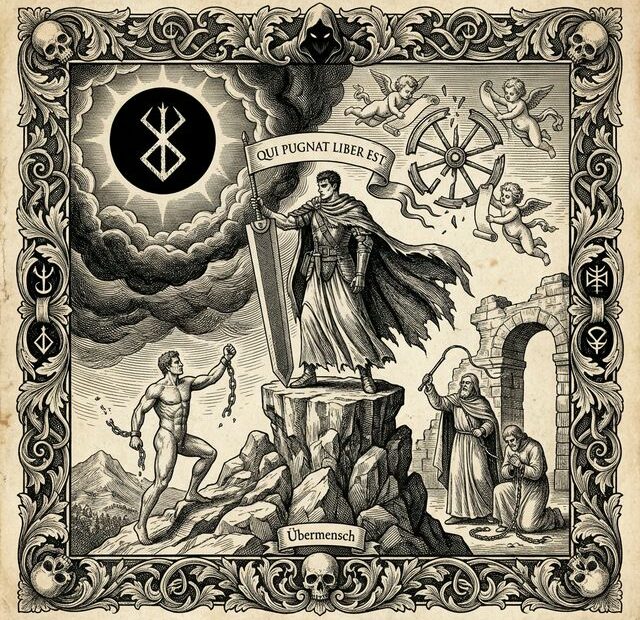
    Griffith: The False Übermensch

    Griffith initially appears to embody Nietzschean ideals. He creates his own values, pursues his dream with unwavering will, and refuses to be bound by conventional morality. His ambition and charisma seem to mark him as an Übermensch, Nietzsche’s ideal of the self-overcoming individual who transcends herd morality.

    But Griffith’s transformation into Femto reveals the hollowness of his philosophy. His “Will to Power” is parasitic, derived from the devotion of others rather than his own intrinsic strength, a manifestation of what Nietzsche called “slave morality” in disguise. By sacrificing his comrades to achieve godhood, Griffith doesn’t transcend humanity; he abandons it entirely, becoming something inhuman and ultimately empty.

    Guts: The True Master of Himself

    Guts, conversely, begins as a nihilistic antihero indifferent to conventional morality. His traumatic past has stripped away any naive belief in cosmic justice or inherent meaning. Yet through his journey, Guts evolves into something closer to Nietzsche’s true Übermensch.

    He creates his own values not through domination but through self-determination. His Dragonslayer sword represents his “Will to Power”, not power over others, but the power to protect his own existence and those he chooses to care for. Unlike Griffith, Guts’s strength is his own, forged through relentless struggle rather than borrowed from followers.

    Most crucially, Guts shifts from a path of pure revenge to one of protection. This evolution demonstrates the Nietzschean concept of self-overcoming: he doesn’t simply react to his trauma but actively chooses a new purpose. He becomes a master of himself, defining his own meaning in a meaningless universe.

    The Idea of Evil: Humanity’s Need for Meaning

    Perhaps Berserk‘s most profound philosophical concept is the “Idea of Evil”, a god-like entity born from humanity’s collective unconscious desire for meaning in suffering. This being manipulates causality to give humans what they desperately crave: a reason for their pain.

    This concept brilliantly inverts traditional theodicy. Rather than asking “why does a good God allow evil?”, Berserk suggests that humans created “evil” itself to explain their suffering. The Idea of Evil exists because humanity cannot bear a universe without purpose, even if that purpose is malevolent.

    This aligns with Nietzsche’s critique of religion and metaphysics. Humans invent cosmic narratives, gods, fate, karma, to avoid confronting the terrifying freedom of a meaningless existence. The Idea of Evil is humanity’s ultimate act of bad faith: creating a demon to avoid responsibility for creating their own meaning.

    Struggle as Life-Affirmation

    Nietzsche argued that life’s meaning comes not from avoiding suffering but from affirming it, saying “yes” to existence despite its pain. Guts embodies this philosophy completely.

    His life is an unending series of tragedies: childhood trauma, betrayal, the Eclipse, the Brand that marks him for eternal torment. By any rational measure, Guts should despair. Yet he continues to fight, not because he expects ultimate victory or reward, but because the struggle itself has become his meaning.

    This is Nietzschean life-affirmation in its purest form. Guts doesn’t struggle for something; he struggles because struggle is what makes him human, what gives his existence weight and significance. His famous declaration, “If there’s no place for me in this world, then I’ll make one with my own hands”, is a perfect expression of creating meaning through will alone.

    The Eternal Return and Perpetual Struggle

    Nietzsche’s concept of eternal return asks: if you had to live your life exactly as it is, over and over forever, would you affirm it? For most people, this is a horrifying thought. For the Übermensch, it’s liberating.

    Guts’s struggle has no clear endpoint. The causality he fights may be unbeatable. The God Hand may be immortal. His quest might be eternal. Yet he continues, suggesting that he would choose this struggle even knowing it might never end, the ultimate affirmation of his existence.

    Companions and Authentic Connection

    While Nietzsche emphasized individual will, Berserk adds a crucial dimension: authentic human connection. Guts’s evolution from solitary warrior to protector of his companions doesn’t weaken his philosophy, it enriches it.

    His relationships with Casca, Schierke, Farnese, and others aren’t dependencies but chosen bonds. They don’t diminish his self-determination; they’re expressions of it. Guts chooses to care, to protect, to connect, and these choices are as much acts of will as swinging his sword.

    This suggests that the Übermensch need not be isolated. Creating one’s own values can include valuing others, not from weakness or need, but from strength and choice.

    The Philosophical Legacy

    Berserk‘s philosophy of struggle resonates because it addresses fundamental human questions: How do we find meaning in suffering? Can we be free in a deterministic universe? What does it mean to be truly human?

    Through Guts, Miura suggests that meaning isn’t found, it’s forged. Freedom isn’t the absence of constraints but the will to struggle against them. And humanity isn’t defined by divine spark or rational soul, but by the choice to keep fighting when every reason says to surrender.

    In a world governed by causality, where gods are born from human weakness and fate seems inescapable, Guts’s struggle becomes a radical act of defiance. Not defiance against evil, but against meaninglessness itself. He fights not because he’s destined to win, but because the fight itself is his answer to existence.

    This is Berserk‘s ultimate philosophical statement: in a universe beyond good and evil, where traditional morality crumbles and cosmic justice is a lie, the struggle to create your own meaning, to become who you choose to be, is the only authentic human response.

    The Struggler struggles on. And in that struggle, he becomes free.

  • Harry Potter: The Magical Series That Enchanted Generations

    Harry Potter: The Magical Series That Enchanted Generations

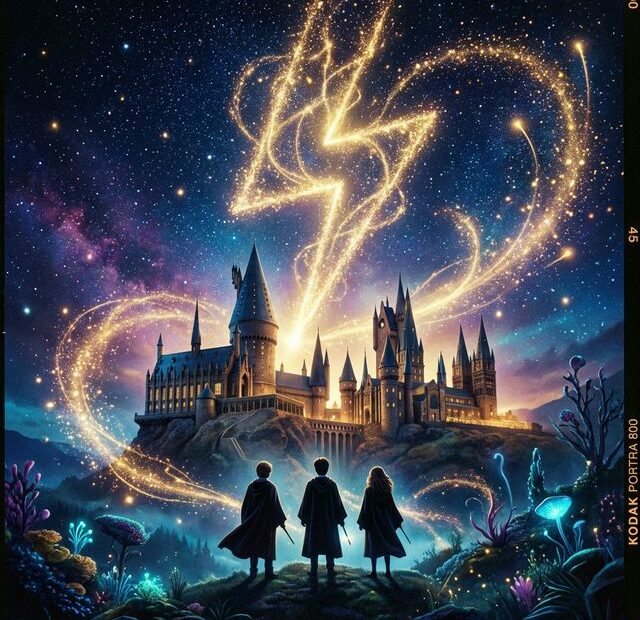
    The Harry Potter saga, created by British author J.K. Rowling, is one of the most impressive literary phenomena in modern history. Published between 1997 and 2007, the series conquered millions of readers worldwide, transcending cultural and age barriers. With seven main books narrating the journey of a young wizard against the forces of darkness, Harry Potter became a cultural landmark that influenced an entire generation.

    Preparing the Sorting Hat…

    The Complete Book Sequence

    The Harry Potter series consists of seven main books, each representing one school year of the protagonist at Hogwarts School of Witchcraft and Wizardry. The chronological order for publication and reading is:

    1. Harry Potter and the Philosopher’s Stone (1997)

    Published as Harry Potter and the Sorcerer’s Stone in the USA

    The first book introduces Harry Potter, an 11-year-old orphan boy who discovers he is a wizard. Living with his hostile relatives, the Dursleys, Harry receives a letter from Hogwarts that changes his life forever. At school, he makes loyal friends, discovers his magical talents, and faces his first confrontation with Lord Voldemort, the dark wizard responsible for his parents’ death.

    Main themes: Identity discovery, friendship, courage.

    2. Harry Potter and the Chamber of Secrets (1998)

    In his second year at Hogwarts, Harry faces mysterious messages written on the castle walls and attacks on Muggle-born students. The legend of the Chamber of Secrets resurfaces, and Harry must discover who is behind the attacks before more lives are lost.

    Main themes: Prejudice, heritage, personal choices.

    3. Harry Potter and the Prisoner of Azkaban (1999)

    Considered by many fans as the best book in the series, this volume introduces Sirius Black, an escaped prisoner from Azkaban who is supposedly after Harry. The book reveals secrets about Harry’s parents’ past and introduces more complex magical concepts, such as Patronuses.

    Main themes: Truth, forgiveness, moral complexity.

    4. Harry Potter and the Goblet of Fire (2000)

    The fourth book marks a darker turn in the series. Harry is mysteriously entered into the dangerous Triwizard Tournament, facing mortal challenges. The book culminates in Voldemort’s physical return and the series’ first significant death, marking the end of innocence.

    Main themes: Competition, betrayal, sacrifice.

    5. Harry Potter and the Order of the Phoenix (2003)

    The longest book in the series explores Harry’s turbulent adolescence as he deals with trauma, anger, and isolation. While the Ministry of Magic denies Voldemort’s return, Harry and his friends form Dumbledore’s Army to prepare for the imminent war.

    Main themes: Resistance, authoritarianism, loss.

    6. Harry Potter and the Half-Blood Prince (2005)

    Dumbledore prepares Harry for the final confrontation, revealing Voldemort’s history through memories. The book explores Horcruxes, objects containing fragments of Voldemort’s soul, and ends with one of the series’ most shocking deaths.

    Main themes: Preparation, knowledge, ultimate sacrifice.

    7. Harry Potter and the Deathly Hallows (2007)

    The epic finale sees Harry, Ron, and Hermione abandon Hogwarts to hunt down and destroy the remaining Horcruxes. The narrative culminates in the Battle of Hogwarts, where the fate of the wizarding world is decided in a final confrontation between Harry and Voldemort.

    Main themes: Death, love, choice between good and evil.

    Additional Work: Harry Potter and the Cursed Child (2016)

    Although not part of the original seven-book series, this stage play written by Jack Thorne, based on a story by J.K. Rowling, John Tiffany, and Jack Thorne, continues the narrative 19 years after the events of “The Deathly Hallows,” focusing on Albus Severus Potter, Harry’s son.

    The Main Characters

    The Golden Trio

    Harry Potter

    The series’ protagonist, Harry is an orphaned wizard destined to defeat Lord Voldemort. Marked by a lightning bolt-shaped scar on his forehead, Harry is known for his courage, loyalty, and willingness to sacrifice himself for others. Throughout the series, he evolves from an insecure boy into a brave leader.

    Characteristics: Brave, loyal, impulsive, compassionate.

    Hermione Granger

    Harry’s best friend, Hermione is a Muggle-born witch known for her exceptional intelligence and logical thinking. She frequently saves Harry and Ron with her vast magical knowledge and research skills. Hermione represents the importance of study, preparation, and social justice.

    Characteristics: Intelligent, determined, perfectionist, defender of the oppressed.

    Ron Weasley

    Harry’s other best friend, Ron comes from a large, loving but poor wizarding family. Although sometimes feeling overshadowed by Harry and Hermione, Ron repeatedly proves his courage and loyalty. He provides humor and emotional support to the trio.

    Characteristics: Loyal, brave, insecure, good-humored.

    Mentors and Allies

    Albus Dumbledore

    The enigmatic and powerful Headmaster of Hogwarts, Dumbledore is a crucial mentor to Harry. Considered the greatest wizard of his time, he guides Harry on his journey, though he doesn’t always reveal all information. Dumbledore represents wisdom but also human fallibility.

    Rubeus Hagrid

    The half-giant Keeper of Keys and Grounds at Hogwarts, Hagrid is one of Harry’s first friends in the wizarding world. His unwavering loyalty and love for magical creatures make him an important father figure for Harry.

    Severus Snape

    The Potions professor and later Headmaster of Hogwarts, Snape is one of the series’ most complex characters. His ambiguous loyalties and tragic past are revealed only at the end, showing that not everything is as it seems.

    Sirius Black

    Harry’s godfather and close friend of his parents, Sirius represents the family Harry always wanted. His death marks one of the series’ most emotional moments.

    Minerva McGonagall

    The Head of Gryffindor and Transfiguration professor, McGonagall is a fair and respected authority figure who demonstrates great courage in defending Hogwarts.

    Remus Lupin

    A former professor and friend of Harry’s parents, Lupin is a werewolf who fights against prejudice while teaching Harry valuable lessons about courage and acceptance.

    Ginny Weasley

    Ron’s younger sister, Ginny evolves from a shy fan into a talented and brave witch who eventually marries Harry.

    Neville Longbottom

    Initially shy and clumsy, Neville transforms into one of the series’ bravest heroes, proving that true courage comes from within.

    Luna Lovegood

    An eccentric Ravenclaw student, Luna is a loyal friend whose unique perspective often offers valuable insights.

    Antagonists

    Lord Voldemort (Tom Riddle)

    The most feared dark wizard of all time and Harry’s archenemy. Obsessed with immortality and power, Voldemort represents absolute evil and the consequences of unbridled ambition.

    Draco Malfoy

    Harry’s rival in Slytherin, Draco is a pure-blood supremacist. Throughout the series, he reveals moral complexity, showing that not all antagonists are completely evil.

    Bellatrix Lestrange

    A fanatically loyal and dangerous Death Eater, Bellatrix is responsible for some of the series’ cruelest acts.

    Dolores Umbridge

    A Ministry of Magic official who becomes a particularly despised figure at Hogwarts, representing bureaucratic authoritarianism and cruelty disguised as order.

    The Dursley Family

    Vernon, Petunia, and Dudley Dursley: Harry’s aunt, uncle, and cousin who mistreat him during his childhood. They represent intolerance and fear of the unknown.

    The Weasley Family

    Molly and Arthur Weasley: Ron’s parents, who treat Harry like a son. Molly is a fierce and protective maternal figure, while Arthur is fascinated by the Muggle world.

    The Series’ Cultural Impact

    The Harry Potter series transcended the status of simple children’s books to become a global cultural phenomenon. With over 500 million copies sold in more than 80 languages, the books inspired:

    • Eight blockbuster films that grossed billions of dollars worldwide
    • Theme parks dedicated to the wizarding world
    • Stage plays, including “Harry Potter and the Cursed Child”
    • Video games and interactive experiences
    • A global fan community that remains active decades after the first book’s publication

    Similar to how Western literature inspired anime, Harry Potter has influenced countless works of fantasy fiction and popular culture worldwide.

    Universal Themes

    The series explores profound themes that resonate with readers of all ages:

    • Love and sacrifice: Lily Potter’s love for Harry is the most powerful force in the series
    • Choices versus destiny: “It is our choices that show who we truly are, far more than our abilities”
    • Prejudice and tolerance: The fight against discrimination of Muggle-borns
    • Growth and maturation: Harry’s journey from childhood to adulthood
    • Death and loss: How to deal with grief and move forward
    • Friendship and loyalty: The power of true bonds

    These themes connect deeply with readers, much like the powerful ideas from Dune or the revolutionary concepts in The Diamond Age.

    Books to Movies: The Adaptation Journey

    The Harry Potter series became one of the most successful book-to-movie adaptations in cinema history. Each film brought the magical world to life, though as with many adaptations, readers often debate which medium tells the story better. For those interested in books to read before their movie adaptations, Harry Potter remains a prime example of why reading the source material first enriches the viewing experience.

    Conclusion

    Harry Potter is not just a series about magic and wizards; it’s a timeless narrative about growth, courage, and the triumph of love over hatred. J.K. Rowling created a rich and complex universe that continues to enchant new generations of readers. Whether you’re a long-time fan or a new reader discovering Hogwarts for the first time, Harry Potter’s journey offers valuable lessons about humanity, morality, and the power of hope.

    The series reminds us that even in the darkest moments, light can be found if we have the courage to look for it. As Dumbledore wisely said: “Happiness can be found even in the darkest of times, if one only remembers to turn on the light.”

    Just as experience is the best teacher but books are faster, the Harry Potter series teaches us profound life lessons through the magical adventures of its characters, making it one of the most influential literary series of our time.